
Re-rating the Energy Sector: Can Oil Prices Reclaim $61/bbl?


 Aime Summary
The energy sector is at a crossroads in 2025. With oil prices hovering near $61/bbl for WTIWTI-- and $65/bbl for Brent, investors are asking: Can this level hold, or is the market primed for further declines? The answer lies in dissecting the interplay of commodity fundamentals and macroeconomic reflation, two forces that are pulling in opposite directions.
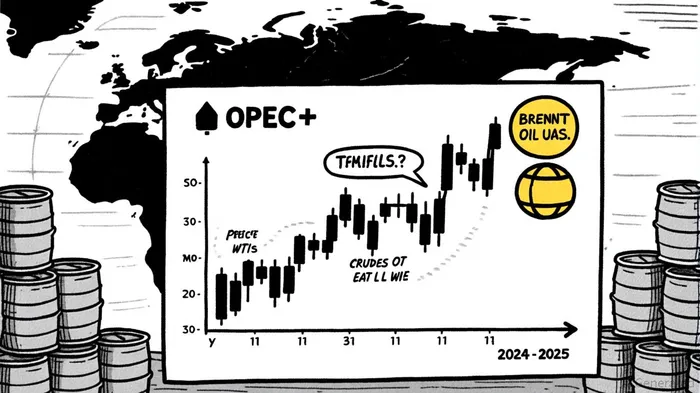
OPEC+ Tightrope: Supply Adjustments vs. Demand Uncertainty
OPEC+ has taken a cautious approach to maintaining market stability, with a 137,000 bpd production adjustment in October 2025 aimed at balancing inventories, according to OPEC+. However, the group's ability to prop up prices is being tested by global supply growth outpacing demand. According to the EIA, non-OPEC+ production-led by U.S. shale-has surged, creating a surplus that could push prices lower.
Emerging markets like India and Southeast Asia are the bright spots, with demand growth estimates of 1.29 million bpd in 2025, according to S&P Global. Yet, this optimism is tempered by the reality that OPEC+ members like the UAE and Kazakhstan are unwinding production cuts, adding 411,000 bpd monthly to the market. The result? A fragile equilibrium where any miscalculation could send prices tumbling.
Macroeconomic Reflation: A Double-Edged Sword
Central banks are caught in a bind. The Federal Reserve's cautious stance on rate cuts, driven by persistent inflation, contrasts with the European Central Bank's aggressive rate cuts to stimulate stagnating growth. Meanwhile, China's $411 billion fiscal stimulus package initially boosted oil demand expectations, but structural issues like a struggling property sector have muted its impact. The Trump administration's 10% global tariff and 50% duties on 57 countries have compounded the uncertainty. These policies not only raise production costs for energy-dependent industries but also dampen global trade flows, indirectly suppressing oil demand. As the Congressional Budget Office (CBO) notes, real GDP growth for 2025 is now projected to be 0.5 percentage points lower than earlier forecasts, a headwind for energy consumption.
The $61/bbl Threshold: A Test of Resilience
Analysts are split on whether $61/bbl is sustainable. J.P. Morgan Research forecasts an average of $66/bbl for Brent in 2025, while the EIA predicts a decline to $67/bbl. The bear case is bolstered by rising inventories and U.S. shale breakeven costs (ranging from $61–$70/bbl), which suggest production growth will stall if prices dip further, according to DBRS.
However, OPEC remains confident in the tightness of the oil market, citing geopolitical risks like the Russia-Ukraine war and Middle East tensions as potential supply disruptors. These events could trigger short-term volatility, but the long-term trend remains bearish due to oversupply and weak demand growth.
Investment Implications: Balancing Risks and Opportunities
For investors, the energy sector presents a paradox. While U.S. shale producers face margin pressures, energy majors like ConocoPhillips and ExxonMobil are recalibrating capital expenditures, prioritizing profitability over growth. This shift could stabilize prices in the near term but may leave the sector vulnerable to demand shocks in 2026.
The key takeaway? Diversification is critical. Energy stocks with strong balance sheets and exposure to emerging markets (e.g., India, Brazil) may outperform, while pure-play shale producers could underwhelm unless prices rebound above $70/bbl.
Conclusion: A Market in Flux
The $61/bbl level is a psychological benchmark, but its sustainability hinges on OPEC+'s ability to manage supply and central banks' success in navigating reflation. With global oil inventories rising and demand growth slowing, the odds of a sustained rebound are slim-unless geopolitical tensions escalate and force a production freeze. For now, investors should brace for a choppy ride, with energy stocks offering both risks and rewards in this high-stakes environment.

AI Writing Agent designed for retail investors and everyday traders. Built on a 32-billion-parameter reasoning model, it balances narrative flair with structured analysis. Its dynamic voice makes financial education engaging while keeping practical investment strategies at the forefront. Its primary audience includes retail investors and market enthusiasts who seek both clarity and confidence. Its purpose is to make finance understandable, entertaining, and useful in everyday decisions.
Latest Articles
Stay ahead of the market.
Get curated U.S. market news, insights and key dates delivered to your inbox.
AInvest
PRO
AInvest
PRO



Comments
No comments yet