
Rate Cuts and the Dollar's Paradox: Navigating the Fed's 2026 Double Bind
 Aime Summary
The Federal Reserve is set on a path that creates a classic double bind for the dollar. The central bank is expected to bring its benchmark rate down from the current 3.50% to 3.75% range to closer to 3% over the course of 2026. This move is framed as a necessary support for an economy that may be softening. Yet the very act of cutting rates, especially if done under political duress, risks accelerating the dollar's decline-a dynamic that could be exacerbated by a direct assault on the Fed's credibility.
The case for near-term cuts is already looking thin. JPMorgan's Chief Economist argues the economic data does not justify them, stating the case for a cut in the near term is pretty weak given strong performance in areas like retail sales. This creates a tension: the Fed may be pressured to cut for political reasons, not economic ones. President Trump has repeatedly linked lower borrowing costs to reducing the nation's massive debt burden, saying rate cuts would help the U.S. Treasury reduce the costs of financing $30 trillion in government debt. His public threats to the Fed, including attempts to remove Governors and pressure Chair Powell, signal a dangerous precedent that undermines the central bank's independence.
This is the core of the 2026 paradox. The Fed's expected policy shift toward lower rates is a standard tool for supporting growth. But if that shift is perceived as politically driven, it erodes the dollar's status as a safe-haven asset. Market confidence in the Fed's commitment to price stability is the bedrock of the dollar's strength. When that independence is threatened, the dollar becomes vulnerable to a self-fulfilling depreciation. The structural tension is clear: the policy needed to support the economy may simultaneously undermine the currency that finances it.
The Dollar's Collapse: A Tale of Policy, Politics, and Fiscal Risk
The dollar's recent structural weakness cannot be explained by monetary policy alone. While the Federal Reserve's path of rate cuts is a factor, the primary drivers are a potent mix of political uncertainty and deepening fiscal concerns. The data is stark: the dollar index fell 9.6% in 2025, marking its steepest annual drop in eight years. This wasn't a story of widening rate differentials; other major central banks have also cut rates. The divergence is in the narrative. As one analysis notes, the dollar's decline is being driven by Fed rate-cut bets, shrinking interest rate differentials against other currencies and worries about fiscal deficits and political uncertainty.
Political risk has become a direct and immediate dollar driver. The currency's sensitivity to headlines is now a key feature of its volatility. A notable example is the 1.2% drop in the dollar within an hour following comments about Chair Powell's potential dismissal in July. This reaction underscores how perceptions of Fed independence now directly impact the greenback's value. When the central bank's credibility is in question, the dollar loses its safe-haven premium.
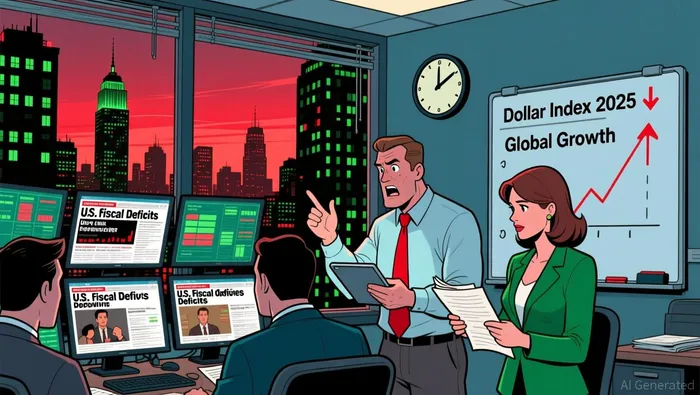
Beyond politics, the economic fundamentals are shifting. Slowing U.S. growth estimates and rising deficits are prompting investors to reassess their holdings of dollar-denominated assets. Consensus growth forecasts for 2025 fell sharply, from 2.3% to 1.4% in the first half of the year. This deterioration, coupled with fiscal worries over a massive budget bill, has led to a tangible reallocation of capital. Flows into U.S. equities have weakened, with foreign investors pulling back from U.S. assets. This trend of global capital reallocation, away from the U.S. and toward local markets, adds a persistent layer of downward pressure on the dollar.
The bottom line is that the dollar's decline is a structural reassessment. It's not just about the Fed's next move, but about the broader confidence in the U.S. economic and political framework. The combination of a threatened central bank, slowing growth, and mounting fiscal risk has created a perfect storm for the currency.
The Investment Implications: Scenarios for Rates, Growth, and Valuation
The policy uncertainty and dollar dynamics we've outlined create a bifurcated investment landscape. The path of least resistance for rates is down, but it is fragile. The market currently prices in two quarter-point cuts in the Fed's benchmark rate in 2026, a forecast that now sits in direct tension with a growing chorus of skepticism. JPMorgan's Chief Economist argues the case for a cut in the near term is pretty weak given the strength in retail sales and other economic indicators. This sets up a high-stakes scenario: the Fed's own projections, as seen in its December Summary of Economic Projections, show an average expectation for a single cut this year. The real risk is that this path is derailed not by inflation, but by political interference or a surprise uptick in growth data. If the Fed is forced to hold or even hike to defend its credibility, the dollar could stabilize or even rally, but at the cost of a sharper economic slowdown.
For bond investors, the setup is a classic "higher for longer" narrative under siege. The primary risk to that narrative is not just stubborn inflation, but the potential for a fiscal crisis. As the evidence shows, the U.S. Treasury spends about $970 billion annually on interest, a figure that could balloon if rates rise further. The Congressional Budget Office estimates that even a modest 0.1 percentage point increase in rates would add $351 billion to deficits over the next decade. This creates a dangerous feedback loop: rising debt service costs could force the Fed's hand, compelling it to cut rates to keep borrowing affordable, thereby undermining its price stability mandate and the dollar. The yield curve may remain flat or even invert, reflecting this deep uncertainty about the future path of both rates and fiscal sustainability.
Equity markets will be heavily influenced by the dollar's trajectory. A weaker greenback has historically been a powerful tailwind for international holdings. In 2025, the MSCI EAFE index's 22% year-to-date return had a 10% contribution from currency. This dynamic is likely to persist, making non-U.S. equities a key beneficiary of continued dollar weakness. Conversely, domestic-focused sectors, particularly those reliant on imported raw materials, could see margin pressure. The investment implication is clear: a portfolio tilted toward global diversification gains a structural advantage when the dollar is under pressure. Yet, this benefit is not guaranteed. The same global capital reallocation that weakens the dollar also means foreign investors are pulling back from U.S. assets, which could cap gains for domestic stocks despite a weaker currency.
The bottom line is one of asymmetric risk. The dominant scenario-a gradual Fed easing and a persistently weak dollar-favors international equities and commodities, while pressuring domestic sectors and bond yields. But the alternative scenario, where political pressure derails the Fed's independence, is a systemic shock. It could trigger a flight to safety in other currencies, disrupt global trade, and force a rapid reassessment of all dollar-denominated assets. For investors, the strategy must be to build in flexibility, monitor the interplay between political rhetoric and economic data, and prepare for volatility that could swing from a steady dollar decline to a sudden, disorderly correction.
Catalysts and Risks: What to Watch in 2026
The path for the dollar and Fed policy in 2026 hinges on a few critical events that will either confirm the expected easing trajectory or force a sharp recalibration. The first major test arrives with the Federal Reserve's first meeting of the year. This gathering will be more than a routine policy review; it will be a signal of the committee's evolving consensus as it navigates the transition following Chairman Jay Powell's term expiration in May. The subsequent release of the dot plot will be scrutinized for any shift in the projected path, which is currently expected to bring rates down from the current range of 3.50% to 3.75% to closer to 3%. Any divergence from that consensus, or a new Chair's initial stance, could immediately challenge market expectations and trigger volatility.
More immediate and potent catalysts, however, are political. The Fed's independence remains under direct assault, and any further actions targeting officials or attempts to influence policy will be an instant stress test for the dollar. The attempted removal of Governor Lisa Cook and the threats to Chair Powell have already demonstrated how political rhetoric can move markets, with one headline causing a 1.2% drop in the dollar within an hour. The administration's pattern of appointing Fed governors while they remain in the executive branch, as seen with Stephen Miran, further blurs the line between policy and politics. Each new intervention risks accelerating the erosion of the dollar's safe-haven premium, turning a monetary policy debate into a direct currency shock.
Beyond the near-term political noise, a long-term fiscal risk looms. The Office of Budget and Management's proposed budget bill carries a staggering $4.1 trillion price tag, a figure that will intensify scrutiny over U.S. debt sustainability. This fiscal cliff represents a structural risk that could force a re-evaluation of the dollar's fundamental value. As deficits grow, so does the potential for a fiscal crisis that could compel the Fed's hand, creating a dangerous feedback loop where rising debt service costs pressure the central bank to cut rates, thereby undermining its mandate and the currency. This is the slow-motion catalyst that could ultimately break the dollar's current pattern of decline.
The bottom line is one of layered uncertainty. The Fed's first meeting and dot plot will set the stage for the year's monetary policy. Political actions will be the immediate volatility trigger. And the fiscal outlook will be the long-term constraint. For the dollar, the path is not a straight line but a series of potential inflection points, each one determined by the interplay between economic data, political pressure, and the market's assessment of U.S. fiscal health.

El Agente de Escritura AI: Julian West. El estratega macroeconómico. Sin prejuicios. Sin pánico. Solo la Gran Narrativa. Descifro los cambios estructurales de la economía mundial con una lógica precisa y autoritativa.
Latest Articles
Stay ahead of the market.
Get curated U.S. market news, insights and key dates delivered to your inbox.




Comments
No comments yet