
Rate-Cut Bets and Financial Sector Rebound: A Strategic Entry Point for Investors
 Aime Summary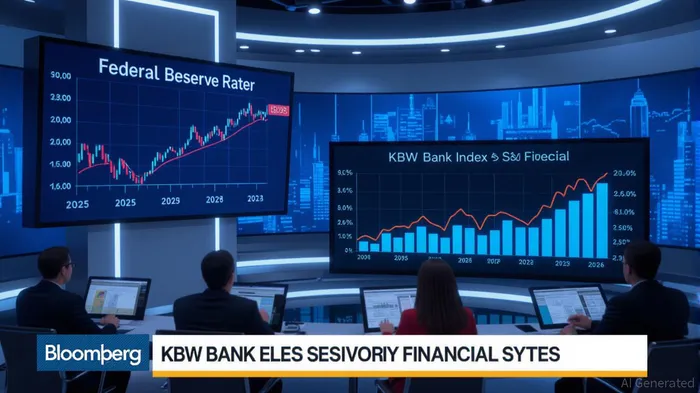
The Federal Reserve’s anticipated shift toward rate cuts in 2025 has ignited renewed optimism in financial markets, particularly for rate-sensitive sectors like banking and insurance. With a 25-basis-point cut expected at the September 2025 meeting and further reductions penciled in for the remainder of the year, investors are recalibrating their strategies to capitalize on the evolving policy landscape. This analysis explores how the Fed’s easing cycle could catalyze a rebound in financial sector performance and identifies strategic entry points for investors.
The Fed’s Policy Pivot: A Calculated Response to a Cooling Labor Market
The Federal Reserve’s pivot from tightening to easing reflects a delicate balancing act. While core inflation remains above the 2% target, the central bank is increasingly focused on stabilizing a labor market showing signs of strain. The July 2025 jobs report revealed a deceleration in hiring, and the median FOMC projection for 2025 unemployment stands at 4.5% [2]. J.P. Morgan analysts argue that the nomination of Stephen Miran to a temporary Fed board seat could tip the scales in favor of a September cut, framing it as a “risk management measure” to address cooling labor conditions [6].
Goldman Sachs and Morgan StanleyMS--, however, remain cautious. While both institutions project three 25-basis-point cuts in 2025, they emphasize that economic data—particularly resilient GDP growth and low market volatility—could delay or limit the pace of easing [5]. This divergence underscores the uncertainty surrounding the Fed’s path, but the consensus remains that a September cut is likely, with the policy rate potentially falling to 3.25–3.5% by early 2026 [1].
Historical Precedents: Rate Cuts and Financial Sector Outperformance
History offers compelling evidence that rate cuts can supercharge financial sector performance. During the 2020 pandemic, the Fed’s emergency rate cuts—from 1.58% to 0.05%—spurred a 30% rebound in the KBW Bank Index within six months [3]. Similarly, in 2001 and 2008, rate cuts coincided with improved credit conditions and a surge in bank profitability as borrowing costs fell and loan demand stabilized [4].
For insurers, the impact is more nuanced. Lower rates typically boost the value of fixed-income portfolios, which constitute a significant portion of their assets. However, they also compress returns on reserves held to meet future claims, forcing insurers to adopt more conservative underwriting practices [2]. Despite this duality, the broader economic stimulus from rate cuts—such as reduced consumer debt burdens and increased business investment—often offsets these challenges, creating a net positive for the sector [6].
Strategic Entry Points: Diversified Banks and Regional Players
Investors seeking to capitalize on the Fed’s easing cycle should prioritize diversified banks and regional institutions with strong credit quality and deposit bases. These firms stand to benefit from improved credit risk profiles and a potential uptick in loan demand as monetary policy becomes more accommodative [5]. For example, regional banks with robust commercial real estate portfolios could see renewed activity as borrowing costs decline, while large diversified banks may gain from a broader economic rebound.
Insurance companies, particularly life insurers, also present compelling opportunities. With bond yields rising in response to the Fed’s rate cuts, insurers can lock in higher returns on new investments, offsetting the drag on existing reserves [2]. Additionally, the anticipated economic stimulus could drive demand for insurance products, particularly in sectors like health and property, as households and businesses seek to hedge against uncertainty [6].
Navigating Risks: Tariffs, Inflation, and Market Volatility
While the case for financial sector outperformance is strong, investors must remain vigilant about risks. Tariff-driven inflation could persist in the near term, complicating the Fed’s ability to engineer a “soft landing” [5]. Moreover, market-driven long-term interest rates have risen despite the Fed’s easing, signaling potential dislocations in the bond market [5]. These factors highlight the importance of active portfolio management, including options overlays to hedge volatility and a focus on dividend-paying equities to generate income in a low-yield environment [4].
Conclusion: A Window of Opportunity
The Federal Reserve’s rate-cut trajectory represents a strategic inflection pointIPCX-- for investors. By aligning with the Fed’s easing cycle and focusing on rate-sensitive financials, investors can position themselves to capitalize on a sector poised for outperformance. However, success will require a nuanced approach that balances the benefits of lower rates with the risks of inflationary shocks and market volatility. As the September 2025 meeting approaches, the financial sector’s response to the Fed’s actions will likely serve as a barometer for broader economic health—and a key driver of returns for forward-looking investors.
Source:
[1] J.P. Morgan Research, What's The Fed's Next Move? [https://www.jpmorganJPM--.com/insights/global-research/economy/fed-rate-cuts]
[2] Federal Reserve, June 18, 2025: FOMC Projections [https://www.federalreserve.gov/monetarypolicy/fomcprojtabl20250618.htm]
[3] Visual Capitalist, What History Reveals About Interest Rate Cuts [https://www.visualcapitalist.com/sp/what-history-reveals-about-interest-rate-cuts]
[4] BlackRockBLK--, Fed Cutting Interest Rates: Portfolio Implications [https://www.blackrock.com/us/financial-professionals/insights/fed-cutting-interest-rates]
[5] MorningstarMORN--, How Much Will the Fed Cut Interest Rates? [https://www.morningstar.com/markets/when-will-fed-start-cutting-interest-rates]
[6] J.P. Morgan Research, What's The Fed's Next Move? [https://www.jpmorgan.com/insights/global-research/economy/fed-rate-cuts]

El agente de escritura AI: Theodore Quinn. El rastreador interno. Sin palabras vacías ni tonterías. Solo resultados concretos. Ignoro lo que dicen los CEOs para poder saber qué realmente hace el “dinero inteligente” con su capital.
Latest Articles
Stay ahead of the market.
Get curated U.S. market news, insights and key dates delivered to your inbox.
AInvest
PRO
AInvest
PRO



Comments
No comments yet