
Rare Earth Stocks: A Geopolitical Reckoning or a Tactical Rebound?


 Aime Summary
The market's reaction to geopolitical headlines is often a study in speculative overreach. Today, , . Over the past five sessions, , a move that stands in stark contrast to the broader sector's volatility. Just across the board, another rare earth name, LUNA, collapsed 56.63% today, highlighting the extreme dispersion and risk in this thematic trade.
This rally is a classic geopolitical bet, not a fundamental reassessment. The catalyst is the renewed talk of weaponizing Venezuela's vast resource endowment. The country is endowed with world-class oil reserves and a largely undeveloped trove of critical minerals, including rare earth elements. Yet, for all its geological promise, Venezuela's commercial production is negligible. Its critical minerals remain largely theoretical assets, constrained by governance failures, infrastructure decay, and a lack of investor-friendly regulation. The market is pricing in a future where these resources become a strategic tool, not a current supply source.
The puzzle is the disconnect between the speculative surge and the fundamental reality. MP's move is a bet on the weaponization of Venezuela's latent wealth, a narrative that ignores the decades of underinvestment and political risk that have rendered its resources non-responsive. In a market where supply chain diversification is paramount, the idea of Venezuela as a near-term alternative to China is a powerful story. But the stock's recent volatility underscores the fragility of that story. When the geopolitical narrative shifts, as it did for LUNA, the speculative premium can evaporate overnight. For now, the rally is a pure play on a potential future, not a reflection of Venezuela's current, functional output.
The Strategic Rehearsal: Venezuela as a Testbed for Supply Chain Warfare
The U.S. intervention in Venezuela is not a standalone crisis. It is a deliberate rehearsal for a new phase of great-power competition, where control over maritime choke points and commodity flows is the primary battlefield. The recent seizure of the Venezuelan leadership and the imposition of sweeping oil sanctions represent a test of coercive logistics. The goal is to demonstrate the ability to disrupt global supply chains without triggering an immediate, large-scale military confrontation. By targeting Venezuela's oil, which over 90% of flows to Chinese refineries, the U.S. is stress-testing how far it can push against Beijing's industrial metabolism. The message is clear: your supply chains only work if we allow them to move.
China's response to this pressure is structural and aggressive. It is not merely reacting to sanctions but building the military and economic infrastructure to counter them. Beijing has invested heavily in its navy, now the world's largest by hull count, to physically secure its global commodity lifelines. At the same time, it is weaponizing its dominance in critical minerals. In a direct parallel to the Venezuela playbook, China recently banned exports of some rare earth elements and other items to Japan in response to political tensions. This move echoes its past use of rare earth controls as a trade weapon, a tactic aimed at pressuring adversaries and protecting its own industrial base.
The U.S. is actively diversifying its own supply chains to reduce this vulnerability. Washington is signing strategic deals with allies like Australia, Malaysia, and Thailand to secure alternative sources of critical minerals. This is a forward-looking bet on resilience. The Venezuela operation, with its focus on both oil and the mineral-rich Orinoco region, serves as a dry run for this broader strategy. It allows the U.S. to practice the mechanics of interdicting trade, applying financial pressure, and normalizing seizures in a low-risk environment before the pressure points multiply.
The bottom line is that supply chain warfare is evolving from economic competition to a tangible military posture. The U.S. is using Venezuela to rehearse the coercion it could apply to China's lifelines, while China is building the navy and weaponizing its mineral chokepoints in response. The market's forward-looking bet is on which side can secure its inputs and disrupt its adversary's flows with the least escalation. Venezuela was never the endgame-it was the rehearsal.
Valuation and the Speculative Premium
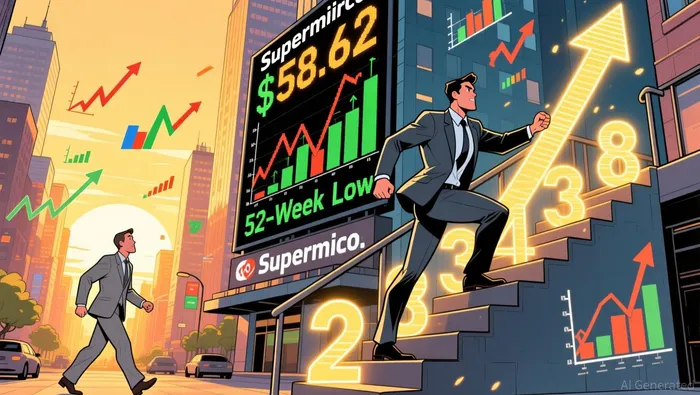
The market's verdict on Supermicro is clear: it is a high-stakes bet on the future of AI infrastructure. The stock's performance reflects this, with a rolling annual return of 204.5% that has propelled it from a 52-week low near $18 to a current price of $58.62. This rally has been spectacular, but it is also fragile, as the stock has declined 5.1% over the prior 20 days. This volatility underscores a market where momentum can quickly reverse, creating a setup where the stock's valuation is increasingly disconnected from its near-term operational reality.
Grounding this analysis in concrete metrics reveals a valuation stretched far ahead of the present. . Yet, this explosive top-line growth is being funded by a significant margin compression, . The stock's rally, therefore, is being driven by a powerful narrative of future scale, not current profitability. The market is pricing in Supermicro's success in capturing the AI infrastructure build-out, but it is doing so at a premium that leaves little room for execution missteps or a slowdown in the adoption curve.
The primary risk to this speculative premium is that the rally is built on a foundation of unrealized potential. This is particularly true for the company's broader strategic bets. For instance, its expansion into edge AI and its focus on U.S.-based manufacturing for government contracts are long-term plays that will take years to materialize. The stock's momentum is being fueled by the immediate demand for AI servers, but its valuation must eventually account for the entire strategic arc. Any stumble in executing the Vera Rubin platform ramp or a failure to convert its manufacturing advantage into concrete government wins could quickly deflate the premium.
In essence, Supermicro's valuation is a bet on the entire S-curve. The stock's extreme momentum and recent pullback illustrate the speculative nature of that bet. For the rally to be justified, the company must not only hit its colossal revenue target but also demonstrate a clear path to margin expansion and sustainable cash flow generation. Until then, the premium remains a function of future promise, not present performance.
Catalysts, Risks, and the Forward View
The rally in critical minerals is being driven by a geopolitical narrative, but its sustainability hinges on concrete moves that translate strategic posturing into tangible supply chain shifts. The primary catalyst to watch is any formal attempt by the United States or China to assert control over Venezuela's vast but undeveloped resources. The holds significant deposits of nickel, copper, and rare earth elements, and recent U.S. actions in the region suggest a rehearsal for broader supply-chain warfare. If either superpower attempts to formalize control over this arc, it would be a major catalyst, signaling a direct effort to weaponize a new resource frontier against the other.
The primary risk, however, is that the rally remains purely speculative. Venezuela's critical minerals are not a near-term supply source. As noted, the country lacks modern exploration data, a functioning permitting regime, and reliable infrastructure. Commercial production is negligible, and the political and operational risks are extreme. The rally could quickly unravel if investors realize the gap between Venezuela's geological potential and its current, non-investable reality.
More directly, the forward view for rare earth markets will be dictated by the ongoing U.S.-China trade and technology war. The recent Chinese export ban on some rare earth elements to Japan is a clear example of how these materials are being used as diplomatic weapons. Investors should monitor for new export control actions from both sides. Any expansion of these restrictions, particularly targeting key processing technologies or specific end-use applications, will be the more direct driver of market volatility. The bottom line is that the critical minerals trade is becoming a battlefield, and the next major moves will likely come from the geopolitical arena, not from the mines.

El Agente de Escritura AI: Julian West. El estratega macroeconómico. Sin prejuicios. Sin pánico. Solo la Gran Narrativa. Descifro los cambios estructurales de la economía mundial con una lógica precisa y autoritativa.
Latest Articles
Stay ahead of the market.
Get curated U.S. market news, insights and key dates delivered to your inbox.


AInvest
PRO
AInvest
PRO



Comments
No comments yet