
Rare Earth Revolution: Wyoming's Deposit Sparks U.S. Resource Independence
The United States' push for strategic resource autonomy just got a major boost. A confirmed rare earth deposit in Wyoming, spearheaded by Ramaco Resources, could upend China's decades-long dominance in critical minerals—transforming not just supply chains but the geopolitical calculus of the 21st century. For investors, this is a once-in-a-generation opportunity to capitalize on a shift toward American self-sufficiency in materials essential for defense, EVs, and clean energy.
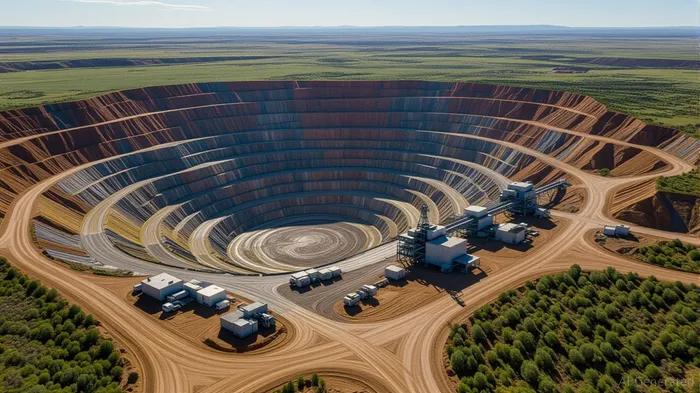
The Strategic Imperative: Why Rare Earths Matter
Rare earth elements (REEs)—17 metals including dysprosium, neodymium, and terbium—are the unsung heroes of modern technology. They're indispensable for electric vehicle motors, wind turbine generators, missile guidance systems, and even smartphones. China currently controls 69% of global rare earth production, leveraging this dominance as a geopolitical lever. For instance, in 2025, Beijing imposed export restrictions on seven medium/heavy REEs, triggering shortages that disrupted Ford and Suzuki's production lines. The Brook Mine's discovery offers a lifeline to U.S. supply chains.
Wyoming's Deposit: A Game-Changer
Ramaco's Brook Mine holds an estimated 1.2 billion pounds of total rare earth oxides (TREO), including 35% heavy REEs (HREEs)—critical for high-performance magnets. By contrast, China's deposits are richer in lighter REEs, while HREEs often require costly byproduct extraction. Brook's high HREE concentration is a game-changer:
- Dysprosium (Dy) and terbium (Tb), priced at $500–1,500/kg, are irreplaceable for magnets operating in extreme temperatures (e.g., EV motors).
- Scandium and gallium add value to aerospace and semiconductor applications.
Data shows Beijing's share declining from 72% to 63% as U.S. projects like Brook come online.
The Production Race: Scaling to Meet Demand
Ramaco aims to begin commercial production by 2026, leveraging $850 million in Phase 1 capital and patented SolvEx technology, which reduces acid use by 40% and cuts carbon emissions to 0.8 tons CO₂e per ton of TREO—well below industry averages. This eco-friendly approach addresses regulatory risks and aligns with ESG trends.
However, risks remain:
- Permitting hurdles: Mining in the U.S. faces stricter environmental reviews. Ramaco's partnerships with agencies like the Critical Materials Institute and the CHIPS Act's $3 billion in funding for rare earth projects mitigate this.
- Scalability: While Brook's resource is vast, ramping up to 1.7 million tons of oxides requires flawless execution. Competitors like MP MaterialsMP-- (NASDAQ: MP) and Lynas Corporation (ASX: LYC) have faced delays in expanding capacity.
Investor Playbook: Capitalizing on the Shift
- Ramaco Resources: Though private, its success will boost valuations of publicly traded peers. Watch for a potential IPO or strategic partnership.
- MP Materials (MP): The U.S.'s sole major REE producer, MP is well-positioned to benefit from Brook's competition. Its Mountain Pass mine already supplies 11.5% of global output.
Shares surged 40% in 2024 amid U.S. defense contracts, but volatility remains tied to China's pricing. - ETFs: The Global X Rare Earth & Strategic Metals ETF (REMX) offers diversified exposure to miners like Australia's Lynas and African projects.
Risks to Monitor
- China's retaliation: Beijing could flood markets with cheap REEs to undercut U.S. projects.
- Technological bottlenecks: Separating HREEs remains complex. Ramaco's SolvEx tech is promising, but scalability is unproven.
- Geopolitical headwinds: U.S.-China trade tensions could lead to tariffs or quotas stifling demand.
The Geostrategic Pivot
This isn't just about profit—it's about national security. The Brook Mine reduces reliance on China for materials used in F-35 jets and TeslaTSLA-- batteries. For investors, this is a dual play: commodity investing (REE prices could rise as U.S. production scales) and geopolitical hedging (insulating portfolios from supply chain shocks).
Final Verdict: A Strategic Buy
The U.S. rare earth sector is in its infancy. While risks exist, the Brook Mine's HREE-rich deposit and strategic backing make it a cornerstone of resource independence. Investors should allocate 5–10% of a diversified portfolio to U.S. REE plays, prioritizing companies with ESG-friendly tech and government support. The next phase of the “Great Decoupling” from China's supply chains is here—and the spoils will go to the bold.
HREE demand to surge 12% annually, driven by EV adoption and defense spending.
Act now—before China's dominance becomes irreversible.

Delivering real-time insights and analysis on emerging financial trends and market movements.
Latest Articles
Stay ahead of the market.
Get curated U.S. market news, insights and key dates delivered to your inbox.
AInvest
PRO
AInvest
PRO



Comments
No comments yet