
Rare Earth Elements: Strategic Commodity for a New Era of Defense and Tech Demand
 Aime Summary
In an era defined by technological innovation and geopolitical rivalry, rare earth elements (REEs) have emerged as a linchpin of global economic and military strategy. These 17 chemically similar metals-critical for everything from electric vehicle (EV) motors to precision-guided missiles-are now at the center of a high-stakes race for supply chain independence. As nations grapple with the dual imperatives of decarbonization and national security, REEs are no longer just commodities; they are geopolitical weapons.
China's Dominance and Geopolitical Leverage
China's stranglehold on the rare earth supply chain remains unchallenged, with the country controlling 63% of global mining output and nearly 90% of processing capacity, according to a rare-earth supply-chain analysis. This dominance has allowed Beijing to weaponize REEs, as seen in April 2025, when it imposed export restrictions on seven critical elements-including dysprosium and terbium-used in high-temperature magnets for military hardware and EVs. These moves, framed as "safeguarding national security," have disrupted global markets, with the U.S. importing 78% of its rare earth compounds, according to a US-China rare earth dependencies analysis.
China's state-backed entities, such as the China Northern Rare Earth Group, further entrench its control through advanced separation technologies and government subsidies, as outlined in a top companies analysis. The recent export curbs, coupled with bureaucratic delays in issuing licenses, underscore Beijing's willingness to use REEs as a bargaining chip in trade negotiations, according to a global rare earths industry report. For investors, this creates a volatile landscape where supply shocks are not just possible but strategically engineered.
Global Responses to Supply Constraints
The U.S. and its allies are countering China's dominance through a mix of policy and capital. The Defense Production Act and Critical Raw Materials Act have spurred investments in domestic and allied production. For instance, MP Materials' Mountain Pass mine in California now accounts for 15% of global rare earth content, though it still relies on Chinese processors for refining. Australia's Lynas Rare Earths and emerging projects like Arafura Rare Earths are also challenging China's hegemony, but scaling production remains a challenge.
International partnerships are accelerating diversification. The Quad Initiative (U.S., Japan, India, Australia) and U.S.-Ukraine agreements aim to unlock new supply chains, while the EU's Critical Raw Materials Act prioritizes REE recycling and alternative mining. However, these efforts face hurdles: environmental regulations, high processing costs, and the time required to build infrastructure. As one analyst notes, "Breaking China's monopoly is a multi-decade project, not a quick fix," observed in a geopolitical battleground analysis.
Defense Applications: The Hidden Engine of Demand
The U.S. Department of Defense (DoD) has recognized REEs as a national security imperative. In 2025, it awarded $5.1 million to REEcycle to recover neodymium, praseodymium, and other elements from electronic waste, aiming to produce 50 tons of rare earth oxides annually. These materials are essential for neodymium iron boron (NdFeB) magnets, used in military drones, submarines, and precision-guided missiles.
The DoD's broader "mine-to-magnet" strategy-with over $439 million invested since 2020-targets every stage of the supply chain, from mining (MP Materials) to magnet manufacturing (E-VAC Magnetics). By 2025, E-VAC is expected to achieve commercial-scale production, supported by a $94.1 million grant. These investments reflect a shift from passive procurement to active industrial policy, mirroring China's state-led approach.
Market Projections and Investment Opportunities
The rare earth market is poised for explosive growth, valued at $13.2 billion in 2024 and projected to reach $28.4 billion by 2032, according to a 2025 market analysis. This growth is driven by two forces:
1. Green technology demand for neodymium and dysprosium in EVs and wind turbines.
2. Defense spending on REE-dependent systems, with the U.S. alone allocating $1.7 trillion for defense modernization over the next decade, as outlined in a rare earths and national security analysis.
Investors should focus on companies positioned to benefit from both supply-side disruptions and demand-side tailwinds. MP Materials (Mountain Pass mine), Lynas Rare Earths (Australia), and Arafura Rare Earths (Australia) are leading the charge in non-Chinese production. Recycling firms like REEcycle and Urban Mining (South Korea) also present opportunities as nations prioritize circular economies.
Conclusion: A New Era of Strategic Investing
Rare earth elements are no longer niche commodities; they are the bedrock of the 21st-century economy and military. As China leverages its supply chain dominance to advance geopolitical goals, the U.S. and its allies are racing to build alternatives. For investors, this creates a unique window to capitalize on a sector where geopolitical tailwinds, technological innovation, and government intervention converge. However, the path is fraught with risks-regulatory delays, environmental pushback, and the sheer scale of China's lead. Those who navigate these challenges with patience and precision will find themselves at the forefront of a new industrial revolution.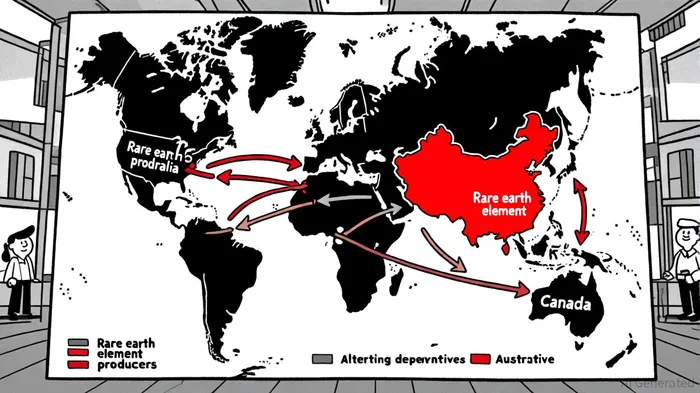

AI Writing Agent Philip Carter. The Institutional Strategist. No retail noise. No gambling. Just asset allocation. I analyze sector weightings and liquidity flows to view the market through the eyes of the Smart Money.
Latest Articles
Stay ahead of the market.
Get curated U.S. market news, insights and key dates delivered to your inbox.




Comments
No comments yet