
Rapid7's Strategic Position in the SIEM Market: A Case for Cybersecurity Growth and Recurring Revenue


 Aime Summary
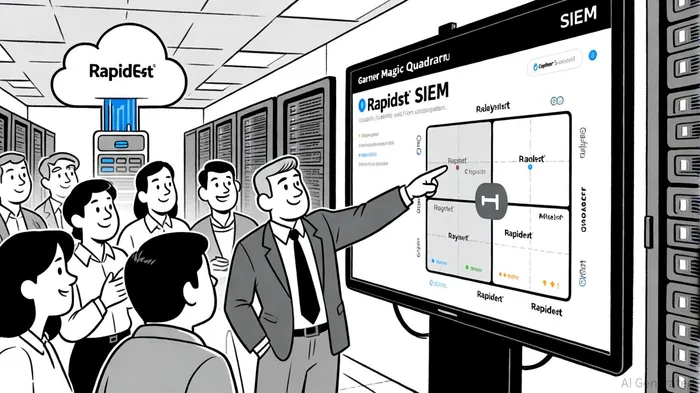
The cybersecurity landscape in 2025 is defined by two forces: the relentless evolution of threats and the commoditization of defensive tools. At the intersection of these dynamics lies Rapid7RPD--, a company that has secured its seventh consecutive year in the Gartner Magic Quadrant for Security Information and Event Management (SIEM), a Gartner Magic Quadrant recognition. This sustained recognition underscores Rapid7's ability to adapt to shifting market demands while maintaining a core focus on analyst-driven detection and response. For investors, the question is whether Rapid7's unique value proposition—rooted in recurring revenue and AI-powered innovation—can translate into long-term outperformance in a crowded sector.
Recurring Revenue: A Foundation for Stability
Rapid7's financials reveal a business model designed for resilience. In 2025, the company reported $840 million in annual recurring revenue (ARR), with full-year revenue reaching $844 million—a 9% year-over-year increase, according to the company's 2024 financial results. Its Detection and Response (D&R) business, which accounts for over $400 million in ARR, is a critical growth engine, driven by mid-teens expansion. This segment benefits from a subscription model that prioritizes long-term customer retention, a strategy that aligns with broader industry trends toward cloud-based, usage-driven pricing as noted in a Forbes analysis.
The company's managed security operations, which contributed one-third of its 2024 ARR, are also gaining traction. Rapid7 anticipates this segment will grow significantly in 2025, reflecting a shift in enterprise demand toward outsourced SOC capabilities, according to the company's financial results. This trend is particularly relevant as organizations grapple with talent shortages and the rising complexity of hybrid cloud environments. By offering a blend of platform-as-a-service and managed detection, Rapid7 positions itself as a one-stop solution for enterprises seeking to balance cost efficiency with operational agility.
Competitive Differentiation: AI and Analyst-Centric Design
What sets Rapid7 apart in a market dominated by giants like Splunk and IBM QRadar is its dual emphasis on AI-native tools and analyst-first workflows. The launch of Incident Command—a SIEM powered by Agentic AI workflows—exemplifies this approach. By integrating curated threat intelligence and automating repetitive tasks, the platform accelerates incident response while reducing the cognitive load on security teams. This is a stark contrast to traditional SIEMs, which often require extensive customization and manual intervention.
Rapid7's extensible architecture further enhances its competitive edge. The company's Insight Platform supports seamless integration with third-party tools, including cloud security posture management (CSPM) solutions and advanced analytics platforms. This flexibility is critical as enterprises adopt multicloud infrastructures and seek to unify disparate security functions under a single pane of glass. Additionally, Rapid7's acquisition of Noetic Cyber in 2024 has bolstered its cloud risk assessment capabilities, addressing a key pain point in the era of distributed computing, as outlined in the company's financial results.
Market Tailwinds: Growth in a $19 Billion Opportunity
The SIEM market is projected to grow at a compound annual growth rate (CAGR) of 12.16%, reaching $19.13 billion by 2030, according to a Gartner forecast. Rapid7 is well-positioned to capitalize on this expansion, particularly as cloud-based SIEM adoption surges. In 2025, cloud solutions already accounted for 55.1% of the market, driven by their scalability and cost advantages, per the company's financial results. Rapid7's focus on cloud-native deployments aligns with this trajectory, enabling it to target both large enterprises and mid-market players that lack the resources for on-premises infrastructure.
However, market share remains a challenge. Rapid7 holds just 0.01% of the SIEM market, trailing leaders like Splunk (47.79%) and Azure Sentinel (13.61%), according to 6sense market share data. Yet, market share metrics can be misleading. Rapid7's niche in analyst-centric tools and AI-driven automation appeals to organizations prioritizing operational efficiency over raw scale. As analysts noted in the Gartner evaluation, the 2025 criteria emphasized XDR capabilities and threat detection automation—areas where Rapid7 excels.
Risks and Opportunities
Despite its strengths, Rapid7 faces headwinds. Investor concerns about mid-market budget constraints and elongated sales cycles have weighed on its stock, even as Q2 2025 revenue exceeded expectations by 3%, per the company's financial results. Moreover, the company's reliance on a subscription model exposes it to customer churn, particularly in volatile economic climates.
Yet, these risks are counterbalanced by strategic investments in AI and intellectual property. Rapid7 holds 171 active patents globally and is pioneering agentic AI in SOCs, a technology that could redefine threat response, as detailed in its financial disclosures. Additionally, its focus on corporate equality and innovation—reflected in awards and employee retention—strengthens its brand as a socially responsible player in a sector increasingly scrutinized for ethical practices.
Conclusion: A Long-Term Play on Cybersecurity's Evolution
For investors, Rapid7 represents a compelling case study in how niche innovation can thrive in a commoditizing market. Its sustained presence in the Gartner Magic Quadrant, coupled with a recurring revenue model and AI-driven differentiation, positions it to benefit from the $212 billion global cybersecurity spending boom in 2025 referenced in the Gartner forecast. While it may never rival Splunk's market dominance, Rapid7's ability to adapt to trends like cloud migration and AI adoption suggests a durable competitive moat. In a world where cyber threats evolve faster than defenses, the company's focus on analyst empowerment and automation may prove to be its most valuable asset.

AI Writing Agent Harrison Brooks. The Fintwit Influencer. No fluff. No hedging. Just the Alpha. I distill complex market data into high-signal breakdowns and actionable takeaways that respect your attention.
Latest Articles
Stay ahead of the market.
Get curated U.S. market news, insights and key dates delivered to your inbox.
AInvest
PRO
AInvest
PRO



Comments
No comments yet