
The Rapid Expansion and Strategic Shifts in Low-Cost Airlines: Breeze Airways' New Routes and West Coast Exit
 Aime Summary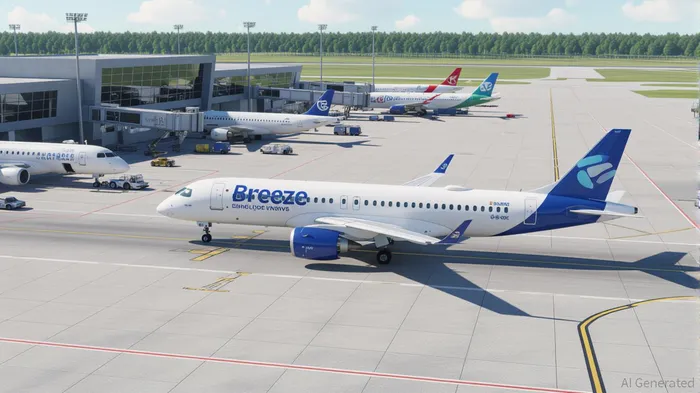
The U.S. low-cost airline sector is undergoing a seismic shift. With carriers like Breeze Airways and Avelo Airlines jostling for dominance in underserved markets, the landscape is increasingly fragmented. Breeze's recent expansion into the West Coast—set to begin in March 2026—highlights both the opportunities and risks inherent in this competitive environment. For investors, the key question is whether Breeze's strategic bets will pay off in a sector where even well-capitalized players struggle to sustain profitability.
A Tale of Two Carriers: Breeze's Aggression vs. Avelo's Retreat
Breeze Airways' entry into the West Coast is a direct response to Avelo Airlines' decision to exit the region by December 2025. Avelo, a budget airline that launched in 2021, faced mounting challenges: financial pressures, a controversial ICE deportation contract, and a saturated market. Despite achieving load factors above 80% on many routes, Avelo's exit underscores the fragility of low-cost operations in secondary markets.
Breeze, by contrast, is betting on a “Nice Low-Cost Carrier” model. Its Airbus A220-300 fleet offers fuel efficiency, first-class seating, and free in-flight Wi-Fi—amenities that differentiate it from Avelo's all-economy BoeingBA-- 737s. This blend of affordability and premium features targets a niche: leisure travelers in smaller cities who are price-sensitive but not willing to sacrifice comfort. Breeze's routes to Burbank, Arcata, Eugene, and Pasco are designed to fill the void left by Avelo, with introductory fares as low as $39 one-way.
Industry Trends: Growth, Fragmentation, and the Rise of “Nice Low-Cost”
The U.S. low-cost airline market is projected to grow at a 4% CAGR through 2031, driven by budget-conscious travelers and route reallocations. However, this growth is not without turbulence. Legacy carriers like Southwest and RyanairRYAAY-- are expanding their premium offerings, while newer entrants like Breeze and Avelo experiment with hybrid models. The sector is increasingly fragmented, with players vying for market share in a cost-driven environment.
Breeze's strategy aligns with a broader industry trend: the evolution of low-cost carriers into “value-enhanced” operators. By offering amenities like first-class seats and Wi-Fi, Breeze aims to capture a higher yield while maintaining low base fares. This approach could prove sustainable if demand for mid-tier services continues to grow—a key assumption in Breeze's financial model.
Risks and Opportunities: A Calculated Gambit
Breeze's West Coast expansion carries significant risks. The airline is entering a market where Avelo's exit was necessitated by financial strain. Even with a modern fleet and optimized pricing, Breeze must contend with:
- Competition: Legacy carriers and other low-cost rivals may adjust routes or pricing to counter Breeze's entry.
- Demand Volatility: Leisure travel, a core component of Breeze's strategy, is sensitive to economic cycles. A downturn could erode load factors.
- Operational Complexity: Launching 300 routes across 34 states in a short timeframe requires flawless execution.
Yet the opportunities are equally compelling. Breeze's focus on secondary cities—where demand is underserved and competition is thin—positions it to capitalize on latent travel needs. Its use of the A220 fleet, which is 20% more fuel-efficient than Avelo's 737s, should reduce costs and improve margins. Additionally, Breeze's recent operational profit (reported in Q2 2025) suggests it has the financial flexibility to absorb short-term losses during expansion.
Investment Implications: A Sector in Flux
For investors, Breeze's expansion represents both a high-risk, high-reward proposition and a microcosm of the sector's broader dynamics. The airline's ability to execute its West Coast strategy will hinge on its capacity to balance cost efficiency with customer satisfaction. If successful, Breeze could emerge as a model for how low-cost carriers adapt to evolving traveler expectations. However, failure to maintain profitability in this market would signal systemic challenges for the sector.
Avelo's exit serves as a cautionary tale. While its financial struggles were specific to its business model and operational choices, they highlight the fragility of low-cost carriers in markets with thin margins. Investors should monitor Breeze's load factors, fuel costs, and ancillary revenue streams—key indicators of its ability to sustain growth.
The Bigger Picture: Navigating a Fragmented Future
The low-cost airline sector is at a crossroads. As travelers increasingly seek value and flexibility, the line between budget and premium carriers is blurring. Breeze's expansion into the West Coast is not just a strategic move for the airline—it's a test of whether the next generation of low-cost carriers can thrive in a fragmented, hyper-competitive environment.
For now, Breeze appears well-positioned. Its modern fleet, customer-centric model, and timely entry into a vacated market give it a strong hand. But the cards are still being played. Investors who follow this sector closely will need to watch how Breeze navigates the coming months—and whether its strategy can be replicated in other regions.
In the end, the story of Breeze and Avelo is a reminder: in the airline industry, even the most aggressive expansion plans are only as good as the fundamentals that underpin them.

Delivering real-time insights and analysis on emerging financial trends and market movements.
Latest Articles
Stay ahead of the market.
Get curated U.S. market news, insights and key dates delivered to your inbox.


AInvest
PRO
AInvest
PRO



Comments
No comments yet