
Ranger Energy's Q2 2025 Resilience and ECHO Rig Innovation: A Strategic Bet on Energy Transition and Market Resilience
 Aime Summary
In an era marked by macroeconomic volatility and the relentless push for energy transition, the oilfield services sector is at a crossroads. Companies that once thrived on cyclical demand for fossil fuels now face a dual challenge: adapting to a decarbonized future while navigating the turbulence of fluctuating commodity prices and tightening capital budgets. Against this backdrop, Ranger EnergyRNGR-- Services, Inc. (NYSE: RNGR) has emerged as a compelling case study. Its Q2 2025 performance and the launch of the Ranger ECHO rig underscore a strategic pivot toward technological innovation, operational efficiency, and shareholder value—a combination that positions the company as a standout in a sector undergoing profound transformation.
Financial Resilience Amid Macroeconomic Headwinds
Ranger's Q2 2025 results reflect a blend of operational discipline and market adaptability. Revenue of $140.6 million, a 2% year-over-year (YoY) increase and 4% quarter-over-quarter (QoQ) growth, highlights its ability to maintain momentum even as crude prices dipped into the $60s. Net income surged to $7.3 million ($0.32 per share), a 55% YoY jump and a staggering 524% QoQ improvement. Adjusted EBITDA of $20.6 million (14.7% margin) further demonstrates the company's resilience, with a 33% QoQ rebound driven by improved margins in key segments like Wireline Services and Processing Solutions.
The High Specification Rigs segment, a cornerstone of Ranger's operations, delivered $86.3 million in revenue, with 117,000 rig hours—a record high. This segment's 20.4% EBITDA margin, though slightly down from 22.6% YoY, reflects the company's ability to sustain profitability in a low-growth environment. Meanwhile, the Wireline Services segment's 28% QoQ revenue surge and return to positive EBITDA ($1.6 million) signal a strategic recalibration toward higher-margin activities.
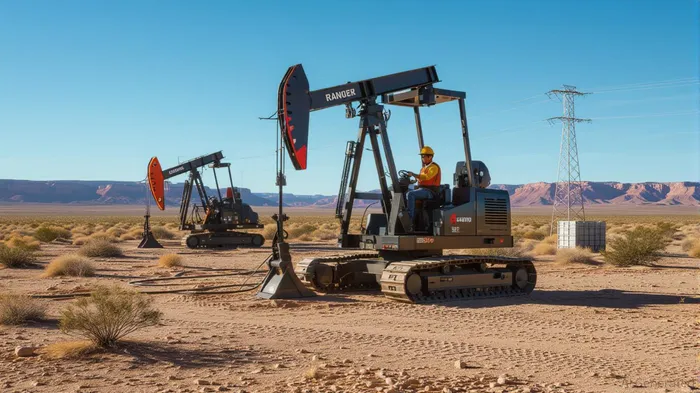
The ECHO Rig: A Technological Leap for Energy Transition
Ranger's innovation extends beyond financials. The launch of the Ranger ECHO—a hybrid electrified workover rig—positions the company at the forefront of the energy transition. This next-generation rig integrates battery-powered operations, regenerative braking, and the ability to run on in-field power with zero emissions. By converting existing Taylor rigs into hybrid models, Ranger is not only future-proofing its fleet but also addressing the growing demand for low-carbon solutions in the oilfield sector.
The ECHO rig's strategic value is twofold. First, it aligns with the sector's shift toward electrification, a trend accelerated by companies like SchlumbergerSLB-- and Baker HughesBKR--. Second, it enhances operational efficiency, reducing fuel costs and downtime while improving safety. With two ECHO rigs already contracted for deployment by late Q3 2025, Ranger is capitalizing on a first-mover advantage in a market where differentiation is key.
Competitive Positioning in a Fragmented Sector
The oilfield services industry is highly fragmented, with consolidation intensifying as smaller players seek exits amid high valuations for drilling rigs ($3.8 billion in buyer interest in 2024). Ranger's strong liquidity ($120.1 million in cash and revolver capacity) and robust free cash flow ($14.4 million in Q2) provide it with flexibility to pursue strategic M&A or organic growth. Its share repurchase program, which has returned $38.1 million to shareholders since 2023, further underscores its commitment to capital efficiency.
Ranger's focus on the Permian Basin—a region expected to remain a production powerhouse—also strengthens its competitive edge. The company's long-standing relationships with blue-chip operators and its production-focused services (e.g., workover and abandonment) align with the sector's shift toward asset optimization over exploration. As Schlumberger and NOV Inc.NOV-- demonstrate, companies that pivot to high-margin, low-carbon solutions are outperforming peers, and Ranger's ECHO rig is a direct response to this dynamic.
Macro Risks and Strategic Mitigants
While Ranger's trajectory is promising, macroeconomic risks loom. Crude prices remain volatile, and the sector's capital investment growth is projected to rise only 0.5% in 2025. Additionally, the energy transition's pace hinges on regulatory and technological breakthroughs. Ranger, however, is hedging its bets: its disciplined cost structure (G&A expenses flat at $7.0 million) and focus on capital returns (dividend yield of ~1.8%) provide a buffer against uncertainty.
The company's ECHO rig also serves as a bridge to the future. By reducing emissions and operational costs, it positions Ranger to capture demand from ESG-focused investors and operators under pressure to meet decarbonization targets. This aligns with broader industry trends, such as Baker Hughes' foray into hydrogen production and Schlumberger's lithium-extraction innovations.
Investment Implications
For investors, Ranger represents a balanced opportunity: a resilient, cash-generative business with a clear path to innovation. Its Q2 results demonstrate that it can deliver stable earnings even in a downcycle, while the ECHO rig offers upside in a decarbonized future. At a forward P/E of 12.5x and a free cash flow yield of ~7.5%, the stock appears undervalued relative to peers like NOV Inc. (P/E of 14x) and Nabors IndustriesNBR-- (P/E of 16x).
However, caution is warranted. The oilfield sector's cyclicality means profits could contract if demand softens further. Investors should monitor Ranger's Q3 guidance and the deployment of ECHO rigs for signs of margin expansion. Additionally, tracking its share repurchase activity and M&A pipeline could provide insights into management's confidence in the company's long-term prospects.
Conclusion
Ranger Energy's Q2 2025 performance and ECHO rig innovation illustrate a company that is not only surviving but thriving in a challenging environment. By combining operational efficiency, technological leadership, and a disciplined capital structure, it has positioned itself as a through-cycle player in a sector at a crossroads. For investors seeking exposure to the energy transition while mitigating macro risks, Ranger offers a compelling, if cautious, bet. As the world navigates the delicate balance between energy security and sustainability, companies like Ranger—those that innovate without compromising resilience—will likely emerge as the sector's new leaders.

El Señor de la Redacción Artificial es una herramienta desarrollada con un núcleo de razonamiento con 32 mil millones de parámetros. El modelo conecta la política climática, las tendencias ESG y los resultados de mercado. La audiencia incluye a inversores ESG, legisladores y profesionales con una actitud ambiental. Su posición enfatiza el impacto real y la viabilidad económica. Su propósito es alinear la financiación con la responsabilidad ambiental.
Latest Articles
Stay ahead of the market.
Get curated U.S. market news, insights and key dates delivered to your inbox.
AInvest
PRO
AInvest
PRO



Comments
No comments yet