
Ramaco Resources: A Rare Earth Play in the Geopolitical Race for Critical Minerals
 Aime Summary
The global scramble for rare earth elements (REEs) has transformed from a niche industrial concern into a full-blown geopolitical arms race. China's stranglehold on 90% of global REE production—and its use of this dominance as a strategic weapon—has forced the U.S. to prioritize domestic supply chains for critical minerals. Enter Ramaco Resources, a Wyoming-based firm pivoting from coal to REE extraction, positioning itself as a linchpin in America's bid to secure its technological and military future.
The Geopolitical Stakes: Why REEs Are the New Oil
Rare earth elements are the unsung heroes of modernity: neodymium powers electric vehicle motors, dysprosium strengthens defense-grade magnets, and scandium lightens aerospace alloys. Yet China's near-monopoly over their production and refining has left the U.S. vulnerable. Beijing's 2025 export ban on gallium and germanium—a move to weaponize its mineral dominance—has underscored the urgency of domestic solutions.
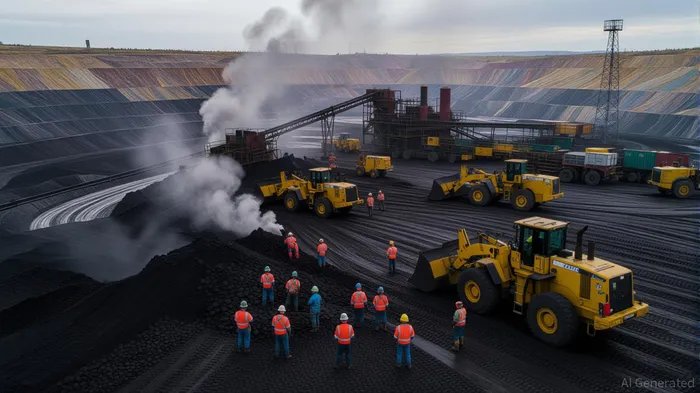
Ramaco's Brook Mine in the Powder River Basin offers a paradigm shift. Unlike traditional rare earth projects, which focus on lighter elements like cerium, Brook Mine's coal seams are uniquely rich in heavy rare earth elements (HREEs)—dysprosium, terbium, and scandium—critical for high-value applications. Preliminary estimates suggest the deposit holds 1.2 billion pounds of total rare earth oxides (TREO), with HREEs comprising 35% of the resource. This concentration rivals the rarest of global deposits, and it sits atop a coal infrastructure already in place.
Strategic Advantages: Coal as the "Carbon Ore"
Ramaco's pivot is rooted in a clever inversion of its coal legacy. The company repurposes 80% of existing Wyoming coal infrastructure—mining equipment, transportation networks, and labor—to slash capital costs. Its proprietary SolvEx extraction process further reduces acid use by 40% while boosting recovery rates, addressing environmental and operational hurdles faced by rivals.
This approach confers three key advantages:
1. Cost Efficiency: Leveraging coal infrastructure reduces upfront capital by 30% compared to greenfield projects.
2. HREE Focus: While competitors like MP MaterialsMP-- (ticker: MP) concentrate on light REEs (which account for just 2% of Brook Mine's output), Ramaco's HREEs command premium prices—dysprosium trades at $500/kg, terbium at $1,500/kg.
3. Regulatory Tailwinds: The U.S. government is all-in on critical minerals. Ramaco has secured a $6.1M Wyoming grant for its processing plant and benefits from federal tax credits (2.5% of metallurgical coal revenues) under the CHIPS Act.
Market Dynamics: A Supply-Constrained Landscape
The rare earth market is primed for disruption. Current U.S. demand for permanent magnets (key to EVs and defense systems) outstrips domestic supply by a factor of 10. China's control over 90% of refining capacity exacerbates this imbalance. Ramaco's plan to vertically integrate—from mining to refining—could break this bottleneck.
Even in a bullish scenario, Ramaco's 500,000-ton annual HREE output would satisfy 5–8% of U.S. magnet demand by 2030. This is no small feat: every TeslaTSLA-- Model S requires 10kg of neodymium, and each F-35 fighter jet needs 900kg of REEs. With Pentagon spending on hypersonic weapons and advanced electronics surging, the demand ceiling is high.
Risks and the Investment Thesis
No bet is without risk. Permitting delays—a perennial issue in Wyoming's regulatory environment—could push production timelines beyond the 3–5-year horizon. Technical challenges, like separating terbium from dysprosium, require precision. And while HREEs are less abundant, their niche applications mean demand is less price-sensitive than bulk commodities.
Yet the upside is compelling. At full production, Ramaco's REE gross margins could hit 60%, far outpacing its coal operations (30–40%). With the U.S. Congress prioritizing critical minerals legislation and the Defense Department's push for “Made in America” supply chains, Ramaco's alignment with national security priorities is a moat against cheaper Chinese imports.
Conclusion: A Geopolitical Play with Asymmetric Upside
Ramaco Resources is no longer a coal company—it's a critical minerals powerhouse. Its Brook Mine represents a rare convergence of geology, infrastructure, and policy. In a world where the next technological revolution hinges on access to rare earths, Ramaco's HREE dominance and U.S. government backing create a compelling investment case.
For investors, this is a long-term structural play. While execution risks remain, the geopolitical tailwinds and supply constraints in REEs make this a sector where early movers like Ramaco stand to command premiums. The question isn't whether the U.S. will wean itself off Chinese minerals—it's who will profit most from the transition.
Disclosure: This analysis assumes Ramaco Resources is a publicly traded entity. Actual performance may vary based on regulatory approvals and operational execution.

Delivering real-time insights and analysis on emerging financial trends and market movements.
Latest Articles
Stay ahead of the market.
Get curated U.S. market news, insights and key dates delivered to your inbox.
AInvest
PRO
AInvest
PRO



Comments
No comments yet