
Ramaco Resources: The Geopolitical Playbook for Rare Earth Dominance
 Aime Summary
The race to secure critical minerals has become the new battleground of global economic power. Nowhere is this clearer than in Ramaco Resources' (NASDAQ: RARX) audacious pivot from coal to rare earth elements (REEs) in Wyoming's Powder River Basin. By leveraging its coal deposits to extract high-demand REEs like dysprosium and terbium—critical for electric vehicle (EV) magnets, wind turbines, and defense systems—Ramaco is positioning itself to disrupt a market dominated by China, which controls 85-90% of global REE production. This strategic move could redefine investor perceptions of the company and the broader critical minerals sector.
The Geopolitical Catalyst: Breaking China's Monopoly
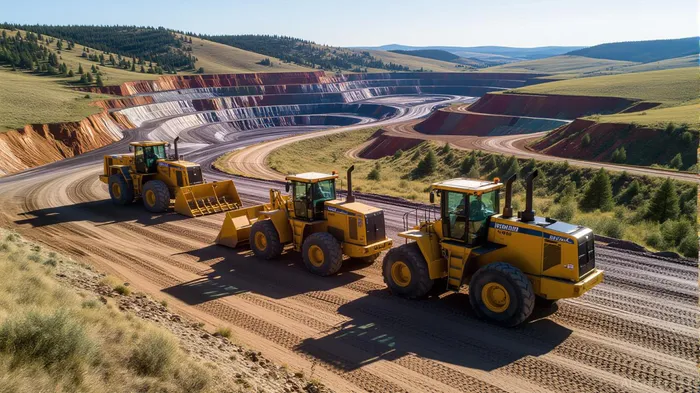
Ramaco's Brook Mine is no ordinary project. Its coal seams contain 10,000 ppm of total rare earth oxides (TREO)—among the highest concentrations globally—and are uniquely rich in heavy rare earths (HREs), such as dysprosium and terbium. These elements are essential for advanced technologies but are scarce in most Western deposits. By targeting HREs, Ramaco avoids direct competition with rivals like MP MaterialsMP-- (NYSE: MP), which focus on light REEs. Instead, it taps into a niche where China's dominance is most entrenched.
The U.S. Department of Defense alone requires 30% of its magnet material needs from domestic sources by 2030—a goal that Brook Mine aims to fulfill. With geopolitical tensions over supply chains and hypersonic arms races, Ramaco's pivot aligns with Biden's Inflation Reduction Act, which mandates critical mineral production for federal contracts. The mine's $500M development plan, supported by a $6.1M Wyoming grant and federal tax incentives, is a $1.2B net present value (NPV) opportunity to secure national security.
Market Disruption Through Technology and Scale
Ramaco's edge lies not just in geology but in innovation. Its SolvEx extraction process reduces acid use by 40% and recovers 95% of targeted elements—a stark contrast to China's energy-intensive methods. Combined with closed-loop water systems and robotic mining, this approach slashes environmental risks. Meanwhile, its existing coal operations provide a $400M/year revenue stream, shielding it from the volatility plaguing pure-play REE miners.
Analysts at TipRanks highlight three critical milestones:
1. July 2025's Preliminary Economic Assessment (PEA) by Fluor CorporationFLR-- will validate scalability.
2. 2026's pilot plant aims to produce 1,242 tons of oxides annually—enough to meet 10% of U.S. demand.
3. 2028's full production targets 5,000 tons/year, rivaling China's light REE mines.
Valuation: A Long-Term Play with Short-Term Catalysts
Ramaco's stock trades at a $480M market cap, far below its Brook Mine's $1.2B NPV. While risks like permitting delays and execution exist, the project's strategic value could attract Pentagon or sovereign wealth funds. **** shows a lagging valuation compared to sector gains—a potential buying opportunity as geopolitical urgency grows.
Analysts project a $14 price target (up 29% from July 2025's $10.85), but upside could surge if Brook Mine secures Defense Production Act funding or accelerates partnerships with U.S. magnet manufacturers. The dividend—$0.06875 per share in Q2 2025—adds stability, even as capital is reinvested in REE development.
Risks and Realities
Skeptics point to the $850M Phase 1 cost, long timelines, and China's price manipulation. However, Ramaco's HRE-rich deposit avoids radioactive thorium, simplifying permitting, and its Wyoming location offers low labor costs and existing infrastructure. Competitors like Estonia's Silmet face higher geopolitical risks, while U.S. rivals like USA Rare EarthUSAR-- lack Brook's scale.
Investment Thesis: A Geopolitical Hedge with Asymmetric Upside
Ramaco's Brook Mine is more than a mine—it's a strategic asset in the decarbonization and defense tech boom. Investors seeking exposure to critical minerals without betting on lithium or cobalt should consider RARX. The stock's current valuation underweights its monopolistic position in HREs, making it a high-conviction long-term hold.
Act on these catalysts:
- Buy RARX on dips below $10 ahead of the July PEA release.
- Watch for Wyoming's regulatory approvals and Pentagon partnerships in Q4 2025.
- Treat it as a geopolitical hedge: 5-10% of a diversified portfolio for exposure to U.S. supply chain resilience.
In a world where minerals are the new oil, Ramaco is writing a playbook for energy independence—one ton of dysprosium at a time.

Delivering real-time insights and analysis on emerging financial trends and market movements.
Latest Articles
Stay ahead of the market.
Get curated U.S. market news, insights and key dates delivered to your inbox.
AInvest
PRO
AInvest
PRO



Comments
No comments yet