
Ramaco Resources: From Coal to Critical Metals – A Strategic Pivot for the Clean Energy Era
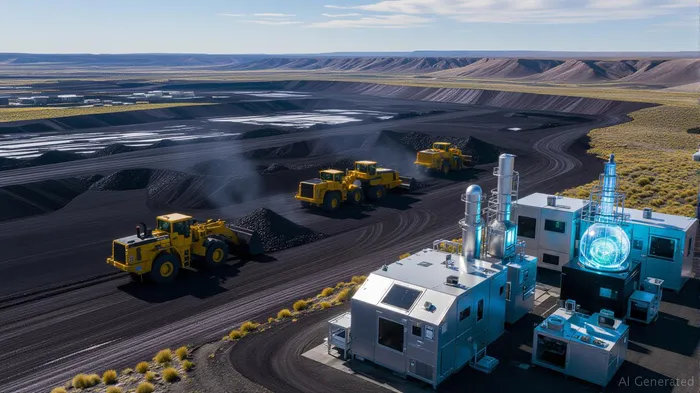
The decline of the coal industry has forced many companies to seek new avenues for survival. Among them, Ramaco ResourcesMETC-- (METC) stands out as a rare example of strategic reinvention. Its shift from coal to rare earth metals extraction in Wyoming's Brook Mine could redefine its valuation and position it as a linchpin in the clean energy supply chain. This pivot is not merely a tactical move—it represents a fundamental realignment with the demands of the 21st-century economy.
The Coal Sector's Decline and Ramaco's Response
The global coal industry is in irreversible decline. Stricter emissions regulations, the rise of renewables, and the shift to cleaner energy sources have eroded demand. For RamacoMETC--, which has historically relied on metallurgical coal for steel production, this presents a stark challenge. However, the company has seized an opportunity in its own backyard: the Brook Mine, a deposit rich in rare earth elements (REEs) and critical minerals.
The Preliminary Economic Assessment (PEA) by Fluor CorporationFLR-- highlights the project's potential. With a net present value (NPV) of $1.197 billion at an 8% discount rate and an internal rate of return (IRR) of 38%, the Brook Mine is financially robust. By 2029, it could produce 1,242 tons of rare earth oxides annually, including scandium, gallium, and neodymium—key materials for EV batteries, wind turbines, and defense systems. This transition aligns Ramaco with a sector expected to grow at a CAGR of 8.5% through 2030, as per the U.S. Geological Survey.
Rare Earth Demand: A Tailwind for Ramaco
The global push for clean energy and electric vehicles (EVs) has created a surge in demand for rare earth metals. A single EV requires up to 10 kg of rare earth elements, while wind turbines use tons of neodymium and dysprosium for their magnets. China currently dominates 85% of global rare earth production, a dependency the U.S. seeks to disrupt. Ramaco's Brook Mine, with its non-radioactive, soft-coal-associated deposits, offers a critical alternative.
The mine's geology is a competitive advantage. Unlike traditional hard-rock deposits, the Brook Mine's materials require lower energy and capital costs for extraction. Fluor's PEA estimates a total capital cost of $579 million (including contingency), which is modest compared to the projected $378 million in annual revenue by 2029. This scalability positions Ramaco to meet 3–5% of U.S. magnet demand and over 30% of defense-related needs, directly addressing supply chain vulnerabilities.
Market Recognition: The RS Rating Surge and Technical Breakout
While the term “RS rating” is not explicitly mentioned in Ramaco's recent disclosures, its stock price surge of 6.1% on July 1, 2025—driven by a KDJ Golden Cross technical signal—speaks to investor optimism. This breakout, coupled with a volume spike of 6% above averages, suggests renewed interest in the company's strategic shift.
The rally is not without context. Ramaco's operational improvements in its coal business—non-GAAP cash costs down 17% to $98 per ton and record production of 989,000 tons in Q1 2025—bolster its financial resilience. Meanwhile, its $6.1 million Wyoming state grant and partnerships with FluorFLR-- Corporation underscore the project's credibility. These factors, combined with geopolitical tailwinds, are likely fueling investor confidence.
ESG and Infrastructure Policies: Long-Term Catalysts
Ramaco's pivot aligns with two powerful trends: ESG-driven investment and U.S. infrastructure policies. The Biden administration's Inflation Reduction Act (IRA) allocates billions to domestic critical mineral production, while the CHIPS and Science Act incentivizes supply chain diversification. For investors, Ramaco's role in reducing reliance on Chinese REEs is a compelling ESG narrative.
Moreover, the Brook Mine's low-radioactivity profile and efficient processing methods mitigate environmental risks, making it more palatable to ESG-conscious funds. With 42 years of initial mine life and scalability beyond that, the project offers a multi-decade growth trajectory—a rarity in today's volatile markets.
Risks and Considerations
No investment is without risk. Regulatory hurdles, delays in the Brook Mine's timeline (currently targeting 2029 for steady-state production), and global rare earth price fluctuations pose challenges. The coal sector's ongoing decline could also strain near-term cash flows. However, Ramaco's $118.4 million liquidity and cost discipline provide a buffer, while the project's 40% revenue contribution from high-margin critical minerals offers a hedge against commodity volatility.
Investment Thesis: Buy with a Multi-Year Horizon
Ramaco Resources is undergoing a transformative shift that could redefine its valuation. The Brook Mine's PEA, combined with geopolitical tailwinds and ESG alignment, positions the company as a critical player in the clean energy supply chain. While short-term risks exist, the long-term upside—domestic REE production, EV demand growth, and infrastructure spending—justifies a buy rating with a multi-year holding period.
Investors should monitor two key milestones: the full PEA release by July 8, 2025, which will clarify scalability, and pilot plant production by mid-2026, a critical proof-of-concept. With a current valuation of $1.197 billion NPV (pre-tax), Ramaco's stock could see significant re-rating once the Brook Mine enters production.
In conclusion, Ramaco's pivot from coal to critical metalsCRML-- is a masterclass in strategic adaptation. For investors willing to look beyond the decline of traditional energy, this is a rare opportunity to capitalize on the future of clean energy—and the minerals that will power it.

Delivering real-time insights and analysis on emerging financial trends and market movements.
Latest Articles
Stay ahead of the market.
Get curated U.S. market news, insights and key dates delivered to your inbox.
AInvest
PRO
AInvest
PRO



Comments
No comments yet