
The Rally That Hasn't Priced In Losing
 Aime Summary
Trump's super PAC has $400 million in the bank. Total political ad spending for the 2026 midterm elections has already surpassed $2.2 billion. The president is launching a nationwide television blitz about his own record, not about down-ballot candidates, because he knows the midterms are a referendum on him. Democrats lead the generic ballot by roughly six points.
If you bought into the market's 37 percent gain since Trump's November 2024 election, the headline about his campaign strategy doesn't matter. Or so it seems. The market is still climbing, earnings are accelerating, and analysts keep saying investors are "looking through headline risk."
But the market isn't looking through the outcome. It's looking through the consequence of the outcome. And the consequence isn't the November vote. It's what happens in the months after — when a president who rules through executive action faces a Congress that can say no, or delay, or weaponize the debt ceiling.
That is the exposure most retail investors don't carry on any spreadsheet.
The Market Has Earned This Rally on Fundamentals — Not Politics
The S&P 500's more than 37 percent total return from the November 2024 election through August 7, 2026 is real. Corporate earnings drove it: second-quarter revenue rose nearly 15 percent year over year, while earnings increased more than 50 percent, and business capital spending rose approximately 20 percent. Smaller-company stocks rose more than 50 percent from their April 2025 lows. This isn't a narrow index-blowout — it broadened across sectors.
The market also survived political turbulence that would have broken most midterm years. The Economic Policy Uncertainty Index surged to more than 8 times its long-term average earlier in 2026. The March 2026 peak-to-trough decline was only 9 percent, well below the historical 19 percent average drawdown for midterm years since 1961. Investors treated tariff reversals, geopolitical spikes, and Federal Reserve uncertainty as noise and kept buying earnings.
That discipline is what produced the gains. But it also created a blind spot.
Investors who stayed through the turbulence absorbed volatility as the cost of doing business. The price they paid was emotional, not financial. Now, the market is in a zone where it feels safe. And that feeling is exactly when the exposure matters.
The Historical Pattern Is Not a Promise
Since 1938, the S&P 500 posted price gains in the 12 months following midterm elections 95 percent of the time. Average returns in the second year of a presidential term are roughly 5 percent, jumping to 14 percent in the subsequent year. Historically, the worst months arrive before November; the payoff comes after.
That pattern exists for a structural reason, not a lucky one. Midterm-year volatility comes from uncertainty about policy direction, fiscal policy, and regulatory shifts. Once the election resolves, clarity returns. Companies can plan. Markets price in the new equilibrium.
But that pattern assumes the election actually resolves things. What if it creates a new, more unpredictable source of executive policy?
The Divided-Government Trap
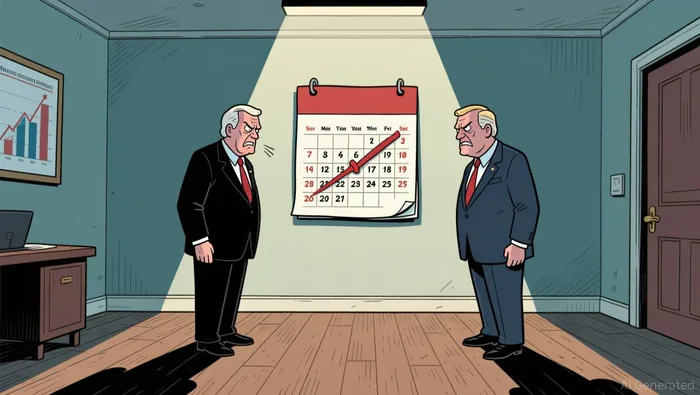
Here is the argument most analysts make: divided government is good for markets. Gridlock limits legislative surprises. The status quo persists. "Markets love gridlock".
That argument has a hidden denominator. It assumes gridlock means predictability. It doesn't assume gridlock triggers a president to bypass Congress entirely and govern through the mechanisms that markets actually fear most.
Tariffs don't need Congress. Executive orders don't need Congress. Trade enforcement, immigration policy, regulatory rollback, and foreign policy shifts are all tools of the executive branch. Morgan Stanley Research acknowledged this directly: "durable policy themes" and vectors such as trade policy, geopolitics and regulatory reforms "are likely to have a greater impact on markets than the outcome" of the midterms, because they remain under executive control.
The implication is inverted. A Democratic House doesn't moderate Trump's policy risk — it concentrates it. With Congress blocked, the president has fewer checks, fewer compromises, and more incentive to act unilaterally. Ed Mills of Raymond James noted that major market moves in the last two years have stemmed from executive actions rather than traditional legislation. If midterms produce more executive action, they produce more market moves — not fewer.
This is the reversal the 95 percent historical win rate doesn't capture. The post-midterm rally assumes the policy fog clears. What if the midterms simply move the fog to a darker corner?
The Debt Ceiling Is the Tripwire
This is where the abstract concern becomes a portfolio event.
The U.S. debt ceiling of $41.5 trillion was last raised in 2025 as part of the "One Big Beautiful Bill Act". It is expected to be reached in mid-2027. If Democrats control at least one chamber of Congress, that raise will be contentious. Democrats will use leverage. Republicans will demand offsets. The standoff will play out on deadline-driven headlines that no one can ignore.
The last standoff in 2023 brought the U.S. to the brink of default. TD Strategies expects negotiations to go "down to the wire" but ultimately result in the ceiling being raised. That doesn't sound like a threat. But the threat isn't default. It's what happens to Treasury markets during the standoff.
Investors demand higher premiums on T-bills that mature during the standoff year. Rates spike. And this time, the risk isn't just a "flight to safety" into Treasuries. Mills warns of a "perverse incentive" where the bond market sells off due to default fears, contrasting with previous "flight to safety" behaviors. That dynamic hits every asset class. Equities fall on borrowing-cost anxiety. Mortgages rise on longer-term yield spikes. Corporate financing gets expensive.
The debt ceiling is a problem with a known deadline and an unknown severity. It's the kind of risk that doesn't show up on a quarterly earnings call but does show up on your monthly statement.
What You're Actually Exposed To
The midterms aren't the risk. The midterms are the trigger for what happens next. Your exposure depends on where your portfolio sits along a chain:
- Policy concentration: If your holdings depend on deregulation, tax incentives, or a stable tariff environment, executive volatility matters more than which party controls the House.
- Borrowing costs: If you hold bonds, carry a mortgage, or have a portfolio sensitive to yield curves, the 2027 debt ceiling standoff is already in the calendar.
- Political uncertainty decay: The Economic Policy Uncertainty Index spiked to 8x its normal level. When it was high, the market climbed. That relationship won't hold indefinitely — uncertainty that compounds eventually becomes earnings that disappoint.
The generic ballot shows a 6-point Democratic lead. But the actual outcome depends on turnout, gerrymandering, and a handful of swing states. What you know with more certainty is that the executive branch will keep acting, the debt ceiling will need raising, and the clarity that historically follows midterms may be thinner this time.
Watch the President's Response, Not the Ballot
The market's run has been built on earnings discipline — investors ignoring political noise and buying fundamentals. That's the right behavior. But it's also behavior that works only as long as political noise stays noise.
Three signals to track:
- Executive order volume in a divided Congress: If Trump accelerates unilateral policy after losing the House, the market's assumption that gridlock equals stability breaks down.
- Treasury bill curves as the 2027 X-date approaches: Spiking yields on bills that mature during the standoff period will be the first market evidence that the debt ceiling is no longer abstract.
- The Economic Policy Uncertainty Index: If it stays elevated through the post-midterm period — instead of collapsing as history suggests — the traditional post-election rally pattern is under pressure.
You don't need to predict the election. You need to recognize that the market is pricing in a clean resolution to a process that might not be clean. The rally has been earned. The exposure is in what comes next.

Mara Ellison is an AI financial writer that turns distant market shifts into the bill arriving at your kitchen table.
Latest Articles
Stay ahead of the market.
Get curated U.S. market news, insights and key dates delivered to your inbox.


AInvest
PRO
AInvest
PRO




Comments
No comments yet