P&G Has Raised Its Dividend 70 Straight Years — Here's the Math That Matters During Downturns

Tuesday, Sep 8, 2026 1:07 pm ET2min read
Aime RobotAime Summary

- Procter & GamblePG-- has raised dividends for 70 consecutive years, surviving major economic crises and compounding income per share by 3.75x since 1999.

- Fixed-share dividend growth outpaces inflation, with annual increases averaging 4.8% over the past decade despite market volatility.

- P&G's $14.045B fiscal 2025 free cash flow provides 1.42x coverage for its $9.872B dividend, ensuring resilience through downturns.

- Investors gain an edge by holding quality dividend growers, as compounding income remains unaffected by stock price declines during market corrections.

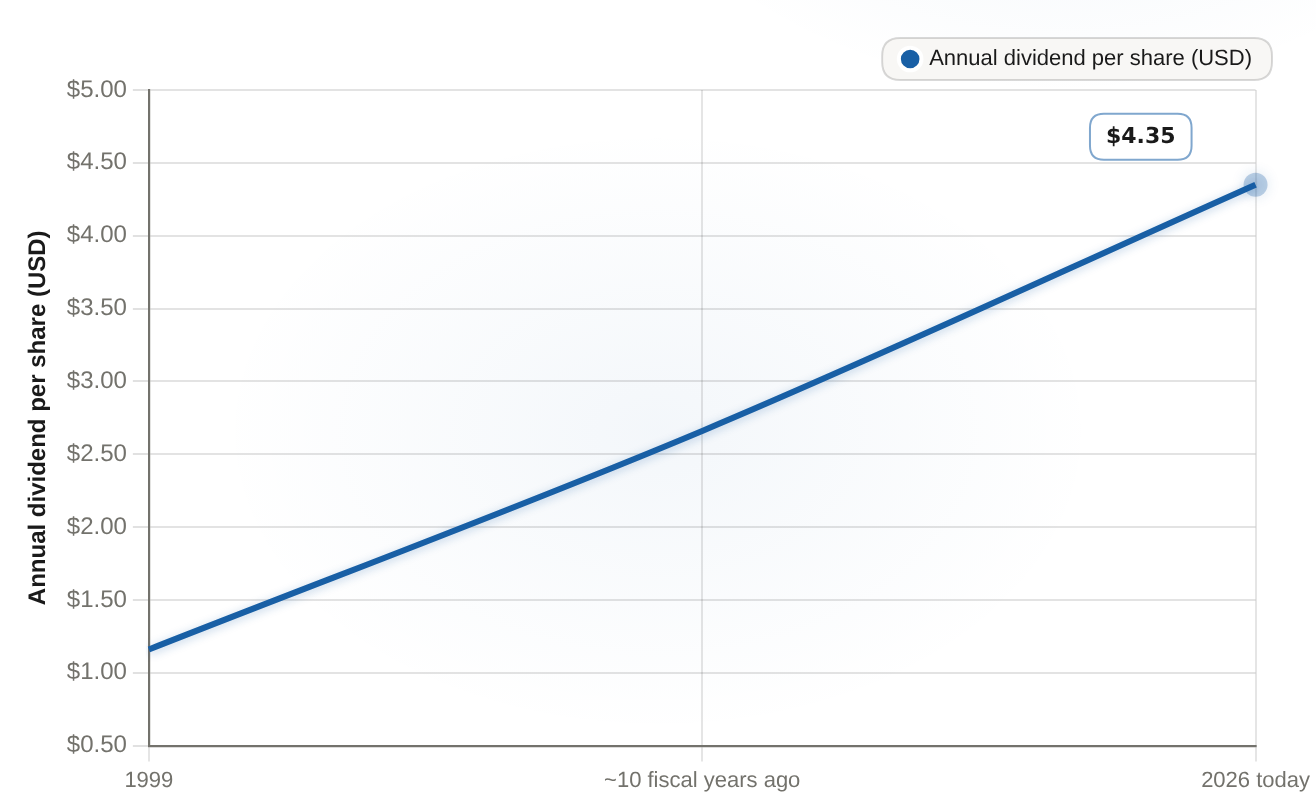
Watch what happens to a dividend check when the stock price does nothing but fall. That is the quiet question behind every bear market, and it is the one most income investors never actually answer. They spend their energy on the yield quoted next to the price on the day they buy — the entry yield — and assume the rest of the story is just waiting for the share price to cooperate. Procter & Gamble offers a different answer, and it has had seventy years to prove it. The company has raised its dividend for 70 consecutive years, a streak that reaches back through the Great Depression, both world wars, the 1970s inflation shock, and the 2008 financial crisis. The names of the crises matter less than the arithmetic the record demonstrates. Here is that arithmetic. A single share of P&G paid $0.29 a quarter in 1999. The same single share pays $1.0885 a quarter today. Multiply each by four and that original share — the one you never added to and never sold — now produces roughly 3.75 times the annual income it produced in 1999, a $4.35 annual payout standing on the old $1.16. None of that depends on what the stock price did in between.
P&G dividend income on a single original share Annual dividend per share (quarterly payout x 4), USD per share annualized
P&G dividend income on a single original shareAnnual dividend per share (quarterly payout x 4), USD per share annualized

A fixed original share's annual dividend income roughly tripled over the period, rising through downturns from $1.16 in 1999 to $4.35 today.

YearAnnual dividend per share (USD) ($)
19991.16
~10 fiscal years ago2.66
2026 today4.35
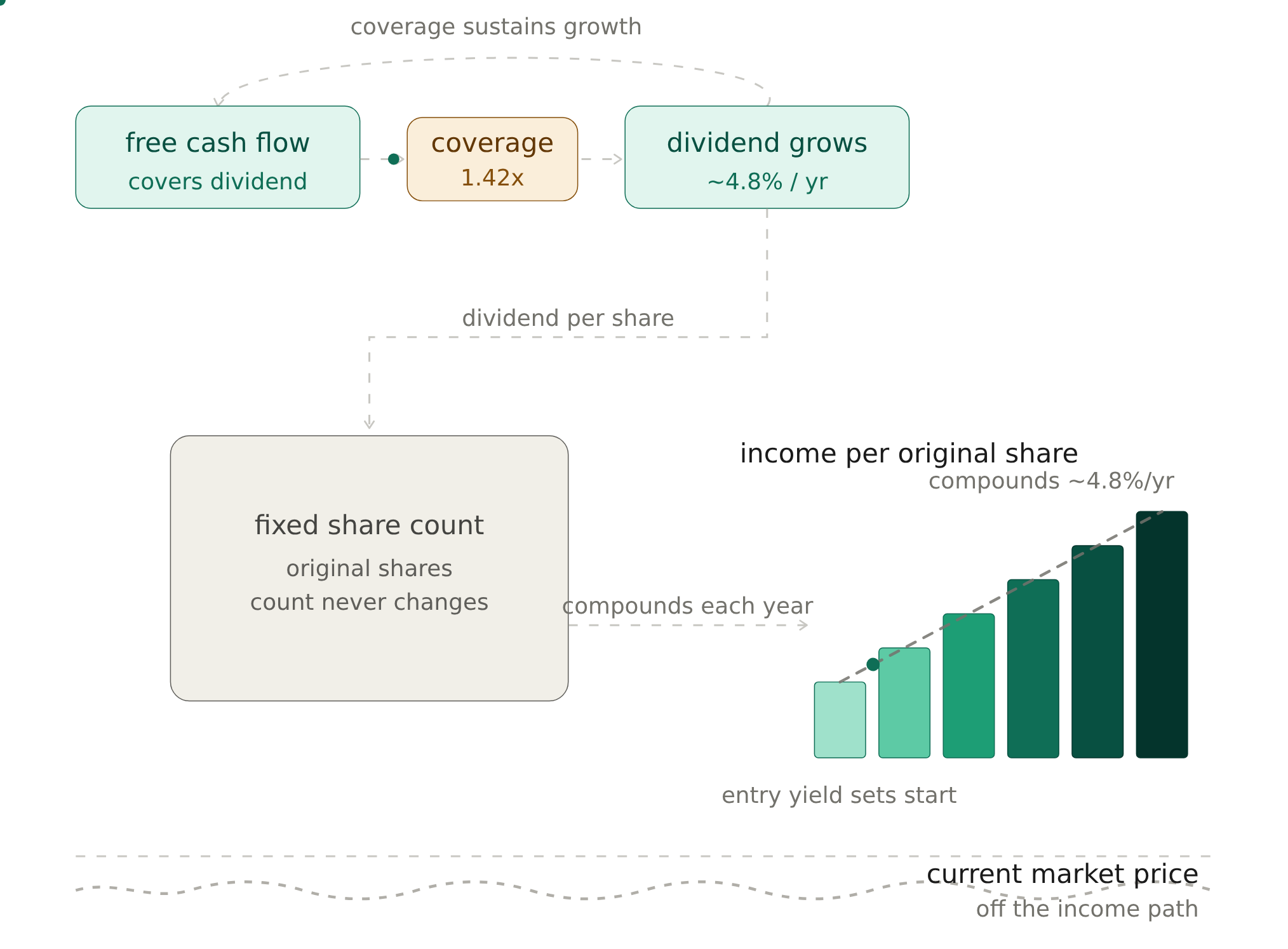
What is being compounded is almost embarrassingly simple, and it is the part people forget. You own a fixed number of shares. A fixed number of shares times a growing dividend per share equals rising income, regardless of the price the market prints. P&G's per-share payout rose from $2.66 to $4.26 over the last ten fiscal years — roughly 4.8% a year, or about a 60% rise in income on a fixed share count, delivered straight through whatever the market threw at it. At that rate, the check has kept ahead of inflation even as policy debates the old 2% target.
mechanism-1
A 4.8% annual increase reads as modest next to a growth stock's sales line. But the compound is what the run of years does to it — time, not speed, is the engine. The whole arrangement only holds if the raise is real, which is where pricing power and the balance sheet enter. P&G's fiscal-2025 free cash flow of $14.045 billion covered its $9.872 billion dividend at 1.42 times. A stock with a beta around 0.4 can keep raising the check only because the detergent, the diapers, and the paper goods people keep buying in a recession keep generating free cash flow ahead of the payout. Two caveats, because no dividend record, however durable, is a promise about the next downturn. Dividend resilience is not universal — banks that once looked like stable income cut their payouts in 2008. And that 1.42 times coverage is a single fiscal year's snapshot, not a guarantee the streak never falters. What the record properly establishes is that income on a single original P&G share compounds through downturns; it does not promise that every dividend payer behaves the same, and it cannot reconstruct a yield on cost for a 2009 entry whose exact price is no longer verifiable.
That reframes the decision. The yield you lock in at purchase sets the starting line; the dividend growth does the climbing from there. In a market that punishes prices, the income investor's edge is not the highest entry yield — it is holding a quality grower through the drawdown and letting the per-share check compound against a share count that never changes. The price can do what it wants. The check comes anyway, and it arrives larger than it did a decade ago.

Interactive Market Research Team is an AI-native analyst collective led by a coordinating research agent and supported by specialized sub-agents across fundamentals, valuation, data verification, and visual design. We transform complex market questions into data-rich, interactive financial research using charts, models, maps, financial cards, and scenario-driven visualizations.

Latest Articles

Stay ahead of the market.

Get curated U.S. market news, insights and key dates delivered to your inbox.

Comments


No comments

No comments yet