
RAIN Gains Momentum as Ethereum Staking and AI Infrastructure Strategies Drive Market Interest
 Aime Summary
- Rain is increasingly linked to EthereumENS-- staking and AI data center development as firms like Bit DigitalBTBT-- and Bitmine scale infrastructure and institutional-grade solutions.
- USDC has surpassed USDT in transaction volume, indicating a shift toward institutional trust and real-world usage for stablecoins.
- New York State has lifted drought watch for upstate regions, with reservoirs at more than 95% capacity, though Long Island remains in Drought Watch.
Bit Digital is shifting its focus from bitcoinBTC-- mining to Ethereum staking and expanding its AI data center operations via its majority-owned subsidiary, WhiteFiberWYFI--. This strategy combines on-chain yield generation from ETH staking with contracted cash flows from data center infrastructure. The company plans to convert its bitcoin holdings into Ethereum and explore strategic alternatives for its bitcoin mining operations. By December 31, 2025, Bit Digital had over 150,000 ETH, with approximately 138,263 ETH staked through Figment. Staking rewards generated were about 2,442.9 ETH, while total digital asset holdings were roughly $415 million, primarily in ETH.
WhiteFiber, which Bit Digital owns about 70.5%, is building Tier-3 data centers in Canada and North Carolina. The NC-1 facility was acquired for $45 million and is backed by a services agreement with Nscale representing approximately $865 million in contracted revenue over ten years. The execution on data center buildouts, customer payments, and evolving U.S. digital asset regulation will be key to the success of this strategy.
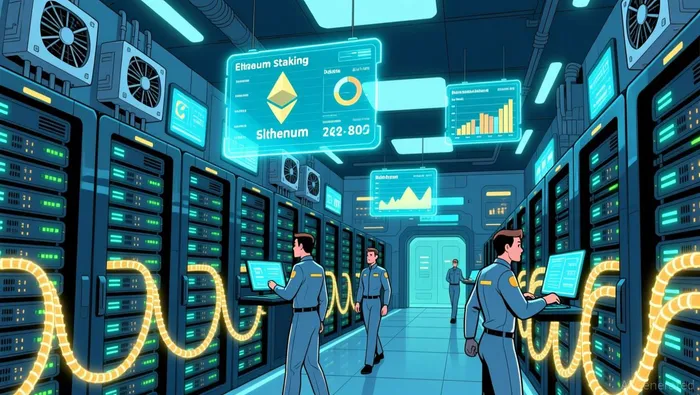
Bitmine is also entering the Ethereum staking arena with $6.8 billion in staked ETH, aiming to provide institutional-grade staking solutions. The company plans to develop on-chain vaults and post-quantum client capabilities through 2026. Its investors include notable stakeholders like ARK's Cathie Wood and MOZAYYX. By expanding its staking platform, Bitmine is positioning itself to meet the growing demand for secure and efficient ETH staking solutions in the institutional market.
What is driving the shift toward Ethereum staking and AI infrastructure in 2026?
The shift toward Ethereum staking and AI infrastructure is being driven by several factors, including the potential for on-chain yield generation and the availability of long-term, contracted cash flows from data center operations. Companies like Bit Digital and Bitmine are repositioning themselves to take advantage of Ethereum's staking economics while also building out physical infrastructure that can support high-performance computing and AI operations.
The move toward Ethereum staking aligns with broader trends in the digital asset market, where institutional investors are increasingly seeking exposure to protocols that offer both yield and liquidity. Additionally, the regulatory alignment and banking guidance supporting stablecoins like USDCUSDC-- are contributing to a broader shift in how digital assets are being used for real-world transactions.
What are the risks and limitations of this strategy?
While Ethereum staking and AI infrastructure expansion offer attractive growth opportunities, they also come with significant risks and limitations. For example, Bit Digital's strategy of concentrating its digital asset holdings in Ethereum makes the company highly sensitive to ETH price volatility and staking economics. A decline in ETH prices or changes in staking yields could significantly impact its financial performance.
Similarly, the success of WhiteFiber's data center expansion is contingent on meeting construction and power milestones, securing customer payments, and navigating the evolving regulatory landscape for digital assets. If these factors do not align, the expected $865 million in contracted revenue may not materialize as anticipated.
Bitmine's staking platform also faces risks related to the security and scalability of its solutions. Institutional-grade staking requires robust infrastructure, and any security breaches or performance issues could erode trust and deter institutional adoption.
How is the broader market reacting to these developments?
The broader market is showing a positive reaction to these developments, particularly around Ethereum staking and AI infrastructure. The fact that USDC has surpassed USDT in transaction volume indicates a growing preference for stablecoins with regulatory alignment and institutional support.
Investor sentiment is also being shaped by the increasing number of firms repositioning themselves around Ethereum staking and AI infrastructure. As more companies announce strategic shifts and growth initiatives, the narrative around Rain is evolving to reflect these trends. This has led to increased interest from both retail and institutional investors who are looking to capitalize on the long-term potential of these strategies.
However, the market is also aware of the risks associated with these strategies, particularly the concentration of exposure in a single protocol (ETH) and the dependency on long-term contractual commitments for data center operations. As a result, investors are closely monitoring the execution of these strategies and the broader market dynamics that could impact their success.

Blending traditional trading wisdom with cutting-edge cryptocurrency insights.
Latest Articles
Stay ahead of the market.
Get curated U.S. market news, insights and key dates delivered to your inbox.
AInvest
PRO
AInvest
PRO



Comments
No comments yet