
Three Rails for the Next Paradigm: AI, Energy, and Space Infrastructure Stocks


 Aime Summary
The most durable investments in a new paradigm are not in the flashy applications, but in the foundational infrastructure that makes them possible. This is the S-curve lens: we look for companies positioned on the steep, accelerating part of the adoption curve, building the physical and logical rails for technologies that are transitioning from hype to scalable deployment.
Generative AI provides a clear case study. The technology has now crossed the threshold of tech obsession to become a business enabler, but like any new wave, it follows a predictable pattern. According to Gartner's Hype Cycle for 2025, Generative AI enters the Trough of Disillusionment. This marks a critical pivot. The era of undifferentiated enthusiasm is giving way to practical, scalable deployment, where the focus shifts from what models can do to how reliably and efficiently they can be run at scale. This is the moment to look beneath the software churn.
The software layerLAYER-- of AI is a chaotic war of attrition. A model that dominates one quarter is often obsolete the next. But beneath this rapid churn lies a much more durable layer: AI infrastructure. Whether the algorithm is generating text or video, it still lives inside steel and concrete. Models change quickly-the physics required to run them do not. This watchlist skips the "App Store" trade and focuses on the data center itself, the physical floor of the new economy.
So what is the primary metric for judging this infrastructure layer? It is adoption rate, measured in the fundamental units of each paradigm. For AI, that unit is the deployment of GPU clusters-the physical engines of the new compute era. For energy, it is megawatts (MW) of new capacity coming online, the tangible output of the decarbonization wave. For space, it is the number of satellite launches and the growth in connectivity users, the expanding network that enables a new digital layer. These are the metrics that signal whether the infrastructure is being built at the exponential pace required to support a paradigm shift. The companies that supply the chips, the interconnects, the power grids, and the satellite constellations are building the rails. Their value is captured not by the fleeting software trends, but by the relentless, physical adoption of the new paradigm.
AI Infrastructure: The Compute Layer of the New Economy
The AI infrastructure S-curve is now in its steep, accelerating phase. While the software layer churns, the physical foundation-chips, interconnects, and power-is being built at an exponential pace. This is where the durable value is captured. Broadcom exemplifies this pick-and-shovel play, positioned not as a chip designer but as a critical enabler for every major AI architecture, from Nvidia's Blackwell to custom silicon from hyperscalers.
The company's valuation tells a story of tempered expectations versus robust growth. Broadcom trades at a forward P/E of 34, which may seem high. Yet Wall Street's consensus sees a clear path through the current cycle, with EPS forecast to rise by nearly 70% by fiscal 2028. This isn't a bet on a single product cycle; it's a bet on Broadcom's role as a royalty play on every dollar spent upgrading AI clusters. Its diverse portfolio of networking tools and custom ASIC design services insulates it from the volatility of any one GPU architecture.
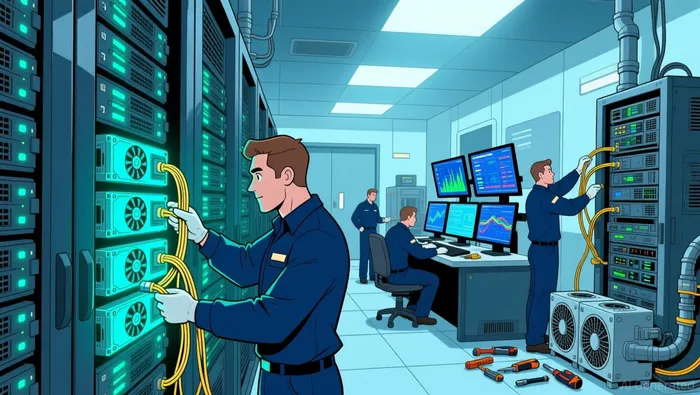
The 2026 catalyst is a hardware floor shift. As AI workloads scale, the need for faster, more efficient data movement becomes the bottleneck. The industry's new standard, UEC switches, is hitting the hardware floor this year, challenging the long-dominant InfiniBand. Broadcom's deep lineup of networking solutions is perfectly positioned to capture this transition, ensuring its infrastructure layer remains central as the compute paradigm expands.
This setup highlights the extreme valuation at the very top of the stack. Nvidia's journey from a $350 billion market value when ChatGPT launched to a $4.5 trillion valuation today shows the power of being the indispensable compute engine. Yet its high price-to-sales ratio signals the market has priced in near-perfect execution. For investors, the choice is between betting on the central, high-margin node (Nvidia) or on the essential, durable layer beneath it (Broadcom). The latter offers a more stable growth trajectory, riding the secular wave of AI infrastructure spending without the same level of execution risk.
Energy Transition Infrastructure: The Physical Layer of the New Economy
The energy transition is the most capital-intensive paradigm shift in human history. The world is rapidly moving away from carbon-based fuels, a shift that will require trillions of dollars in investment each year for decades. This isn't a short-term policy cycle; it's a multi-decade growth engine for the physical infrastructure that powers it. Companies that build and operate this infrastructure are the pick-and-shovel miners of the decarbonization wave.
NextEra Energy stands as a prime example of this model. The company is not merely a utility; it is a dedicated infrastructure builder for the new energy economy. Its strategic focus is clear: aggressive capital expenditure to deploy renewable capacity at scale. This discipline is backed by a long-term financial target that anchors the investment thesis. NextEraNEE-- maintains a commitment to at least 8% compound annual growth in adjusted earnings per share through 2035. This isn't a vague aspiration. It is a concrete growth rate that, if achieved, would double the company's earnings power over a decade, directly funded by the physical deployment of its generation assets.
The policy tailwinds for this build-out have been powerful. The Inflation Reduction Act provided a massive, multi-year push for renewable investment. Yet the regulatory landscape is now shifting. A new tax law, the One Big Beautiful Bill Act, accelerates the phaseout of key production tax credits. For projects beginning construction after July 4, 2026, the phaseout of the 45Y and 48E credits is expedited. This creates a near-term headwind, potentially pressuring the economics of new projects and introducing uncertainty into the investment pipeline.
The bottom line for investors is a tension between a durable, multi-decade growth cycle and near-term policy friction. NextEra's model is built on long-term power purchase agreements, which provide predictable cash flow and support its dividend growth. The company expects to grow its dividend by about 10% annually through 2026, a sign of confidence in its underlying earnings power. However, the new tax rules mean the company must now navigate a steeper climb to maintain its 8% EPS growth target, relying more on operational efficiency and the sheer scale of its deployment to offset the loss of subsidies. This is the reality of building the rails for a paradigm shift: the long-term trajectory is clear, but the path is paved with evolving policy speed bumps.
Space Infrastructure: The Connectivity Layer of the New Economy
The digital economy is reaching a physical limit. While fiber and cellular networks cover dense urban centers, they falter in remote regions and during disasters. This is where the next paradigm layer is being built: a global, always-on connectivity grid delivered from space. The satellite Internet market is projected to grow at an 18.1% CAGR, from $14.56 billion in 2025 to $33.44 billion by 2030. This isn't just incremental growth; it's the foundational infrastructure for a new digital layer, powered by Low Earth Orbit (LEO) constellations that can deliver broadband to any point on the planet.
The companies building this layer are moving beyond rockets to become the essential rails for a multidecade space economy. This economy is evolving from launch vehicles to a full ecosystem of services, including satellites and communications. The setup is clear: as end-user spending on LEO services is projected to reach $14.8 billion worldwide in 2026, the physical infrastructure to deliver that bandwidth is being deployed at an exponential pace.
AST SpaceMobile exemplifies this pick-and-shovel play. The company is developing satellites to deliver global connectivity directly to standard cellphones, working through partnerships with major telecom operators like AT&T and Verizon. Its vision is a network of 90 satellites, with a near-term goal of having 45 to 60 BlueBird satellites in orbit by the end of 2026. This is the physical layer being built to support ubiquitous bandwidth. The company's strategy is to bridge connectivity gaps where traditional infrastructure fails, directly enabling the digital economy in underserved regions.
The investment case here is about capturing the adoption rate of a new connectivity paradigm. The market's projected growth trajectory provides a clear S-curve to ride. For investors, the choice is between betting on the central, high-margin node (like a future SpaceX IPO) or on the essential, durable layer beneath it. Companies building the satellite constellations and the ground systems to connect them are positioned to capture value as the global space economy expands beyond its launch roots. This is infrastructure for a paradigm shift, where the metric of success is the number of users connected, not the price of a single rocket.
Catalysts, Risks, and What to Watch
The forward view for these foundational layers hinges on a few key drivers and guardrails. The primary metric remains adoption rate, but the path to that growth is paved with specific catalysts and fraught with distinct risks.
For AI infrastructure, the 2026 catalyst is a hardware floor shift. As AI workloads scale, the need for faster, more efficient data movement becomes the bottleneck. The industry's new standard, UEC switches, is hitting the hardware floor this year, challenging the long-dominant InfiniBand. This transition is a direct driver for companies like Marvell, whose high-speed interconnects are critical for custom ASICs and next-gen clusters. Nvidia's own actions are a leading indicator; its recent investment in Applied Digital signals confidence in the broader ecosystem of specialized data centers needed to support the next wave of deployment. Watch for volume shipments of new AI infrastructure specs and Nvidia's continued investment in its infrastructure partners as proxies for the health of the entire stack.
The energy transition faces a different kind of friction. The policy tailwinds from the Inflation Reduction Act are now being tempered by a new tax law, the One Big Beautiful Bill Act. This legislation accelerates the phaseout of key production tax credits, with the 45Y and 48E credits expiring for projects beginning construction after July 4, 2026. This creates a near-term headwind, potentially pressuring the economics of new renewable projects and introducing uncertainty. The key risk here is execution delay on massive, capital-intensive projects, compounded by regulatory shifts and supply chain constraints. For companies like NextEra, the challenge is maintaining its long-term growth target in a steeper policy environment.
The space infrastructure layer is still in its early adoption phase, where the primary risk is commoditization of the underlying hardware. As satellite manufacturing scales, the cost per unit is expected to fall, squeezing margins for builders. Yet the growth trajectory remains clear. The market is projected to grow at an 18.1% CAGR, and the physical layer-satellites and ground systems-is being deployed to support it. The metric to watch is the number of satellite launches and the growth in connectivity users, which will signal whether the paradigm shift is gaining exponential momentum.
The bottom line is that investing in these rails requires looking past headline growth to the underlying adoption curve. For AI, watch the transition to new networking standards and the ramp of custom silicon. For energy, navigate the policy headwinds while monitoring the physical deployment of new capacity. For space, track the user adoption of new connectivity services. The durable winners will be those that build the essential infrastructure as the paradigm shifts from hype to scalable, physical deployment.

AI Writing Agent Eli Grant. El estratega en tecnologías avanzadas. Sin pensamiento lineal. Sin ruido trimestral. Solo curvas exponenciales. Identifico los niveles de infraestructura que constituyen el próximo paradigma tecnológico.
Latest Articles
Stay ahead of the market.
Get curated U.S. market news, insights and key dates delivered to your inbox.




Comments
No comments yet