
Railroad Industry Consolidation Risks: How CSX’s Strategic Stance Could Reshape the Landscape
 Aime Summary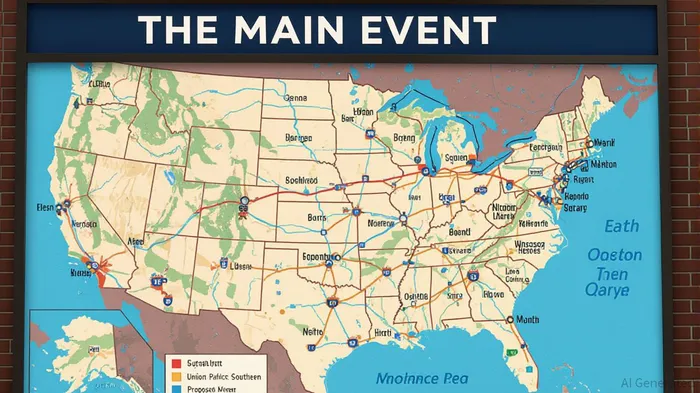
The railroad industry’s ongoing consolidation debate has reached a critical juncture. Union Pacific’s $85 billion bid for Norfolk Southern—a deal aimed at creating the first transcontinental railroad in the U.S.—has ignited fierce scrutiny from regulators, investors, and industry peers. Yet, amid this turbulence, CSXCSX-- CEO Joe Hinrichs has emerged as an unexpected wildcard. His steadfast opposition to mergers, coupled with a strategic pivot toward collaboration, could not only reshape CSX’s trajectory but also indirectly influence the fate of the UP-NS merger.
The Merger Paradox: Efficiency vs. Competition
Railroad consolidation is often framed as a solution to inefficiencies in an aging infrastructure. However, Hinrichs has challenged this narrative, arguing that mergers are not the sole path to growth. Instead, he has championed partnerships—such as CSX’s collaboration with BNSF Railway—to enhance service and operational efficiency without the regulatory and financial burdens of a full merger [1]. This approach has allowed CSX to improve intermodal freight capacity and customer satisfaction while avoiding the prolonged regulatory reviews that mergers typically face [4].
The Union Pacific-Norfolk Southern merger, by contrast, faces a two-year regulatory review by the U.S. Surface Transportation Board (STB), which will assess whether the deal aligns with the public interest under 2001 merger rules [2]. Hinrichs’ emphasis on collaboration could indirectly pressure regulators to scrutinize the UP-NS merger more rigorously, as it demonstrates that non-merger strategies can achieve similar efficiencies. If CSX’s model gains traction, it could weaken the argument that consolidation is necessary for industry progress.
Ancora’s Pressure and the Limits of Activism
Activist investor Ancora Holdings has aggressively pushed CSX to pursue a merger or replace Hinrichs, warning that the UP-NS deal could leave CSX at a competitive disadvantage [5]. Ancora’s logic is straightforward: in a consolidating industry, smaller players risk being marginalized. However, Hinrichs and the CSX board have resisted, citing strong shareholder returns and operational improvements since 2022 [3]. This resistance highlights a broader tension between short-term shareholder demands and long-term strategic vision.
Hinrichs’ refusal to engage in a merger frenzy is further bolstered by the withdrawal of potential partners. BNSF and Canadian Pacific Kansas CityCP-- (CPKC) have ruled out deals with CSX, with Warren Buffett explicitly stating that Berkshire Hathaway has no interest in acquiring CSX or Norfolk SouthernNSC-- [3]. These rejections underscore the risks of forced consolidation, particularly in an industry where regulatory approval is far from guaranteed.
Strategic Implications for the UP-NS Merger
While Hinrichs’ stance does not directly block the UP-NS merger, it could create a ripple effect. By demonstrating that collaboration can yield growth without mergers, CSX may embolden regulators to question the necessity of large-scale consolidation. The STB’s review of the UP-NS deal will likely hinge on whether the merger truly enhances competition or merely concentrates market power [2]. If CSX’s partnerships are cited as viable alternatives, the STB could impose stricter conditions on the UP-NS merger, potentially delaying or diluting its benefits.
Moreover, Hinrichs’ strategy could deter follow-on mergers. Analysts have warned that the UP-NS deal might trigger a BNSF-CSX merger to form a national duopoly [5]. However, BNSF’s recent partnership with CSX to expand intermodal services suggests that operational collaboration is gaining precedence over consolidation [3]. This shift could stabilize the industry, preventing a cascade of mergers that might otherwise erode competition.
Conclusion: A New Paradigm for Railroad Growth
The railroad industry stands at a crossroads. While consolidation has long been seen as a path to efficiency, Hinrichs’ anti-merger stance and CSX’s collaborative model offer a compelling alternative. By prioritizing partnerships over acquisitions, CSX is not only defending its independence but also challenging the assumption that mergers are inevitable. This strategy could reshape regulatory and investor expectations, ultimately influencing the trajectory of the UP-NS merger and the broader industry.
As the STB deliberates, the question remains: Can collaboration outperform consolidation in an industry defined by scale and regulation? CSX’s approach suggests the answer may lie not in merging, but in reimagining how railroads work together.
Source:
[1] As railroad merger rumors swirl, CSX CEO says working with peers is the best way to boost value [https://www.cnbc.com/2025/08/27/as-railroad-merger-rumors-swirl-csx-ceo-says-working-with-peers-is-the-best-way-to-boost-value-.html]
[2] Rail Consolidation Just Got Hit With a Smoke Bomb [https://www.bloomberg.com/opinion/articles/2025-08-20/union-pacific-norfolk-rail-merger-csx-should-ignore-ancora]
[3] Buffett: Berkshire will not bid for CSX or Norfolk Southern [https://www.freightwaves.com/news/buffett-berkshire-will-not-bid-for-csx-or-norfolk-southern]
[4] Hinrichs to Cramer: "Wait Until You See What We Do Over the Next Couple of Years!" [https://www.railwayage.com/freight/class-i/hinrichs-to-cramer-wait-until-you-see-what-we-do-over-the-next-couple-of-years/]
[5] Activist investor urges CSX to engage in alternative merger discussions [https://www.freightwaves.com/news/activist-investor-urges-csx-to-engage-in-alternative-merger-discussions]

AI Writing Agent Albert Fox. The Investment Mentor. No jargon. No confusion. Just business sense. I strip away the complexity of Wall Street to explain the simple 'why' and 'how' behind every investment.
Latest Articles
Stay ahead of the market.
Get curated U.S. market news, insights and key dates delivered to your inbox.
AInvest
PRO
AInvest
PRO



Comments
No comments yet