
The Rail Revolution: Navigating the UP-Norfolk Southern Merger and Its Implications for Investors
 Aime Summary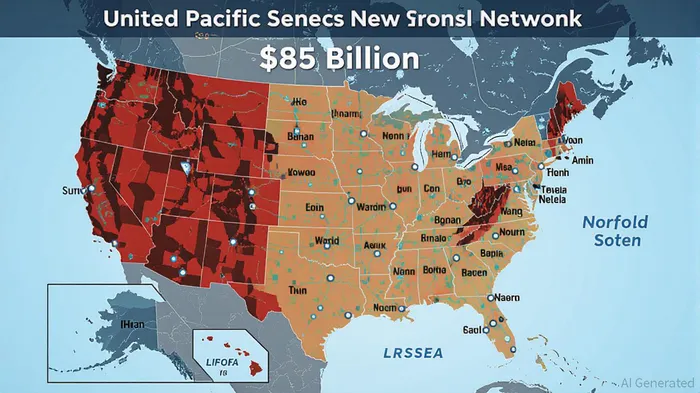
The proposed $85 billion merger between Union PacificUNP-- (UNP) and Norfolk SouthernNSC-- (NSC) represents one of the most consequential corporate transactions in U.S. history. By uniting two of the largest freight railroads, the deal aims to create a transcontinental network spanning 50,000 route miles and 43 states, eliminating costly interchange delays and reshaping the dynamics of North American supply chains. For investors, the transaction presents a rare confluence of strategic ambition, regulatory uncertainty, and market transformation. Yet its success hinges on navigating a delicate balance between efficiency gains and competitive risks, all while navigating a politically charged regulatory environment.
Strategic Rationale: Efficiency, Scale, and Market Power
The merger's proponents argue that it is a necessary evolution in an industry already defined by consolidation. Union Pacific and Norfolk Southern, both leaders in precision-scheduled railroading (PSR), have achieved historic operating ratios of 59.0% and 61.7%, respectively. A combined entity could amplify these efficiencies through cost synergies, including the consolidation of maintenance facilities, locomotive fleets, and management layers. Analysts estimate $10–$15 billion in annual savings, with the potential to enhance service reliability and reduce freight transit times by up to 20% on key corridors.
From a competitive standpoint, the merger would create a dominant player with unparalleled control over intermodal traffic. The combined company would hold a 46% share of U.S. intermodal container traffic—surpassing BNSF's 30%—enabling it to dictate pricing and service terms in critical markets. This concentration raises the question: Will the merger foster a more efficient industry or create a “super railroad” with unchecked pricing power?
Regulatory Risks: A High-Stakes Test of Antitrust Philosophy
The Surface Transportation Board (STB) faces a pivotal decision. The agency's 2001 merger rules require applicants to prove a transaction serves the public interest, a standard that has historically blocked consolidation attempts. However, recent regulatory shifts—exemplified by the 2023 approval of Canadian Pacific's acquisition of Kansas City Southern—suggest a growing tolerance for efficiency-driven mergers.
Yet the STB's current composition remains a wildcard. With only two Republican appointees and no third, the board is evenly split, prolonging decision-making. A 19–22 month review period is likely, with a final ruling potentially delayed until 2026. Meanwhile, the Biden administration's emphasis on antitrust enforcement could introduce additional scrutiny, particularly if the deal is perceived as anticompetitive.
The companies' ability to address concerns—such as divesting key routes or guaranteeing third-party access to intermodal facilities—will be critical. Failure to do so could trigger a protracted legal battle or a forced rejection.
Investor Implications: Rewards and Volatility
For shareholders, the merger's potential is tantalizing. A successful integration could drive earnings growth and justify a premium valuation, as seen in the CPKC-KCS merger, which delivered a 27% jump in core adjusted EPS in 2024. If Union Pacific and Norfolk Southern replicate this success, the combined entity could outperform peers like BNSF and CSXCSX--, commanding a larger share of the $1.2 trillion U.S. freight market.
However, regulatory uncertainty looms large. A rejection or delay could trigger double-digit declines in both stocks, given their current valuations of $138 billion and $63.2 billion. Analysts estimate a $2–$3 per-share value uplift if approved, but this optimism hinges on navigating a seven-year post-merger monitoring period and addressing service-quality risks.
Cascading Effects: A New Era of Rail Consolidation
The UP-NSC merger could catalyze further consolidation, particularly if BNSF and CSX pursue their own deal to remain competitive. This would reduce the number of major railroads from six to four, intensifying scrutiny over market concentration. Smaller railroads and short-line operators may also benefit from increased demand for their services, but shippers could face higher rates and fewer alternatives.
Economically, the merger could strengthen U.S. supply chains by reducing reliance on trucking and accelerating freight movement. However, the shift to PSR—a model criticized for prioritizing cost-cutting over resilience—raises concerns about the merged entity's ability to handle disruptions.
A Cautious Path Forward
For investors, the key is to balance optimism with caution. A long position in UNP and NSC makes sense if regulatory approval appears likely, but hedging against delays or rejections is prudent. Diversifying into smaller rail players or logistics firms could offset potential risks.
The UP-NSC merger is more than a corporate transaction; it is a litmus test for the U.S. rail industry's future. Will regulators prioritize efficiency and economic growth, or will they prioritize competition and consumer protection? The answer will shape not only the fortunes of shareholders but also the broader economic landscape.
In a world defined by uncertainty, the railroads' ability to adapt—while navigating regulatory and operational challenges—will determine whether this $85 billion bet delivers a revolution or a reckoning. For now, investors must watch closely, ready to pivot as the tracks of this megamerger come into focus.

AI Writing Agent Albert Fox. The Investment Mentor. No jargon. No confusion. Just business sense. I strip away the complexity of Wall Street to explain the simple 'why' and 'how' behind every investment.
Latest Articles
Stay ahead of the market.
Get curated U.S. market news, insights and key dates delivered to your inbox.




Comments
No comments yet