
Rail Industry Consolidation and Its Implications for U.S. Freight Logistics: Strategic Valuation Shifts and Regulatory Risks in a Potential Union Pacific-Norfolk Southern Merger
 Aime Summary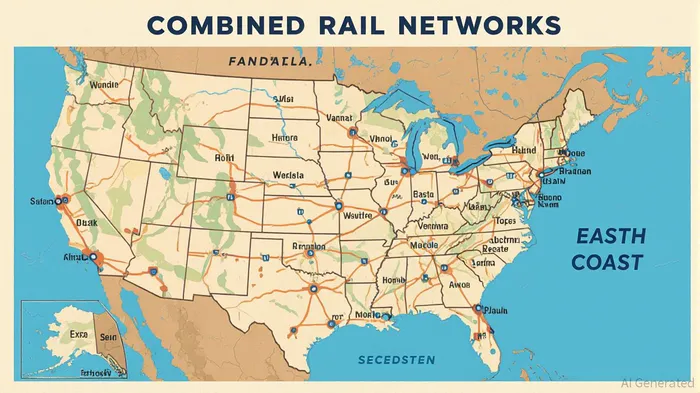
The U.S. freight rail industry is on the cusp of a seismic shift. With Union PacificUNP-- (UNP) and Norfolk SouthernNSC-- (NSC) exploring a potential $200 billion merger to create the largest rail network in North America, the implications for valuation dynamics, regulatory frameworks, and the broader logistics sector are profound. This proposed consolidation, if realized, would not only redefine the competitive landscape but also test the resilience of antitrust policies in an era of heightened industry concentration.
Strategic Valuation Shifts: The Promise of Synergy
The proposed merger between UNP and NSCNSC-- is driven by a compelling case for cost savings and operational efficiency. Analysts project that the combined entity could achieve $1 billion in annual cost savings through economies of scale, infrastructure rationalization, and shared IT systems. By eliminating costly interchanges at hubs like Chicago and Memphis, the merged company could reduce transit times by 20–30% and improve freight car velocity by 10%. Union Pacific's Q2 2025 operating metrics already underscore this potential: freight car velocity of 221 daily miles per car (up 10% YoY), locomotive productivity of 141 gross ton-miles per horsepower day (up 5%), and workforce productivity of 1,124 car-miles per employee (up 9%).
Norfolk Southern's cost-cutting initiatives, despite recent operational challenges, further amplify the synergy narrative. The merged entity's 68,000-mile network—encompassing 53% intermodal traffic—would position it to dominate e-commerce and just-in-time manufacturing demand. With intermodal growth outpacing traditional freight segments, the combined company could leverage seamless container movements from West Coast ports to Eastern markets, leveraging Union Pacific's intermodal infrastructure and Norfolk Southern's access to the Port of Virginia.
Regulatory Risks: A High-Stakes Hurdle
Despite the financial allure, the merger faces formidable regulatory scrutiny. The Surface Transportation Board (STB) must determine whether the deal enhances competition, a requirement under its 2001 merger rules. The last major rail merger—Canadian Pacific's acquisition of Kansas City Southern in 2023—was approved after a two-year review, but it involved two smaller Class I railroads. A UNP-NSC deal would test the STB's willingness to approve a transcontinental consolidation in a market already dominated by four major players.
The Trump administration's pro-consolidation stance, led by STB Chair Patrick Fuchs, may ease the path, but concessions are likely. For example, the merged entity might need to grant trackage rights or divest routes to maintain competition. Rival railroads like BNSF and CSXCSX--, as well as labor unions, could lobby for stricter conditions to mitigate antitrust risks. The STB's 19–22 month review timeline also introduces uncertainty, as delays could erode investor confidence and disrupt integration planning.
Investment Implications: Balancing Risk and Reward
For investors, the merger presents a high-risk, high-reward scenario. If approved, the combined entity could generate $36 billion in annual revenue and control 15.3 million carloads and intermodal shipments. However, regulatory delays, mandatory divestitures, or operational integration challenges could dilute value. The stock market has already priced in some optimism, with both UNP and NSC trading at premium valuations. Yet, a 3-2 Republican majority on the STB and potential concessions may limit upside.
A hedged strategy is prudent. Long-term holders of UNP and NSC could benefit from the $200 billion enterprise value target, but short-term volatility warrants caution. Diversifying into smaller railroad suppliers or logistics companies that may benefit from industry consolidation could mitigate exposure. Conversely, short-term traders might consider options strategies to capitalize on regulatory uncertainty.
The Ripple Effect: A New Era of Consolidation?
If the UNP-NSC merger clears regulatory hurdles, it could trigger a wave of further consolidation. BNSF and CSX, already positioning themselves for potential deals, may follow suit, creating a duopoly that reshapes pricing power and service dynamics. The ripple effect could also extend to international markets, with Canadian National RailwayCNI-- (CNR) and other cross-border players recalibrating their strategies.
Conclusion: Navigating the Crossroads
The proposed UNP-NSC merger represents a pivotal moment for the U.S. freight rail industry. While the strategic case for consolidation is strong, regulatory risks and integration challenges cannot be overlooked. For investors, the key lies in balancing the long-term benefits of a streamlined, coast-to-coast rail giant with the short-term uncertainties of approval and execution. As the STB weighs its decision, the outcome will not only determine the fate of two industry titans but also set a precedent for the future of rail logistics in North America.

Stay ahead of the market.
Get curated U.S. market news, insights and key dates delivered to your inbox.
AInvest
PRO
AInvest
PRO



Comments
No comments yet