
RadNet's Q3 2025: Contradictions Emerge on EBCD Reimbursement, AI-Driven Margins, and TechLive Rollout
 Aime Summary
Date of Call: November 10, 2025
Financials Results
- Revenue: Total company revenue increased 13.4% year-over-year
- Operating Margin: Adjusted EBITDA margin 16.2%, improved 26 basis points vs 16.0% in the prior year
Guidance:
- Increased 2025 revenue guidance: +$50M at the low end and +$30M at the high end.
- Increased 2025 adjusted EBITDA guidance by $5M at both the low and high ends.
- Increased 2025 capital expenditure guidance by $5M.
- Lowered 2025 cash interest expense guidance by $4M at both low and high ends.
- Digital Health revenue guidance increased by $5M to reflect iCAD; strong Q4 expected.
- CMS final 2026 rule implies an estimated $4M–$5M Medicare revenue uplift in 2026.
Business Commentary:
- Revenue and EBITDA Growth:
- RadNet's
total company revenueincreased13.4%andadjusted EBITDAincreased15.2%relative to the same period last year. The growth was driven by robust same-center procedural volume, particularly in advanced imaging, and improved reimbursement rates with commercial and capitated payers.
Advanced Imaging Expansion:
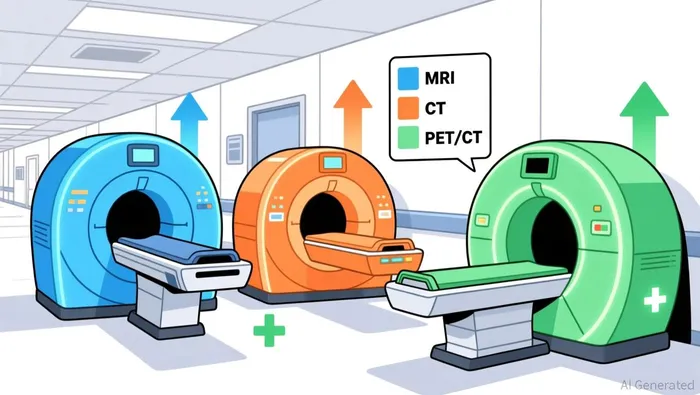
- Same-center advanced imaging, including MRI, CT, and PET/CT, increased by
11.5%,6.7%, and14.9%, respectively. - This expansion was due to equipment and software upgrades, dynamic scheduling, and the shift from expensive hospital imaging to ambulatory freestanding imaging.
- Digital Health Segment Growth:
- Digital Health revenue increased by
51.6%from last year's third quarter, partially due to iCAD's revenue contribution. Growth was also driven by the adoption of AI solutions and partnerships with medical groups for breast cancer screening programs.
Successful Acquisitions and Integration:
- RadNet acquired iCAD and Alpha RT, with iCAD's revenue contributing
$3.9 millionin Q3. - The acquisitions expanded RadNet's portfolio, enabling integration of advanced AI solutions and staffing services, and contributing to cost synergies ahead of plan.

Sentiment Analysis:
Overall Tone: Positive
- Management called Q3 a record quarter: “Revenue and adjusted EBITDA were both quarterly records”; total revenue +13.4% YOY and adjusted EBITDA +15.2% YOY; company raised full-year 2025 revenue and adjusted EBITDA guidance and highlighted strong cash ($804.7M) and ~1.0x net debt/adjusted EBITDA.
Q&A:
- Question from David MacDonald (Truist Securities, Inc.): Where is TechLive rollout across geographies and can you explain the dynamic scheduling approach?
Response: TechLive rollout is largely complete by year-end/early Q1 (MRIs substantially connected); in 83 centers it reduced exam-room closure hours ~42%; dynamic scheduling uses AI no-show prediction to overbook and infill slots and will expand to CT and PET/CT.
- Question from David MacDonald (Truist Securities, Inc.): Any updates on payer coverage for EBCD and are capitated contracts starting to reprice in your favor?
Response: Payer discussions are positive but slow; several large capitated groups now reimburse EBCD (covering ~700k members); patient self-pay adoption >45% (expected >50% early 2026); capitated contracts have been yielding increases and some converted to higher-fee-for-service arrangements.
- Question from Brian Tanquilut (Jefferies LLC): Status of joint-venture/partnership opportunities with health systems and physician groups?
Response: Inbound interest from health systems is robust; active discussions ongoing and management expects announcements in coming weeks or early Q1.
- Question from Brian Tanquilut (Jefferies LLC): Exposure to Medicaid/exchanges and views on labor/wage inflation for technologists and radiologists?
Response: Medicaid/exchange exposure is minimal (~2.5% Medicaid fee-for-service); labor remains a challenge but is stabilizing—company is investing in hiring, training, bounties and tech programs and will build wage increases into 2026 guidance while using TechLive/AI to mitigate labor needs.
- Question from John Ransom (Raymond James & Associates, Inc.): Could RadNet develop a virtual radiology capability leveraging iCAD/DeepHealth for reads beyond its centers?
Response: Yes — management views virtual radiology as inevitable and plans to develop capabilities to assist (not replace) radiologists, enabling automated triage/interpretation and improved speed/accuracy.
- Question from John Ransom (Raymond James & Associates, Inc.): Where is DeepHealth gaining market traction and which modules are resonating versus point solutions?
Response: DeepHealth is showing strong internal adoption via co-development/pilots; the platform approach (integrating modules vs many point solutions) is the selling point; several modules will be primetime and positioned for external adoption next year.
- Question from John Ransom (Raymond James & Associates, Inc.): What is happening with external growth on the core imaging M&A front given the large cash balance?
Response: Core imaging remains central; there is an active acquisition pipeline and de novo openings expected before year-end, and Digital Health may enable less capital-intensive expansion and broader reach going forward.
- Question from Andrew Mok (Barclays Bank PLC): Post-iCAD, do you have enough sales personnel to sell DeepHealth or is more hiring needed?
Response: iCAD brought a substantial salesforce enabling accelerated cross-selling; additional hires will be needed but there are alternative ways to scale the sales effort.
- Question from Andrew Mok (Barclays Bank PLC): Why didn't EBITDA margins expand more given strong advanced imaging volume?
Response: Some limits to incremental margin as capacity is created and filled; management expects more meaningful margin expansion over time driven by Digital Health/AI operating efficiencies rather than just capacity gains.
- Question from Yuan Zhi (B. Riley Securities, Inc.): Clarify Digital Health Q4 after iCAD (≈$5M/quarter) — will Digital Health be flat or down year-over-year in Q4?
Response: Digital Health guidance was increased by $5M to reflect iCAD; iCAD contributed ~$3.9M this quarter and Digital Health is expected to have a strong Q4, not be flat or down.
- Question from Yuan Zhi (B. Riley Securities, Inc.): Within PET/CT growth, how much is oncology (PSMA) vs amyloid/Alzheimer's and are you preparing for new tracers in 2026?
Response: PSMA comprises ~12% of PET/CT volume and amyloid brain ~8% (≈20% combined); both are driving strong growth and management expects additional tumor-specific tracers coming to market that will further grow PET/CT utilization.
- Question from James Sidoti (Sidoti & Company, LLC): You added one center in the quarter — are you at 406 centers now?
Response: RadNet is at 407 centers as of September 30, 2025 (includes acquisitions, de novos and consolidations).
- Question from James Sidoti (Sidoti & Company, LLC): Where do you expect the center count to be by the end of 2025?
Response: Expect to be higher by year-end given pipeline of acquisitions and de novo openings, but timing/close dates make a precise projection uncertain.
- Question from James Sidoti (Sidoti & Company, LLC): What was the overall same-center procedure volume change?
Response: Total same-center procedure volume increased approximately 4.9% year-over-year.
- Question from James Sidoti (Sidoti & Company, LLC): Details on the Alpha RT acquisition — price and consideration?
Response: Alpha RT was acquired for roughly $5M paid in registered stock; the platform provides remote technologists, an AI MRI-room safety system and a tech-aide training/certification program to complement TechLive.
Contradiction Point 1
Payer Adoption and Reimbursement for EBCD
It involves the adoption and reimbursement for EBCD, which is a crucial aspect of RadNet's revenue and market penetration strategy.
Are there updates on EBCD payer coverage and capitated contract progress? - David MacDonald (Truist Securities)
2025Q3: Commercial payer adoption of EBCD is positive but slow; larger capitated groups are adding EBCD as a covered benefit for compliance with screening guidelines. Regal Medical and Desert Oasis Healthcare provide reimbursement for EBCD, creating pressure for commercial insurance companies to follow. Education to employers is also ongoing. - Howard Berger(CEO)
Have you seen increased payer interest in expanding EBCD reimbursement coverage? - David MacDonald (Truist Securities)
2025Q2: The announcement of capitated group endorsement has prompted interest from other payers. The value proposition is recognized, and pressure is building on payers to adopt breast cancer screening tools. RadNet anticipates wider adoption in the future. - Howard Berger(CEO)
Contradiction Point 2
AI and Digital Health's Impact on Margins
It involves the expected impact of AI and digital health solutions on RadNet's margins, which is a key aspect of the company's strategic growth and financial outlook.
Why didn't advanced imaging volumes improve EBITDA margins? - Andrew Mok (Barclays Bank)
2025Q3: Margins benefited from capacity creation but will see further improvement from digital health tools. AI will drive margin enhancement in the future. Transition from capacity creation to AI-driven efficiency will continue. - Howard Berger(CEO)
Will the integration of TechLive, See-Mode, and other innovations drive expected capacity growth, and what is the impact on the current workforce? - David MacDonald (Truist Securities)
2025Q2: The margins have been and will be impacted by these capital and operating costs. We expect that improving margins will continue to accrue as iCAD's and DeepHealth's products provide revenue and margin improvements. - Howard Berger(CEO)
Contradiction Point 3
TechLive Rollout and Hiring Trends
It involves the timeline and effectiveness of the TechLive rollout, which directly impacts operational efficiency and staffing challenges, affecting business operations and financial performance.
What is the status of TechLive's rollout beyond New York, and can you elaborate on the dynamic scheduling process? - David MacDonald (Truist Securities)
2025Q3: TechLive rollout is nearly complete, with MRI connections mostly done and CT and PET/CT to follow shortly. In New York, exam closure hours reduced by 42% relative to last year, with substantial benefits to MRI scanning. Dynamic scheduling uses AI to predict patient no-shows, overbooking schedules, and filling exam slots effectively. - Mark Stolper(CFO)
How has the TechLive rollout progressed? - Grayson McAlister (Trust Securities)
2025Q1: TechLive has been well-received by technologists, with 265 centers implementing it. It improves procedure oversight and accelerates scanning. All centers should be on TechLive by year-end, aiding in reducing outside staffing. - Howard Berger(CEO)
Contradiction Point 4
AI and Digital Health Revenue Growth Expectations
It involves differing expectations for the growth trajectory of the Digital Health business, which is a strategic focus and significant revenue driver for the company.
What is the Digital Health revenue outlook for Q4? - Yuan Zhi (B. Riley Securities)
2025Q3: Digital Health revenue guidance includes iCAD's contribution, showing strong growth. - Mark Stolper(CFO)
Are there temporary efficiency negatives during system implementation, and could they occur despite being short-term? - Larry Solow (CJS Securities)
2024Q4: Without giving multiyear guidance because I don't think we're in a position to do that, I don't think that what you're saying is far-fetched at all. - Mark Stolper(CFO)
Contradiction Point 5
EBCD Payer Coverage and Reimbursement
It involves differing statements about the pace of commercial payer adoption and reimbursement for the Early Breast Cancer Detection (EBCD) service, impacting revenue projections and market positioning.
Are there any updates on payer coverage for EBCD and progress on capitated contracts? - David MacDonald (Truist Securities)
2025Q3: Commercial payer adoption of EBCD is positive but slow; larger capitated groups are adding EBCD as a covered benefit for compliance with screening guidelines. - Howard Berger(CEO)
What growth rates were considered in the guidance prior to the storm impact? And what observations do you have regarding market demand dynamics? - Brian Tanquilut (Jefferies)
2024Q4: We believe that it will be completely absorbed by the end of this year, probably even sooner. - Howard Berger(CEO)

Discover what executives don't want to reveal in conference calls
Latest Articles
Stay ahead of the market.
Get curated U.S. market news, insights and key dates delivered to your inbox.
AInvest
PRO
AInvest
PRO



Comments
No comments yet