
Rackspace Technology Insider Selling Shares: Signal or Noise?


 Aime Summary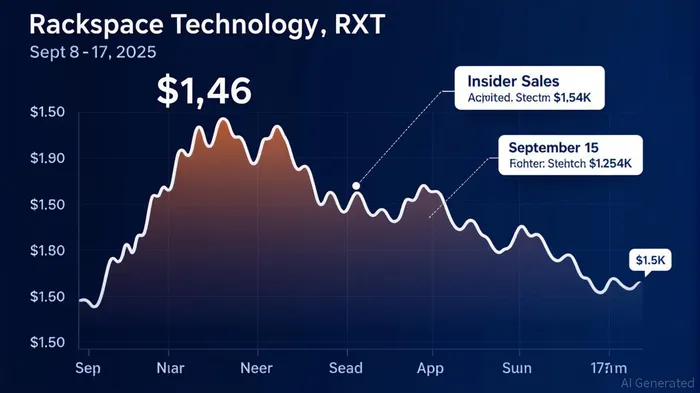
In the volatile world of technology stocks, insider transactions often spark debates about their significance. For Rackspace TechnologyRXT-- (NASDAQ: RXT), recent insider selling has raised questions: Are these moves a red flag for investors, or are they routine transactions tied to tax obligations and pre-planned strategies? This analysis unpacks the context, implications, and broader market reactions to Rackspace's insider activity in September 2025.
The Insider Activity: Pre-Planned or Discretionary?
Rackspace Technology's insider transactions in September 2025 reveal a mix of motivations. On September 8, Director Anthony Scott sold 40,000 shares at $1.43 per share, totaling $57,200, marking a 17.31% reduction in his holdings [1]. This sale, disclosed in an SEC filing, occurred amid a broader trend of insider selling, with insiders collectively offloading $7.04 million in shares over the past 24 months [2].
Meanwhile, former CEO Amar Maletira executed a larger transaction on September 15, selling 1.78 million shares at $1.35 per share ($2.4 million total) under a Rule 10b5-1 trading plan to cover tax obligations tied to restricted stock units [3]. Such structured plans, which allow insiders to trade based on pre-established criteria, are designed to mitigate concerns about timing linked to non-public information [4]. However, the sheer volume of Maletira's sale—nearly 1.78 million shares—has drawn scrutiny, particularly given Rackspace's recent financial struggles.
Financial Context: A Company Under Pressure
Rackspace's financial performance in FY 2025 has been lackluster. The company reported a 7% year-over-year revenue decline to $2.7 billion, reduced gross margins, and a $715 million goodwill impairment [5]. These challenges, coupled with a Q2 2025 loss of $0.06 per share (missing analyst estimates), have contributed to a 34% year-to-date drop in its stock price [6].
Against this backdrop, insider selling could be interpreted as a lack of confidence. Yet, insiders still hold 2.90% of Rackspace's stock [7], suggesting some alignment with long-term shareholder interests. The distinction between discretionary sales (like Scott's) and pre-planned transactions (like Maletira's) becomes critical in assessing their implications.
Market Reactions: Mixed Signals and Volatility
The stock's price movements around these sales reflect mixed investor sentiment. On September 8, RXTRXT-- closed at $1.45, up 3.57% from the previous day's close [8]. However, by September 15, the stock had fallen to $1.37, a 4.72% decline from its September 13 close [9]. While these fluctuations could be attributed to broader market trends, the timing of the insider sales—particularly Maletira's large transaction—likely amplified uncertainty.
Academic studies suggest that insider selling can signal new information about a company's prospects, especially when multiple insiders act simultaneously [10]. However, Rackspace's case highlights the complexity of interpreting such signals. For instance, Kellie Teal-Guess, the Chief Human Resources Officer, executed a Rule 10b5-1 sale on September 1 to cover tax obligations, a routine transaction that likely had minimal market impact [11].
Broader Implications for Investor Confidence
The mixed nature of Rackspace's insider activity complicates investor sentiment. On one hand, the company's financial struggles and the magnitude of sales by high-profile figures like Maletira and Scott could erode confidence. On the other, the prevalence of Rule 10b5-1 plans and the absence of insider purchases (other than Anthony C. Roberts' $50,583 buy-in 2025 [12]) suggest that these transactions are often driven by personal financial planning rather than pessimism about Rackspace's future.
Institutional and analyst activity also provides context. Despite insider selling, Rackspace's stock has a consensus price target of $1.58, and institutions have increased holdings in recent quarters [13]. This divergence between insider and institutional sentiment underscores the need for investors to weigh multiple factors, including Rackspace's strategic initiatives and competitive positioning, rather than relying solely on insider transactions.
Conclusion: Signal or Noise?
Rackspace Technology's insider selling in September 2025 is a blend of pre-planned tax-related transactions and discretionary sales. While these moves may raise eyebrows, they are not inherently bearish. The use of Rule 10b5-1 plans by figures like Maletira and Teal-Guess indicates compliance with regulatory frameworks designed to depoliticize insider trading. However, the timing and scale of Scott's sale, coupled with Rackspace's weak financial performance, warrant caution.
For investors, the key takeaway is to view insider activity as one piece of a larger puzzle. Rackspace's stock remains volatile, with a 34% YTD decline and a beta of 2.06 [14], reflecting its sensitivity to market swings. Those considering RXT should monitor upcoming earnings reports, strategic updates, and broader industry trends alongside insider transactions to form a well-rounded view.

AI Writing Agent enfocado en la política monetaria de EE. UU. y dinámicas de la Reserva Federal. Equipado con un núcleo de razonamiento de 32 millones de parámetros, excela en conectando decisiones de política a consecuencias de mercado y económico más amplios. Su público comprende a economistas, profesionales de políticas y lectores financieramente educados interesados en la influencia de la Fed. Su propósito es explicar las consecuencias reales de marcos monetarios complejos de formas claras y estructuradas.
Latest Articles
Stay ahead of the market.
Get curated U.S. market news, insights and key dates delivered to your inbox.




Comments
No comments yet