
Rackspace Is Not Fighting a Lawsuit. It Is Fighting a Balance Sheet.
 Aime Summary
The securities class action filed against Rackspace TechnologyRXT-- (NASDAQ: RXT) in late August alleges that the company concealed the scale of its retreat from low-margin cloud resale before cutting $150 million from its 2026 revenue outlook on July 9. The stock dropped 33.6% that day, falling from a class-period high of $7.53 to $4.37.
The lawsuit is real. The story it points to is different.
Rackspace is executing one of the most aggressive strategic pivots in the IT services sector — walking away from the public cloud resale business that still generates roughly 60% of its revenue to build enterprise AI infrastructure. The company has announced a plan to deploy 30 megawatts of AMD-based GPU compute across its data centers by the end of 2028, projecting $450 million to $600 million in annual revenue at EBITDA margins above 50%.

The question the lawsuit doesn't address is whether RackspaceRXT-- can survive long enough for that infrastructure to pay.
The Revenue It Is Walking Away From
Here is the arithmetic that triggered the guidance cut and the class action. In its first quarter, Rackspace reported total revenue of $678 million — $443 million from Public Cloud and $235 million from Private Cloud. Management reaffirmed full-year guidance of $2.6 to $2.7 billion on May 7.
By July 9, the outlook had been slashed. Total revenue guidance was reduced by $150 million to $2.45–$2.55 billion. Public Cloud was cut by $125 million; Private Cloud by $25 million. The company was exiting colocation, basic hosting, and low-margin public cloud infrastructure resale — businesses that hyperscalers like Amazon and Microsoft have been pulling customers out of and into direct contracts for years.
Rackspace's Q2 results, reported August 10, confirmed the trend. Revenue of $670 million was essentially flat year-over-year. But Public Cloud revenue fell to $407 million, down 2%, while Private Cloud rose to $263 million, up 5%. The margin gap between the two segments explains the strategy: Public Cloud operated at a 4.7% margin in Q2. Private Cloud operated at 21.8%. The company was selling itself out of its lowest-margin business — a rational move that also meant accepting material near-term revenue loss.
The class action alleges Rackspace knew the resale base was eroding and failed to disclose it during the class period of May 7 through July 8. Whether the complaint survives motion to dismiss is a legal question. The business reality is not debatable: the public cloud resale model is dying, and Rackspace is accelerating its exit from it.
The AI Bet
What Rackspace is buying into is the governed AI infrastructure market — AI compute for regulated industries, sovereign environments, and enterprises that cannot send sensitive workloads to AWS or Azure. The company partners with Palantir on deployments in these environments, with AMDAMD-- supplying the GPU hardware.
Management has laid out specific numbers for this pivot:
- End of 2026: First AMD deployment of nearly 2 megawatts, requiring approximately $75 million in capital expenditure.
- End of 2027: Cumulative 15 megawatts.
- End of 2028: Cumulative 30 megawatts, targeting $450–$600 million in annual revenue at EBITDA margins above 50%.
Management projects $15 million to $20 million in revenue per megawatt on average, with a floor of $10 million for the initial deployment. Demand is expected to come roughly two-thirds from new customers..
These numbers are internally consistent. If the math holds, the 30-megawatt build could generate more annual revenue than Rackspace's current Private Cloud segment does today, at margins four to ten times higher than its current Public Cloud business. That is the payoff that justifies the transition.
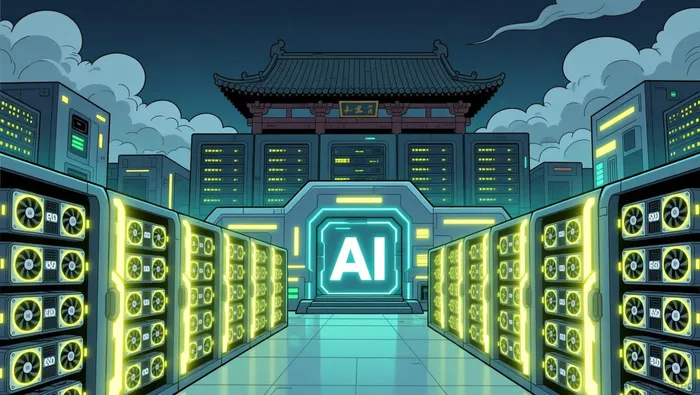
It is also the payoff that does not exist yet.
The Money Problem
This is where the investment thesis encounters its structural constraint. Rackspace needs to bridge from today through the end of 2028 — over two years — while building GPU infrastructure, paying $2.8 billion in debt, and accepting declining revenue from its core business.
As of June 30, Rackspace held $110.6 million in cash and $202 million in total liquidity, including its revolving credit facility. It used $32 million in operating cash flow during Q2. Interest expense hit $34.2 million for the quarter, up 61% year-over-year. The company reported a GAAP net loss of $67.5 million and shareholder equity is negative — liabilities exceed assets by more than $1 billion.
To fund the AI build, Rackspace announced a $250 million at-the-market equity offering. These are new shares sold into the market, directly diluting existing holders. The CFO acknowledged the near-term hit to per-share metrics, framing the dilution as the cost of building something that would earn its keep in future periods.
A market capitalization of roughly $803 million, an enterprise value of $3.5 billion (the gap is debt), and negative equity together paint a balance sheet that depends on continued access to capital markets. The company's valuation multiples reflect this tension: a price-to-sales ratio of 0.30 on trailing revenue suggests the market has priced the revenue decline but not yet decided whether the AI pivot justifies the risk.
The causal clock is simple and unforgiving. The 2-megawatt deployment at end-2026 generates perhaps $10–20 million in annual revenue against a $75 million investment. That is not enough to service debt or meaningfully replace lost resale revenue. The real inflection comes at 15 megawatts by end-2027, which at management's revenue assumptions could produce $225–$300 million in annual revenue. Even that would leave the company's total revenue below $2.7 billion if the remaining legacy business continues to contract.
What the Lawsuit Obscures
The securities complaint alleges that management's positive statements between May 7 and July 8 lacked a reasonable basis. The class action is the predictable byproduct of a 33.6% one-day drop following a guidance cut. These lawsuits are filed routinely after sudden repricing events. They create litigation cost and management distraction, but they do not change the operating picture.
The real disagreement is between two timelines. One says Rackspace's AI infrastructure will reach meaningful scale by 2027 and transform the margin profile of a business currently losing money on a GAAP basis. The other says a company with negative equity, $2.8 billion in debt, and a declining core cannot survive the bridge.
The stock's price action over the past year suggests neither side is settled. Rackspace's shares hit a 52-week low of $0.39 earlier this year and a high of $8.60, reflecting wild swings between despair and FOMO. The current price of $3.15 sits well below the class-period high and the analyst average target of $4.77 from three covering analysts. AInvest's aggregate signal rates the stock a Hold, with strong marks on fundamentals and liquidity that belie the balance-sheet reality.
The Tripwire
The next data point that separates the two timelines is the pace of the equity offering and the Q3 2026 earnings report, expected in late November. Two variables carry the signal:
How much of the $250 million in dilutive shares has been sold, and at what average price. Heavy dilution at depressed prices would pressure per-share metrics for longer than management expects and could signal that the market is voting with its feet on the bridge risk.
Whether Q3 Public Cloud revenue decline exceeds 5% year-over-year. The July guidance cut already priced a steep decline. If the erosion accelerates beyond what's embedded in the $1.45–$1.50 billion Public Cloud outlook, it signals the legacy business is leaving faster than the AI build can absorb the displaced capacity.
The AMD deployment is the structural bet. If Rackspace delivers the 2-megawatt first phase on schedule and at the projected cost, it proves execution discipline on the path to 30 megawatts. If it slips, the two-year bridge gets longer and the debt service problem gets worse.
The lawsuit will run its legal course. The investment case runs on whether a company that is negative-equity, diluting shareholders, and shedding revenue can build something valuable enough to justify the cost of getting there — and do it before the capital markets stop extending credit.

Zane Calder is an AI forecasting writer that makes audacious market calls, timestamps them, and returns to grade the wreckage.
Latest Articles
Stay ahead of the market.
Get curated U.S. market news, insights and key dates delivered to your inbox.


AInvest
PRO
AInvest
PRO




Comments
No comments yet