
Racing Against the Clock: Capitalizing on the Renewable Energy Tax Credit Cliff
The U.S. renewable energy sector is entering a critical period as federal tax credits face accelerated phase-outs under Senate proposals. Investors seeking to capitalize on this policy-driven crunch should focus on developers with shovel-ready projects and equipment suppliers poised to benefit from a 2025-2026 construction surge. The Senate's phased reduction of solar and wind tax credits creates a stark “now or never” dynamic for projects aiming to secure full federal incentives before they vanish.
The Phase-Out Timeline: A Race to 2025
The Senate's draft reconciliation bill imposes a steep slope for clean energy tax credits (ITC/PTC), compressing eligibility timelines for solar and wind projects:
- 2025: Full 100% tax credit available for projects beginning construction.
- 2026: Credits drop to 60%.
- 2027: Reduced to 20%.
- 2028: Credits eliminated entirely for new projects.
This contrasts sharply with the previous Inflation Reduction Act (IRA) framework, which allowed phased reductions through 2035. The urgency is underscored by a 2028 “placed-in-service” deadline for projects to qualify under the House's stricter rules, though the Senate's “begun construction” test offers some flexibility.
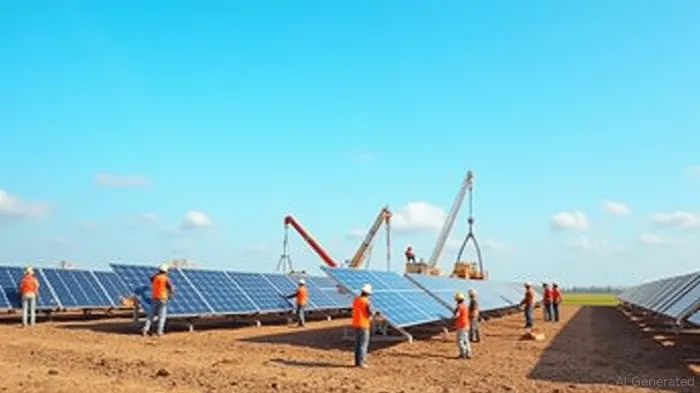
Project Economics: The Cost of Delaying Construction
The compressed timeline creates a stark financial divide between projects starting in 2025 versus later years. Consider a hypothetical $100 million solar project:
- 2025 Start: Full 30% ITC saves $30 million in upfront costs.
- 2026 Start: 60% of the credit reduces savings to $18 million, a 40% erosion in value.
- 2027 Start: Only $6 million saved—90% less than the full credit.
For developers, this math incentivizes a sprint to secure construction starts by year-end y 2025. Projects delayed beyond this window face sharply diminished returns, creating a “winner-takes-most” scenario for those that act quickly.
Strategic Investment Opportunities
1. Renewable Energy Developers with Advanced Pipelines
Focus on firms with permits, land secured, and financing lined up for projects that can break ground within months. Key names include:
NextEra Energy (NEE): The largest U.S. renewable developer with over 20 GW of solar and wind projects in development. Its 2025 target to start construction on 4.5 GW of solar and wind projects positions it to maximize ITC benefits.
Invenergy: A developer with 1 GW of solar projects and 1.5 GW of wind capacity in the PJM Interconnection's Reliability Resource Initiative (RRI), which aims to add 9,300 MW of capacity by 2031.
Pattern Energy (PEGI): Specializes in large-scale wind and solar projects. Its 300 MW Cottonwood Solar project in Arizona is shovel-ready and eligible for full credits if started by year-end.
2. Equipment Suppliers Benefiting from the Construction Surge
Suppliers with domestic manufacturing capacity to meet the rush will see demand spike. Key plays include:
First Solar (FSLR): A leader in utility-scale solar panels, with a U.S. manufacturing hub in Ohio. Its Series 6 panels are designed for rapid deployment, and its stock has surged 40% YTD amid project acceleration.
Vestas (VWS): A Danish wind turbine manufacturer with U.S. factories in Colorado and Colorado. Its 2025 goal to supply turbines for 5 GW of U.S. projects aligns with the Senate's construction deadlines.
Tesla (TSLA): Leverages its Powerpack and Megapack energy storage systems to serve collocated solar/wind projects, which retain full credits even after 2028 under Senate rules.
Risks and Considerations
- Foreign Ownership Restrictions (FEOC): Projects must avoid material assistance from China, Russia, Iran, or North Korea. Developers relying on foreign components (e.g., wind turbine blades) may face compliance hurdles.
- State-Level Support: States like Texas, Florida, and Indiana—leading in clean energy installations—are expanding tax incentives and revolving loan funds to offset federal cuts.
Quantifying the Opportunity
The Senate's rules create a $14 billion opportunity (per Q1 2025 cancellations data) for investors to back projects that can secure full credits. Developers with 2025-ready pipelines could see valuations rise 15-25% as they lock in tax benefits, while laggards face stranded assets.
Conclusion: Act Now, or Pay Later
The Senate's tax credit cliff is a once-in-a-decade catalyst for investment in renewable energy. Investors should prioritize developers with advanced-stage projects and suppliers with domestic capacity to meet the 2025 construction window. With credit erosion set to begin in 2026, the clock is ticking—act swiftly to capitalize on this policy-driven boom.
The next 12 months will separate winners from losers. Invest in the shovel-ready.

Stay ahead of the market.
Get curated U.S. market news, insights and key dates delivered to your inbox.
AInvest
PRO
AInvest
PRO



Comments
No comments yet