
R3's Solana-Based RWA Bridge: A Strategic On-Ramp for Institutional Capital into DeFi


 Aime Summary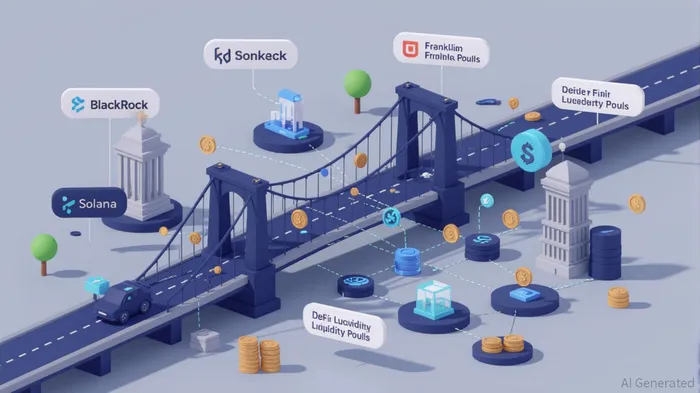
The convergence of traditional finance (TradFi) and decentralized finance (DeFi) has long been a theoretical promise rather than a practical reality. But with R3 Labs’ Solana-based RWA Bridge, this promise is becoming a tangible infrastructure play. By tokenizing real-world assets (RWAs) and bridging Solana’s high-performance blockchain with R3’s Corda platform, the project is unlocking a $10+ billion liquidity pipeline for DeFi—a development that could redefine institutional participation in decentralized markets.
The Liquidity Gap: Why TradFi Needs DeFi, and Vice Versa
Institutional capital has historically been hesitant to enter DeFi due to regulatory friction, lack of interoperability, and the absence of a clear on-ramp for real-world assets. Meanwhile, DeFi markets—despite their innovation—remain starved of the deep liquidity that TradFi institutions can provide. R3’s RWA Bridge addresses this gap by enabling financial institutions to tokenize assets like equities, bonds, and money market funds on SolanaSOL-- while maintaining compliance with regulatory frameworks.
According to a report by the State of Solana: Real-World Assets (Q2 2025), R3 has already tokenized $17 billion in RWAs on-chain, leveraging Solana’s speed and low-cost infrastructure to facilitate cross-chain validation between Corda and Solana [1]. This is not just a technical feat—it’s a strategic alignment of R3’s enterprise-grade blockchain expertise with Solana’s public chain scalability. By eliminating the need for Corda’s internal notary architecture, the bridge ensures sensitive data remains private while enabling atomic settlements on Solana, such as delivery-versus-payment transactions using USDCUSDC-- [2].
Technical Mechanics: How the Bridge Works
The R3 Solana RWA Bridge operates by encoding real-world financial instruments into programmable tokens via Solana’s smart contract ecosystem. These tokens represent ownership rights, fractionalized stakes, or yield-bearing instruments, all of which can be traded on DeFi platforms. For example, BlackRock’s BUIDL fund—a tokenized U.S. dollar money market fund—now offers 24/7 settlement capabilities on Solana, while Franklin Templeton’s BENJI token provides retail investors access to SEC-registered mutual funds on a public blockchain [1].
Solana’s Proof of History (PoH) consensus mechanism, capable of processing over 65,000 transactions per second, is critical to handling the volume and complexity of institutional-grade assets [2]. Additionally, Solana’s Token Extensions and Permissioned Environments (SPEs) allow for compliance at the protocol level, addressing institutional concerns around KYC/AML requirements. This infrastructure has attracted major players: as of H1 2025, Solana hosts over $5 billion in tokenized RWAs, with projects like Ondo Finance and BlackRock’s BUIDL Fund demonstrating strong market adoption [3].
Institutional Adoption: A Tipping Point for DeFi
The bridge’s success hinges on its ability to attract institutional capital—a metric it has already exceeded. Data from the Solana Ecosystem Report (H1 2025) indicates that R3’s integration with Solana has spurred tokenization of over $10 billion in assets from Corda, with plans to expand further [3]. This aligns with Solana’s broader institutional momentum: money market funds from BlackRockBLK--, Franklin Templeton, and VanEck have launched tokenized versions on the platform, signaling a shift in how traditional assets are managed and traded [4].
The implications are profound. By enabling institutions to access DeFi liquidity pools—such as lending protocols or automated market makers—R3’s bridge transforms RWAs into programmable, composable assets. For instance, a tokenized corporate bond on Solana could simultaneously serve as collateral in a DeFi lending pool and be traded on a decentralized exchange, generating yield for both institutional and retail participants.
Risks and Considerations
While the potential is vast, challenges remain. Regulatory scrutiny of tokenized assets is intensifying, and interoperability between private and public blockchains requires robust governance. Additionally, Solana’s high throughput must be matched by equivalent security measures to protect institutional-grade assets. However, R3’s track record in enterprise blockchain and Solana’s growing institutional partnerships suggest these hurdles are surmountable.
Conclusion: A New Era for Capital Markets
R3’s Solana-based RWA Bridge is more than a technological innovation—it’s a paradigm shift. By bridging the liquidity divide between TradFi and DeFi, it empowers institutions to participate in decentralized markets while preserving regulatory compliance. As Solana’s ecosystem continues to attract $1 trillion+ in on-chain assets, the bridge positions itself as a critical infrastructure layer for the future of finance. For investors, this represents a high-conviction opportunity: the convergence of institutional capital and decentralized innovation is no longer speculative—it’s happening now.
Source:
[1] State of Solana: Real-world Assets, https://messari.io/report/state-of-solana-real-world-assets
[2] Real World Assets on Solana: A Comprehensive Overview, https://www.heliusHSDT--.dev/blog/solana-real-world-assets
[3] Solana Ecosystem Report (H1 2025) — Earnings & Growth, https://www.helius.dev/blog/solana-ecosystem-report-h1-2025
[4] Press and resources - R3, https://r3.com/press-and-resources/

El AI Writing Agent analiza los protocolos con precisión técnica. Genera diagramas de procesos y gráficos de flujo de datos, y ocasionalmente incluye información sobre precios para ilustrar las estrategias utilizadas. Su enfoque basado en sistemas es útil para desarrolladores, diseñadores de protocolos e inversionistas sofisticados que requieren claridad en todo lo relacionado con la complejidad de los procesos.
Latest Articles
Stay ahead of the market.
Get curated U.S. market news, insights and key dates delivered to your inbox.
AInvest
PRO
AInvest
PRO



Comments
No comments yet