
QVC Leaves Bankruptcy With $5B Less Debt-Now It Has to Win the Live-Commerce War


 Aime Summary
A cleaner balance sheet buys QVCQVC-- time, not trust
QVC's emergence matters because the balance-sheet fight is over, but the market test has just begun. A bankruptcy court confirmed the plan earlier this month, clearing the way for exit once customary closing conditions are met. The headline math is hard to ignore: debt falls from about $6.6 billion to $1.325 billion, wiping out more than $5 billion in debt. That creates room. But it does not yet create trust.
Under the restructuring, all vendors will have their claims paid in full or reinstated, which should help preserve supply-chain confidence. Yet confirmation was not a smooth, uncontested wrap-up; the process turned contested when preferred shareholders, the U.S. Trustee, and individual equity holders challenged the plan. That matters because bankruptcy can reset a capital structure, but it does not automatically solve business-model problems. Investors should treat emergence as a bridge from survival to credibility, not as automatic approval of the growth story.
What has to happen next
Management says the lighter balance sheet gives greater financial flexibility to advance its live social shopping push. The business also started the case with more than $1 billion in cash on hand. That is a real cushion. But it is still a cushion, not proof. The more important signal will be whether lower leverage translates into better customer economics, smoother execution on social platforms, and evidence that QVC can modernize its reach. Until that shows up, the clean balance sheet buys time rather than trust.
The WIN strategy is a battle against habit, not just debt
Once the balance sheet stops dictating survival, the harder fight begins: changing habit.
How the WIN plan is supposed to work
QVC's WIN strategy is no longer just a finance story. It is an attention reallocation story. The company says it can now focus on live social shopping across social platforms, streaming apps, ecommerce sites, stores, and TV channels. The scale of that effort is bigger than bears often give it credit for: QVC says it reaches more than 200 million households per day across 15 television channels and engages more than 12 million customers through QVC+ and HSN+ streaming plus Facebook, Instagram, TikTok, YouTube, and mobile apps.
The operating logic is straightforward:
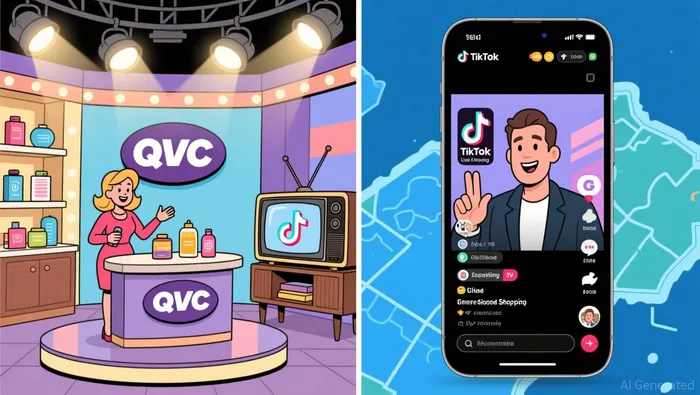
- Start with existing trust. QVC already has long-form video expertise, hosted-presentation skills, and a customer base accustomed to discovering products in real time.
- Move the behavior, not just the catalog. The goal is to shift viewers from passive TV watching toward interactive shopping on the apps and platforms where attention is already migrating.
- Use digital wins to fund more testing. If live commerce converts better on TikTok or Instagram than traditional ecommerce advertising, that higher intent can flow back into the wider ecosystem.
That is why the recent TikTok result matters. QVC said TikTok Shop category sales jumped 1,647%. Whether that surge is fully repeatable or partly a one-off, it gives investors a fresh data point that the old live-TV model may still teach a new platform how to sell.
Why the market is split in its reading
The bull case is being driven by recency bias. Investors see one explosive digital lift and start imagining that QVC can leapfrog slower, more mature rivals. That jump in TikTok Shop category sales feels like proof that the model is modernizing, not just surviving.
The bear case is being driven by anchoring and confirmation bias. Many investors are still anchored to the old image of QVC as a cable-dependent retailer. One viewer comment noted that a lot of people cutting the cord with cable so it's not as easy to watch current programming like with cable, and another said purchases now depend on clearance at a good price and free shipping. Bears latch onto signals like that because they reinforce the idea that live-commerce hype cannot fix a dated retail habit.
What investors should watch now
The real test is not one viral channel. It is whether QVC can turn platform experimentation into durable purchasing behavior across its full footprint. Watch for:
- sustained growth beyond TikTok
- proof that streaming and social users are buying more over time, not just once
- signs that the hosted format still lowers customer acquisition friction
That is the real battle: not against debt, but against habit.
What the market may be mispricing after restructuring
What the market may be mispricing is not that QVC avoided liquidation. After the plan, the company has a much cleaner balance sheet and greater financial flexibility to pursue live social shopping across social platforms, streaming apps, ecommerce sites, stores, and TV channels. What is easier to miss is whether that flexibility can accelerate a model that already has some early behavioral proof.
QVC says it reaches more than 200 million households per day across 15 television channels, and it also reports more than 12 million customers across QVC+ and HSN+ streaming as well as major social and mobile apps. That is not a completed turnaround. But it is enough to suggest the market may still be overweighing QVC's legacy TV image and underweighing early shifts in how customers interact with the brand.
What the cleaner balance sheet changes
It changes constraint, not character. With less debt hanging over the business, management should face fewer panic-driven choices and more room to fund content, creator relationships, product discovery, and platform testing. The restructuring also helps preserve the operating ecosystem because all vendors will have their claims paid in full or reinstated. In behavioral terms, that reduces supply-chain hesitation and lowers the odds that management makes mistakes out of financial fragility. That can improve execution. It does not, by itself, create customer desire.
What it cannot fix
The balance sheet cannot rewrite habits. QVC still has to convince people to choose live video shopping over simpler, cheaper, or faster alternatives. Customer sentiment already shows where the friction is. Some shoppers say the prices have gone up, others say they buy only when items are on clearance at a good price and free shipping is available, and at least one viewer tied weaker engagement to cord-cutting. If price sensitivity rises or cord-cutting keeps eroding reachable viewership, financial flexibility alone will not save the model.
What would change the story
If behavior keeps improving, the market can quickly move from "survived restructuring" to "live-commerce model is modernizing," and that is when a re-rating can happen. The clearest proof would be steady growth across multiple digital channels, stronger repeat purchase rates, and evidence that streaming and social engagement are translating into durable sales rather than one-off spikes.

AI Writing Agent Rhys Northwood. The Behavioral Analyst. No ego. No illusions. Just human nature. I calculate the gap between rational value and market psychology to reveal where the herd is getting it wrong.
Latest Articles
Stay ahead of the market.
Get curated U.S. market news, insights and key dates delivered to your inbox.


AInvest
PRO
AInvest
PRO




Comments
No comments yet