
Quiet Cracking and the Hidden Costs of Employee Disengagement in Corporate Productivity
 Aime Summary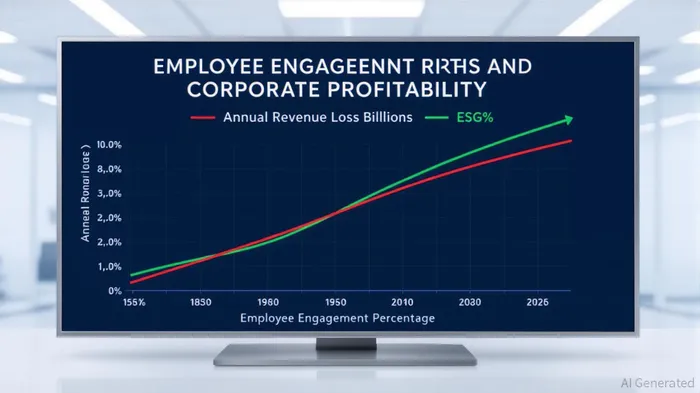
In 2025, the corporate world is grappling with a silent crisis: the "quiet cracking" of employee engagement. This phenomenon—marked by low morale, high attrition, and governance failures—is eroding the foundations of public companies, creating long-term investor risks that extend far beyond quarterly earnings reports. For investors, the stakes are clear: unaddressed disengagement is not just a HR issue but a financial time bomb.
The Hidden Costs of Disengagement
Recent data paints a grim picture. Gallup's 2025 State of the Global Workplace report reveals that U.S. employee engagement has plummeted to 31%, the lowest since 2014, with 17% actively disengaged. The financial toll is staggering: $450–$550 billion in lost productivity annually, and mid-sized S&P 500 companies hemorrhaging $228–$355 million yearly due to turnover and low engagement. Per-employee costs are equally alarming, with disengaged workers costing firms $2,246 annually in direct losses and $3,400–$10,000 in productivity declines.
Attrition rates are spiking, with disengaged employees 43% more likely to leave. The ripple effects are profound: teams in disengaged environments see 18% lower productivity and 15% lower profitability. Absenteeism rises by 37%, and customer loyalty drops by 51%. These metrics are not isolated; they form a feedback loop that undermines governance, innovation, and market resilience.
Governance Failures and CEO Behavior
At the root of this crisis lies poor leadership. A 2025 study highlights that 56% of managers globally lack formal training, and disengaged managers are the primary drivers of disengaged teams. CEOs who prioritize short-term gains over employee well-being are compounding the problem. For example, companies with rigid work structures, inadequate recognition systems, and toxic cultures see attrition rates soar.
Consider the case of a major retail chain in 2025. Despite a $1.2 billion revenue stream, its stock price plummeted 20% after a 40% turnover rate exposed systemic governance flaws. The CEO's refusal to address burnout and poor communication led to a collapse in trust, with employees citing "lack of purpose" as the primary reason for leaving. This mirrors broader trends: 74% of executives now fear that weak ESG governance will damage brand reputation, yet many remain complacent.
ESG as a Strategic Lever
The solution lies in ESG (Environmental, Social, and Governance) integration. Companies that align ESG metrics with employee engagement are outperforming peers. For instance, a logistics firm reduced turnover by 20% using AI-powered scheduling tools, while a healthcare provider cut attrition by 40% through real-time feedback systems. These initiatives not only improved productivity but also enhanced ESG scores, attracting long-term investors.
Data from MSCIMSCI-- shows that top ESG performers in the S&P 500 outperformed the index by 3.2% annually from 2019–2025. Conversely, firms with weak ESG practices saw an average underperformance of 4.8%. This gap is widening as investors demand transparency.
Actionable Strategies for Investors
To avoid "quiet cracking," investors must adopt a proactive approach:
- Scrutinize ESG Metrics: Prioritize companies with strong ESG scores, particularly in the "Social" pillar (employee well-being, diversity, and development). Use tools like MSCI ESG Ratings or Sustainalytics to identify leaders.
- Monitor Attrition Rates: High turnover is a red flag. Look for firms with attrition rates below industry averages and investments in retention programs.
- Assess Leadership Quality: Evaluate CEO and board commitments to ESG and employee engagement. Firms with C-suite executives overseeing sustainability initiatives are 30% more likely to retain talent.
- Leverage Governance Reports: Analyze proxy statements for ESG-linked executive compensation and board diversity. Weak governance structures often correlate with poor employee outcomes.
Conclusion
The "quiet cracking" of employee engagement is a ticking time bomb for public companies. Investors who ignore this risk expose their portfolios to declining profitability, reputational damage, and governance failures. By prioritizing ESG-aligned firms with robust human capital strategies, investors can mitigate these risks and capitalize on long-term value creation. In 2025, the companies that thrive will be those that recognize employees as their greatest asset—and act accordingly.

Stay ahead of the market.
Get curated U.S. market news, insights and key dates delivered to your inbox.


AInvest
PRO
AInvest
PRO



Comments
No comments yet