

The two highest paid-for outcomes on Rocket LabRKLB-- are not built on a number. Morgan Stanley and KeyBanc each justify their top-of-the-street targets with the same mechanism — Neutron and a faster Electron launch cadence — and that mechanism now has a deadline: the next quarterly report. Before that print lands, the stock trades at about $63 (Ainvest data), down from a $151 52-week high, on a multiple that assumes the mechanism works. The market is paying for forward revenue it has not yet seen.
Name the disagreement plainly. In January, Morgan Stanley upgraded Rocket Lab to Overweight and set a then-street-high $105 target, citing a potential Neutron debut in early 2026 and rising launch cadence. Six months later KeyBanc leapfrogged it, going Overweight at a $135 street-high and flagging Rocket Lab as the clear #2 player behind SpaceX — its label for the same growth story. Both calls rest on the vehicle that has not flown yet, plus a launch cadence that must keep climbing.
The magnitude is a tool forecast, not the bulls' math
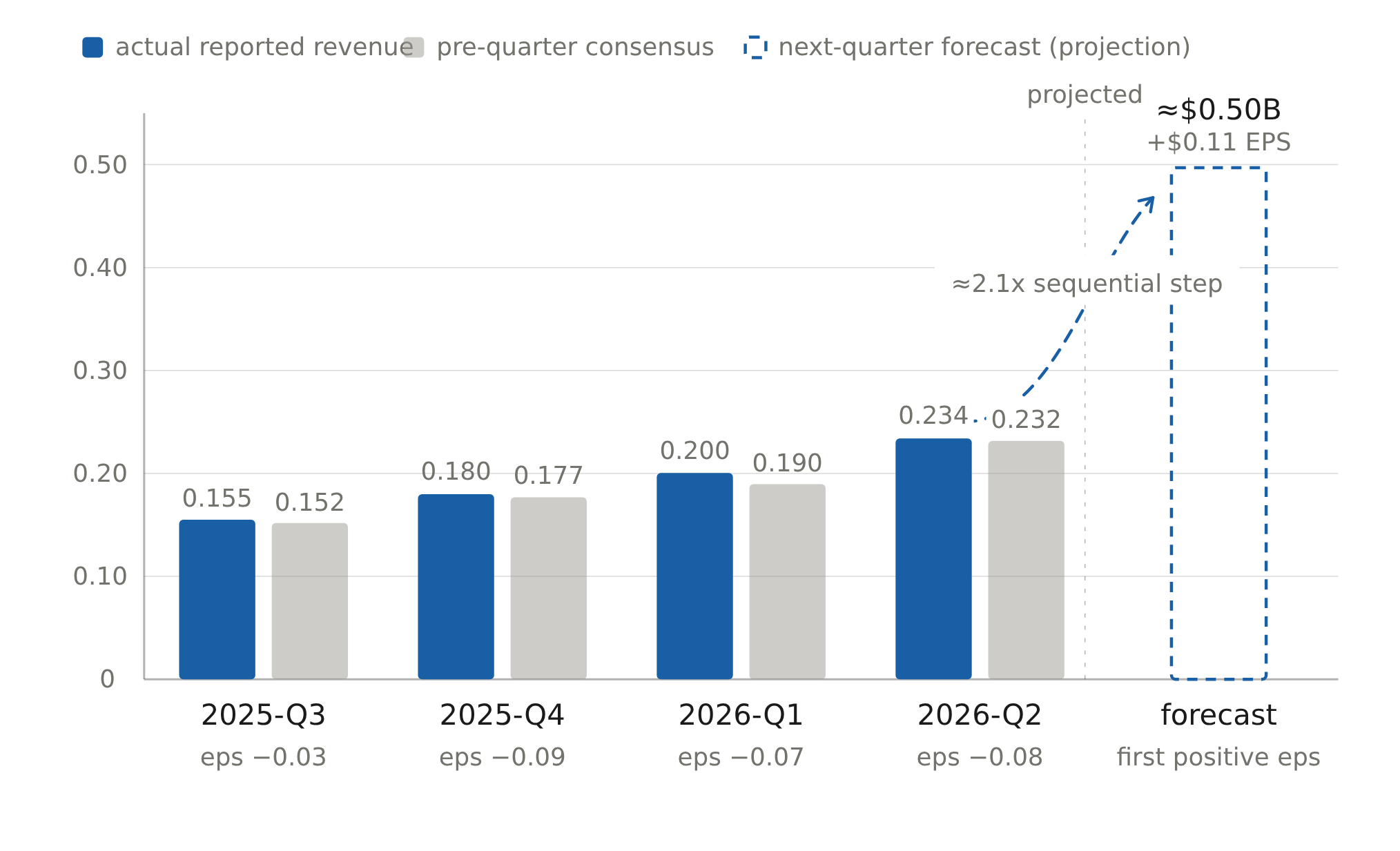
Here is the part worth being precise about. The next-quarter forecast on the market tool reads $497.1 million in revenue and earnings of +$0.11 per share (Ainvest data) — against $234.1 million and a loss of $0.08 a share that Rocket Lab just reported for the second quarter (Ainvest data). That is a roughly 2.1x step in revenue, and a swing to the first positive-EPS quarter in the visible record, after four straight negative ones. Do not file this under "the analysts said so." No retrieved source bridges either named bank to those specific numbers, and the tool labels the figure only as a forecast, not survey consensus. The magnitude is an unbridged model output; the mechanism the sell-side actually articulated is the real anchor.
The clock is running on launch volume
Look at what the recent record makes of that step. Quarter over quarter, revenue has compounded from $155 million to $234 million across four reported quarters, a steady grind, with losses attached to every one (Ainvest data). Nothing in that window previews a near-doubling in a single quarter. To get from $234 million to $497 million, launch revenue from Electron's cadence would have to accelerate at the same time a brand-new heavy-lift vehicle enters service. That is the entire bet in one sentence: the step only arrives if the mechanism delivers.
That is why the next report is not one earnings event among many. It is the falsifiability contract the two named bulls wrote when they put their targets on Neutron. If the vehicle slips past the early-2026 window Morgan Stanley cited, or cadence stalls, revenue reports below the tool forecast and the profitable-EPS switch never arrives — and the ~49x trailing-sales multiple, already extreme for a company losing money on the trailing twelve months, loses its forward justification. The high-end case and its multiple compress together.
The trade is buying the inflection's probability
Price is the honest ledger of how much of this is already paid for. As of early August 2026 the stock traded 37.6% below Wall Street's consensus target of $114, and it has only fallen further since; yet it still wears a ~49x trailing price-to-sales multiple and a negative trailing price-to-earnings ratio (Ainvest data). You are not buying the company we have seen at that multiple; you are buying the probability that the next print flips the sign on earnings and the revenue curve bends to the forecast. The bulls have already named the mechanism that gets you there. The quarter is where conviction pays or the clock stops.
One tripwire decides it. When Rocket Lab next reports, watch revenue against roughly $497 million and the EPS line against zero. Beat the forecast, and the first positive-EPS quarter — on a step the visible record has never produced — validates the $105 and $135 targets in a single print. Miss, the mechanism the sell-side priced is delayed, the negative trailing P/E persists, and the high end has no forward justification left. Either way, one quarter turns the named mechanism into a scored outcome.








Comments
No comments yet