
QuantumScape's Recent Volatility Amid EV Battery Innovation
 Aime Summary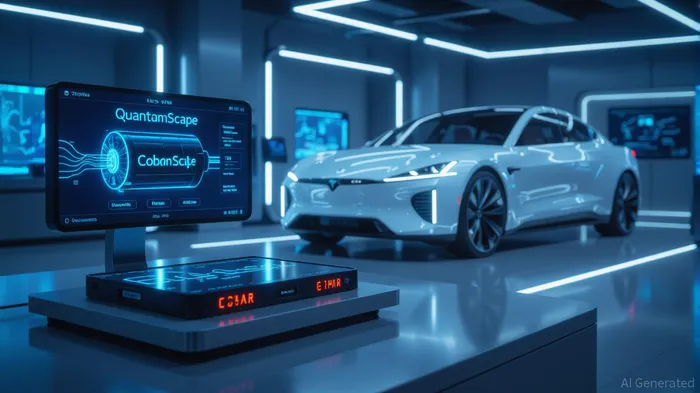
In the ever-evolving landscape of electric vehicles (EVs), QuantumScapeQS-- (NYSE: QS) has emerged as a high-risk, high-reward player, its stock swinging wildly between euphoria and despair. The company's recent volatility—spiking 66% in two days on July 18, 2025, only to plummet 14.5% the next—has drawn both retail traders and institutional skeptics into a heated debate. But what does this mean for investors? How does QuantumScape stack up against the titans of tech, like NVIDIANVDA-- (NASDAQ: NVDA) and AppleAAPL-- (AAPL), who are quietly reshaping the EV and battery sectors? Let's break it down.
QuantumScape: Innovation With a Side of Volatility
QuantumScape's story hinges on its solid-state battery technology, a potential game-changer for EVs. The company's recent integration of the "Cobra" separator process into baseline cell production is a major win. This advancement slashes production time by 25x and reduces the operational footprint, bringing the company closer to gigawatt-hour-scale manufacturing. For context, solid-state batteries promise higher energy density, faster charging, and safer performance compared to lithium-ion—a critical edge in a sector plagued by range anxiety and charging delays.
However, innovation alone doesn't justify a $7 billion market cap for a pre-revenue company. QuantumScape's Q1 2025 results showed a net loss of $114.4 million, with cash burn slowing to $64.6 million in adjusted EBITDA. While its $860 million liquidity runway through 2028 is comforting, the stock's overbought RSI reading and lack of commercial contracts raise red flags. The recent 14.5% drop after its July 23 earnings report—despite a $0.20 loss per share in line with estimates—signals profit-taking and skepticism about its ability to scale.
The Risk-Reward Equation: QuantumScape vs. NVIDIA and Apple
To assess QuantumScape's potential, let's compare it to NVIDIA and Apple, two companies with vastly different approaches to the EV and battery sectors.
NVIDIA: The AI-Driven Powerhouse
NVIDIA's dominance in AI semiconductors has made it a linchpin for EV innovation. Its GPUs power autonomous driving systems, battery management algorithms, and AI-driven energy optimization. With a $3.28 trillion market cap in 2024, NVIDIA's revenue surged 122% year-over-year in Q2 2025, driven by demand for its Hopper and Blackwell architectures. Unlike QuantumScape, NVIDIA generates consistent profits and operates in a sector with clear, near-term demand. Its partnerships with automakers like ToyotaTM-- and Hyundai further cement its role in the EV ecosystem. For investors, NVIDIA offers a safer bet: a company with recurring revenue, strong margins, and a clear path to growth.
Apple: The Premium Enigma
Apple's rumored "Project Titan" has kept the EV world guessing. While the company hasn't launched a car, its AI-driven software and sustainability focus position it as a potential disruptor. Apple's $4 trillion market cap in 2025 reflects confidence in its ecosystem, but its 1% revenue CAGR from 2022–2024 highlights a slowdown in hardware innovation. Unlike QuantumScape, Apple isn't betting on radical battery tech but rather leveraging its software prowess to enter the EV space. Its forward P/E of 28, however, raises questions about whether its valuation is justified by current fundamentals.
QuantumScape's Wild Card: Potential vs. Practicality
QuantumScape's appeal lies in its disruptive technology and strategic partnerships, like its $130 million licensing deal with Volkswagen's PowerCo. These alliances validate its IP and provide a revenue stream, but they're far from guarantees. The company's capital-light licensing model is clever, avoiding the costly pitfalls of building gigafactories, but it also means it's dependent on third parties to commercialize its tech.
The risks? QuantumScape is still pre-revenue, with no proven ability to scale production or secure large-scale contracts. Its reliance on unproven manufacturing milestones and the volatile EV sector—where automakers like GMGM-- and FordF-- are scaling back EV production due to weak demand—adds another layer of uncertainty.
The Bottom Line: Who Should Bet on QuantumScape?
For investors with a high-risk tolerance, QuantumScape's breakthroughs in solid-state batteries and its strategic positioning in the EV supply chain could pay off handsomely if it executes. The company's recent stock surge to $15.03 (a 108% gain in nine days) reflects this optimism. However, its current valuation—7.8x price-to-book for a pre-revenue company—is stretched.
In contrast, NVIDIA and Apple offer more stability. NVIDIA's AI-driven growth and proven market leadership make it a safer long-term play, while Apple's ecosystem and brand power could eventually translate into EV dominance. Both are less speculative but also less likely to deliver the explosive returns that QuantumScape's supporters dream of.
Investment Advice:
- QuantumScape (QS): For aggressive investors willing to stomach short-term volatility for a potential 10x return. Consider dollar-cost averaging into dips but set strict stop-loss levels given the stock's sensitivity to sentiment.
- NVIDIA (NVDA): A core holding for growth-focused portfolios. Its AI and EV-related momentum is hard to ignore, and its strong balance sheet supports continued innovation.
- Apple (AAPL): A defensive play in the tech sector. While its EV ambitions are unclear, its ecosystem and services business provide consistent cash flow, making it a reliable long-term bet.
In the end, the EV and battery sectors are still in their early innings. QuantumScape's gamble on solid-state tech could redefine the industry—but only if it can navigate the execution risks. For now, the road to commercialization is paved with both promise and peril.

Delivering real-time insights and analysis on emerging financial trends and market movements.
Latest Articles
Stay ahead of the market.
Get curated U.S. market news, insights and key dates delivered to your inbox.




Comments
No comments yet