
QuantumScape's Solid-State Battery Breakthrough: A Game-Changer for EVs or Overhyped Risk?
The race to dominate the electric vehicle (EV) battery market is heating up, and QuantumScapeQS-- (QS) has emerged as a contender with its solid-state battery technology. The company's recent advancements—particularly its QSE-5 battery with an energy density of 844 Wh/L—promise to redefine EV performance. But can QuantumScape scale its innovation into a commercially viable product, or will execution risks and competition derail its ambitions?
The Breakthrough Technology
QuantumScape's anode-free solid-state batteries use a proprietary ceramic separator to eliminate flammable electrolytes, enabling higher energy density, faster charging, and extended lifecycles compared to lithium-ion batteries. Key specifications include:
- Energy Density: 844 Wh/L (surpassing conventional lithium-ion cells at ~700 Wh/L), translating to 400–500 miles per charge for EVs.
- Cycle Life: 95% energy retention after 1,000 cycles (~300,000 miles of driving).
- Fast Charging: 12.2 minutes for 10%–80% charge, rivaling Tesla's Supercharger network.
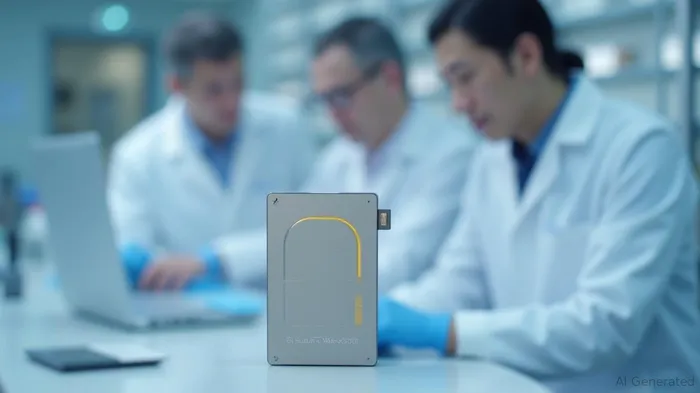
The Cobra manufacturing process is central to scalability. By accelerating heat treatment 25x faster than prior methods and reducing equipment footprint, QuantumScape aims to cut production costs by 30–50%—a critical factor in making EVs affordable.
Commercial Viability: Partnerships and Scaling
QuantumScape's collaboration with Volkswagen's PowerCo subsidiary is its linchpin. The partnership:
- Licenses up to 80 GWh/year of solid-state battery production by 2028.
- Aims to deliver B1 production-intent cells by end-2025, triggering milestone payments of $75–200 million.
- Includes field testing in 2026 and commercialization by 2028, aligning with Volkswagen's EV roadmap.
Other strategic moves include:
- A partnership with Murata Manufacturing to scale ceramic separator production.
- Sampling agreements with luxury automakers, signaling early adoption.
The $860 million cash runway as of Q1 2025 provides breathing room, but the company still faces a net loss of $114 million in Q1. Success hinges on transitioning from R&D to revenue via licensing deals, a model that could generate $100–300 million annually if partners meet production targets.
Risks and Challenges
- Execution Risks:
- Delivering B1 cells on time and passing field tests will validate technical feasibility. Delays could spook investors.
Scaling to gigafactory levels requires flawless manufacturing.
Competitor Pressure:
Toyota, CATL, and Samsung are racing to commercialize solid-state batteries by 2027–2028. QuantumScape's lead is unproven at scale.
Financial Fragility:
Trading at $4.62/share (June 2025), QuantumScape's $2.6 billion market cap implies no near-term revenue. Investors demand tangible progress to revalue the stock.
Supply Chain Bottlenecks:
- Reliance on Murata for ceramic separators poses a single-point failure risk.
Investment Considerations
- Valuation: The stock trades at 3.0x cash, implying the market dismisses QuantumScape's potential. Success in 2025 milestones could re-rate it as a capital-light IP licensor, potentially tripling or quintupling the stock.
- Risk Profile: High volatility (historical 34.92% returns post-earnings but significant drawdowns) makes this a speculative play.
- Investment Thesis:
- Bull Case: B1 delivery and field-test success unlock licensing revenue, positioning QuantumScape to capture a dominant share of the $500 billion EV battery market.
- Bear Case: Missed milestones or competition erodes its edge, leaving it as a pre-revenue story without profit visibility.
Conclusion: A High-Risk, High-Reward Opportunity
QuantumScape's technology has the potential to revolutionize EVs, but it remains a pre-commercial firm navigating steep execution hurdles. Investors must weigh the asymmetric upside (10–20x returns if milestones are met) against the real risk of failure.
Recommendation:
- Aggressive Investors: Consider a small position (1–3% of portfolio) with a long-term horizon (>5 years). Monitor the B1 delivery (2025) and field tests (2026) as critical catalysts.
- Conservative Investors: Avoid until commercial production begins (2028).
QuantumScape is a bet on innovation over certainty—a gamble worth taking only if you believe in its ability to outpace rivals and scale its breakthrough. For now, the jury remains out, but the stakes couldn't be higher.

Delivering real-time insights and analysis on emerging financial trends and market movements.
Latest Articles
Stay ahead of the market.
Get curated U.S. market news, insights and key dates delivered to your inbox.




Comments
No comments yet