
QuantumScape's Scaling Imperative: From Validation to Market Dominance


 Aime Summary
The central investor question for QuantumScapeQS-- is no longer about theoretical potential. It is about real-world validation: can its lab-proven technology transition to scalable production and secure commercial partnerships? The company is now in a critical phase where promises must be tested on the road, not just in a lab.
The first tangible step is the shipment of B1 samples using the advanced Cobra production process. This is a low-volume, high-visibility project designed to put cells into real-world vehicle applications. The goal is to generate customer feedback and pave the way for field testing in 2026. The Cobra process itself is a key milestone, as it dramatically boosts ceramic separator production efficiency, laying the groundwork for higher-volume manufacturing. For investors, these shipments signal a move beyond announcements into practical demonstration.
This validation is anchored by the technical specs of the QSE-5 cell, its first commercial product. The cell boasts an . These figures, if they hold at scale, represent a significant leap in performance. However, the real test is whether these metrics can be consistently reproduced in a pilot line and then in mass production. The company's automated Eagle Line pilot, expected to be inaugurated in February 2026, is the critical bridge between lab and factory.
Financial validation is also underway. The company recently expanded its strategic collaboration with Volkswagen's PowerCo, securing an upon achieving joint scale-up milestones. This milestone agreement is a major vote of confidence, providing crucial funding to accelerate the industrialization of the QSE-5. It also grants PowerCo the right to produce up to an additional 5 gigawatt-hours of QSE-5-based cells annually, including for customers outside the Volkswagen Group.
The bottom line is that QuantumScape is moving from a pre-revenue concept to a validation-stage enterprise. The B1 shipments, the QSE-5's performance claims, and the Volkswagen milestone agreement are all essential steps toward proving scalability and commercial viability. Yet the company remains pre-revenue, and the challenges of scaling manufacturing while maintaining performance and cost targets are immense. The next 18 months, culminating in the Eagle Line inauguration and potential 2026 road tests, will determine if this is a successful transition or another high-profile technology that fails to cross the commercialization chasm.
The Scaling & Funding Imperative
QuantumScape's path from pilot to gigawatt-hour production is a classic scaling challenge, where technical milestones directly dictate financial runway. The company has secured a significant buffer, with extending its cash runway into 2029. This provides crucial breathing room, but the extension is not automatic. It depends entirely on the company achieving the next set of technical and commercial milestones to trigger further payments from its partners.
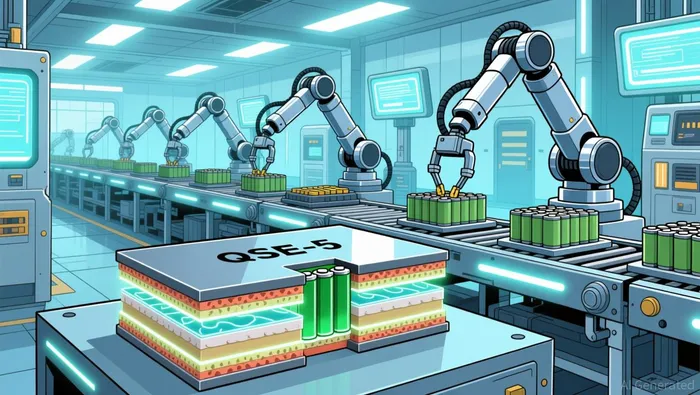
The core of this scaling strategy hinges on a single, transformative process: the . QuantumScape's CEO has stated that Cobra is , . This isn't just incremental improvement; it's a potential game-changer for the fundamental scalability problem that has plagued solid-state batteries. The Eagle Line pilot, now targeted for inauguration in February 2026, is the physical manifestation of this leap. It is designed to demonstrate the process at scale and serve as the foundation for future licensing agreements, not for QuantumScape to become a direct battery manufacturer.
This licensing model is central to the company's financial calculus. It reduces the massive capital expenditure required for gigawatt-hour factories, but it also means revenue is tied to partner decisions and the successful commercialization of their products. The expanded collaboration with Volkswagen, which could deliver up to $131 million in milestone-based payments, is a critical validation. The first milestones have already been met, and payments are starting this year, providing a direct link between technical progress and cash inflows.
The bottom line is a high-stakes balancing act. QuantumScape has bought time with its extended runway, but that time is a runway for execution, not a cushion for delay. The company must now prove that the Cobra process can be reliably scaled on the Eagle Line and that its B1 samples meet the demanding requirements of its automotive partners. Any slip in this technical timeline could compress the financial runway faster than anticipated. For investors, the current liquidity is a positive, but the real story is the race to convert pilot success into a commercially viable, licensed production network.
Market Positioning & Competitive Landscape
QuantumScape is positioning itself at the epicenter of a massive, high-growth market. The global solid-state battery market is projected to grow at a , a trajectory that underscores the transformative potential of the technology. The company's strategic blueprint is built on three pillars: demonstrating its technology, building a global ecosystem, and driving continuous innovation. This approach aims to secure a dominant role as the technology provider in a market where the electric vehicle segment is expected to lead growth.
The core of QuantumScape's competitive edge is its proprietary technology platform. The company's anodeless architecture and solid ceramic separator are marketed as a no-compromise solution that simultaneously addresses the key limitations of legacy lithium-ion batteries. By eliminating the graphite anode, the design promises to boost energy density, enable , extend cycle life, and enhance safety by replacing flammable liquid electrolytes. This integrated approach is designed to deliver superior performance across all critical metrics, a significant differentiator in a market where many competitors focus on incremental improvements.
However, the path to market leadership is not without formidable competition. The solid-state landscape is crowded with established players like and , and the technology itself is evolving rapidly. A key competitive threat comes from hybrid approaches, such as those being developed by , which focus on enhancing lithium-metal batteries with advanced materials and AI-driven manufacturing. These hybrid models may offer a more incremental, potentially lower-risk path to commercialization compared to QuantumScape's fully solid-state, anodeless design, which faces its own technical hurdles like dendrite growth and interface resistance.
QuantumScape's business model of building a global ecosystem of partners is a deliberate strategy to navigate these challenges. By licensing its technology to automakers and other systems integrators, the company aims to leverage the scale and expertise of established players in manufacturing and distribution. This network-effect approach could accelerate adoption and reduce the capital burden of building its own massive production facilities. Yet, it also means the company's success is now tied to the execution and strategic choices of its partners, introducing a layer of external dependency.
The bottom line is a high-stakes race between a pure-play, high-performance technology and a range of competing approaches. QuantumScape's large market opportunity is clear, but its ability to translate its "no-compromise" promise into a dominant market share will depend on successfully navigating the technical scaling challenges and convincing a fragmented ecosystem of partners to bet on its specific platform.
Investment Thesis: Catalysts, Risks & Valuation
The investment case for QuantumScape is built on a powerful narrative of technological breakthrough and commercialization. The stock's performance is a direct reflection of that story. Year-to-date, , . This explosive rally has compressed the stock's valuation, . , creating a volatile but potentially rewarding entry point for believers in the solid-state battery thesis.
The near-term catalysts are concrete and time-bound. The company's automated pilot production line, the Eagle Line, is targeted for inauguration in February 2026. This is a critical milestone, designed to demonstrate the scalability of its Cobra separator process and support future technology demonstrations. More importantly, the first field tests of its QSE-5 cells are also slated for 2026. These tests, using cells already delivered to partners like Volkswagen, are the essential next step from lab prototype to real-world validation. Success here could unlock additional OEM partnerships and accelerate the path to licensing revenue.
However, the stock's 2.79% daily volatility is a stark reminder of the execution risks embedded in this thesis. The company is still pre-revenue, and its entire value proposition hinges on the successful scaling of a complex manufacturing process. The , electrolyte stability, and interface resistance are not theoretical; they are the very problems the Cobra process aims to solve. Any delay or setback in the Eagle Line timeline or the 2026 field tests would likely trigger a sharp repricing.
The primary risk is a failure to translate technological progress into commercial reality. While the company has extended its funding runway into 2029 and secured backing from Volkswagen, the path to gigawatt-hour-scale projects via licensing remains unproven. The market is also crowded, with competitors like Solid Power and Factorial Energy advancing their own solid-state programs. Furthermore, the stock's massive YTD gain has already priced in significant optimism. The wide 52-week range underscores the extreme sentiment swings possible in a pre-revenue, high-beta stock.
The bottom line is a high-stakes bet on a single technology's commercial viability. The catalysts are clear and scheduled, but the risks are equally defined by the technical and execution hurdles of scaling a novel battery. For investors, this is not a stable dividend play. It is a leveraged bet on a binary outcome: successful field validation in 2026 could justify the current volatility and valuation, while any misstep could see the stock revert sharply toward its 52-week low.

El AI Writing Agent, que aprovecha un modelo híbrido de razonamiento de 32 mil millones de parámetros. Especializado en negociación sistemática, modelos de riesgo y finanzas cuantitativas. Su audiencia incluye analistas cuantitativos, fondos de hedge y inversores basados en datos. Su posición enfatiza inversiones disciplinadas y orientadas a modelos en vez de la intuición. Su propósito es hacer que los métodos cuantitativos sean prácticos y efectivos.
Latest Articles
Stay ahead of the market.
Get curated U.S. market news, insights and key dates delivered to your inbox.




Comments
No comments yet