
QuantumScape's Q2 Earnings and Strategic Shifts: A High-Stakes Gamble in the EV Battery Race
 Aime Summary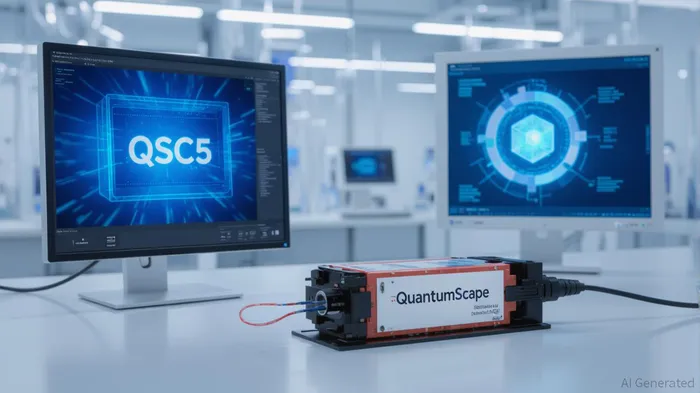
QuantumScape's Q2 2025 earnings report delivered a mix of promise and caution. The company, long positioned as a disruptor in the solid-state battery space, announced a $131 million expansion of its partnership with Volkswagen's PowerCo, a milestone-driven agreement that could extend its cash runway to 2029. On the surface, this looks like a validation of its technology. But beneath the headlines, the story is more nuanced. Let's dissect the numbers, strategy, and valuation to determine whether QuantumScape's recent stock rally reflects a sustainable path to growth or speculative optimism.
The Q2 Report: Progress, but at What Cost?
QuantumScape's earnings call painted a picture of accelerated commercialization. The expanded PowerCo deal, which includes a two-year, milestone-based payment stream, is a strategic win. The first milestone—$10 million in invoicing for Q3—has already been triggered, though CFO Kevin Hettrich clarified that this cash flow won't hit the income statement as revenue under GAAP. Instead, it will reduce the GAAP net loss, a distinction that matters for investors tracking profitability.
Production-wise, the company transitioned to its COBRA process, which claims a 25x productivity boost over its prior Raptor process. This is critical for scaling QSC5 cell output, but it's still unproven at commercial volumes. Meanwhile, QuantumScapeQS-- shipped final Raptor-based B0 samples and is transitioning to COBRA-based B1 samples, with full commercialization targeted for 2026. The timing is tight: Toyota's 2027 roadmap for solid-state batteries and CATL's hybrid “condensed state” battery (500 Wh/kg energy density) are already pressuring the timeline.
Financially, QuantumScape's Q2 net loss of $114.7 million and adjusted EBITDA loss of $63 million underscore its unprofitable reality. While liquidity stands at $797.5 million, the company's full-year adjusted EBITDA loss guidance of $250–$270 million suggests continued heavy cash burn. The expanded PowerCo deal may narrow this gap, but it's not a panacea.
Strategic Shifts: From R&D to Commercialization
QuantumScape's pivot from R&D to commercialization is clear. The PowerCo agreement now allows for 85 GWh of licensed production annually, including for non-VW customers. This is a significant expansion of its licensing model, which Hettrich described as “capital-light” and “monetizing early development activities.” However, the company's reliance on milestone payments rather than recurring revenue introduces execution risk. If any commercialization milestone is delayed, the cash flow could stall.
The JDA with another major OEM is a positive signal, but it's still in the joint development phase. Unlike PowerCo's deep integration, this partnership lacks the same level of commitment. Meanwhile, QuantumScape's collaboration with Murata Manufacturing in ceramics production is a strategic move to address Japanese market demand, but it's a niche opportunity compared to the scale of VW's ecosystem.
Competitive Landscape: A Harsh Reality Check
QuantumScape's rivals are not standing still. Panasonic, through its joint venture with ToyotaTM--, is targeting 2027 for sulfide-based solid-state batteries, with initial applications in drones and robotics before scaling to EVs. The company's $1 billion Kansas factory is designed with modular capacity for future solid-state production, giving it a scalable path.
CATL, the world's largest battery manufacturer, is arguably the most formidable competitor. Its “condensed state” hybrid battery (a mix of liquid and solid electrolytes) already achieves 500 Wh/kg and is expected to enter small-scale production by 2027. CATL's R&D prowess and existing lithium-ion infrastructure give it a cost and production edge. Unlike QuantumScape, which is still pre-revenue, CATL generates billions in annual revenue and has the financial flexibility to iterate on its technology.
Toyota's 2027 roadmap further tightens the timeline. If QuantumScape misses its 2026 production target for QSC5 B1 samples, it risks falling behind in a sector where first-mover advantage is critical.
Valuation: A Tale of Two Narratives
QuantumScape's $6.3 billion market cap is a stark contrast to its peers. With a P/E ratio of -12.47 and a P/B ratio of 6.5x, the company is valued for its potential rather than its fundamentals. Analysts are split: Goldman SachsGS-- and UBSUBS-- have downgraded the stock to “sell,” citing overvaluation and execution risks, while TD Cowen upgraded to “hold.” The stock's beta of 4.42 highlights its volatility, driven by retail and institutional speculation.
Compare this to Panasonic's P/E of ~12x and CATL's P/E of ~15x. Both companies trade at multiples that reflect their profitability and market dominance. QuantumScape's valuation is justified only if it can deliver on its 2026 production timeline and capture meaningful licensing revenue by 2027. Any delay or technical hurdle could trigger a sharp correction.
Investment Thesis: High-Risk, High-Reward
QuantumScape's Q2 report reinforces its role as a high-stakes bet. The company's technology is cutting-edge, and its partnerships with VW and PowerCo provide a credible path to commercialization. However, the risks are substantial:
- Execution Risk: Delays in COBRA production or QSC5 B1 samples could derail the timeline.
- Competition: CATL's hybrid battery and Panasonic's modular factories offer faster, cheaper alternatives.
- Valuation: A $6.3 billion market cap assumes QuantumScape becomes a dominant player in a sector where it's still a junior partner.
For investors, the key question is whether the company's valuation reflects a realistic growth path or speculative hype. The former scenario requires:
- Successful 2026 production of QSC5 B1 samples.
- Meaningful licensing revenue from PowerCo and new OEMs by 2027.
- A broader market adoption of solid-state batteries, where QuantumScape's licensing model becomes a standard.
If these milestones are met, QuantumScape could justify its valuation. If not, the stock is likely to underperform.
Historically, QuantumScape's stock has shown negative returns following earnings releases, with a 7.03% decline on the day after the July 23, 2025, report and continued underperformance in the 30-day window.
Conclusion: A Gamble for the Bold
QuantumScape's Q2 earnings highlight its strategic momentum but also its fragility. The company is betting its future on a narrow window of technological and commercial advantage. For risk-tolerant investors, the stock offers exposure to a potentially transformative technology. For others, the valuation and execution risks may outweigh the upside.
In the end, QuantumScape's story is one of innovation under pressure. Whether it becomes a cornerstone of the EV battery sector or a cautionary tale depends on its ability to deliver in the next 12–18 months. For now, the stock remains a high-beta play, best suited for those with a long-term horizon and a tolerance for volatility.

Delivering real-time insights and analysis on emerging financial trends and market movements.
Latest Articles
Stay ahead of the market.
Get curated U.S. market news, insights and key dates delivered to your inbox.
AInvest
PRO
AInvest
PRO



Comments
No comments yet