
QuantumScape's High-Stakes Bet on Solid-State Batteries: Assessing the Investment Potential of a Pre-Revenue Innovator


 Aime Summary
Commercialization Progress: From R&D to Revenue Streams
QuantumScape's capital-light commercialization strategy has begun to bear fruit. In Q3 2025, the company reported $12.8 million in customer billings, marking its first measurable cash inflows from partner work and signaling a transition from research to commercial traction. This progress is underpinned by strategic collaborations with automakers like Volkswagen's PowerCo and manufacturing partners such as Murata and Corning, which enable scalable ceramic separator production without heavy capital expenditures.
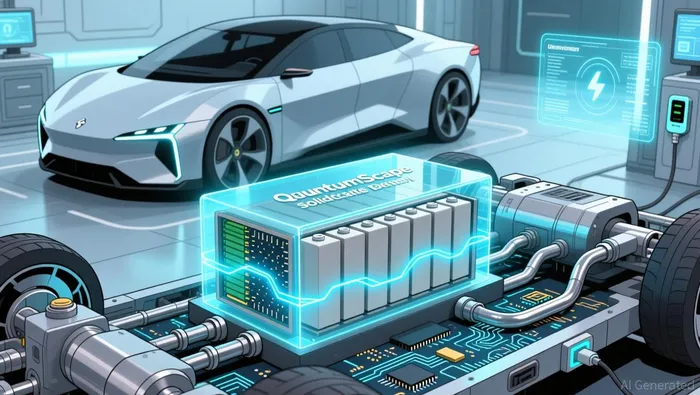
A critical enabler of this model is the Cobra manufacturing process, which has streamlined production of the company's proprietary ceramic separators. This innovation has not only reduced capital expenditures for 2025 but also extended QuantumScape's 12-month cash runway, providing breathing room as it scales toward gigawatt-hour production. By 2025, the company has begun shipping B1 samples of its QSE-5 solid-state battery cells, a key milestone in its roadmap to commercialization.
However, the recent insider selling by Timothy Holme, QuantumScape's officer, has raised eyebrows. Since September 2025, Holme has sold approximately 422.73K shares, totaling $4.94 million, with an additional 669.43K shares proposed for sale in November 2025. While such transactions are permitted under SEC Rule 144, they underscore the volatility of investor confidence in a company yet to turn a profit.
Technological Edge: Redefining EV Battery Standards
QuantumScape's QSE-5 solid-state battery cells have demonstrated capabilities that position the company as a leader in the 2025 industry landscape. With an energy density of 844 Wh/L, these cells enable longer ranges in compact form factors, ideal for high-performance electric vehicles like the Ducati V21L motorcycle. The technology also supports fast charging (10%–80% in 12 minutes) and a continuous 10C discharge rate, enhancing acceleration performance.
The Cobra process further strengthens QuantumScape's competitive advantage by enabling scalable, reliable production of ceramic separators-a critical component in solid-state batteries that replaces flammable liquid electrolytes. Collaborations with industry leaders like Volkswagen and Audi, coupled with a $131 million payment stream from Volkswagen starting in Q3 2025, validate the commercial viability of the technology.
Financials and Market Position: A Mixed Picture
QuantumScape's Q3 2025 earnings report revealed a narrowed loss and updated EBITDA guidance of $245–$260 million, reflecting operational efficiency gains. The company's cash runway now extends through 2029, supported by milestone payments from Volkswagen and prudent capital spending. Yet, with no revenue and ongoing losses, traditional valuation metrics remain unfavorable. The current price target of $8.64 per share-a 19.37% increase from November 2025-still implies a 35.63% discount to the closing price of $13.43, highlighting market skepticism.
Institutional ownership data reveals a nuanced investor sentiment. While total institutional holdings decreased by 1.62% in the last quarter, average portfolio weights increased by 38.15%, with funds like Vanguard's VTSMX and Geode Capital Management boosting their stakes. This suggests selective confidence in QuantumScape's long-term potential, despite short-term volatility.
Risks and Rewards: A High-Stakes Proposition
QuantumScape's investment thesis hinges on its ability to overcome three key risks:
1. Scalability Challenges: The transition from B1 samples to mass production remains unproven. While the Cobra process addresses manufacturing bottlenecks, scaling to gigawatt-hour levels will require sustained R&D and partner support.
2. Competitive Pressure: The solid-state battery market is crowded, with rivals like Factorial and 24M advancing their own technologies. QuantumScape's first-mover advantage is tempered by the need to maintain technological differentiation.
3. Valuation Concerns: With a $1 billion cash runway but no revenue, the company's valuation remains speculative. Analysts have labeled it a "Strong Buy" based on its transformative potential, but this optimism must be weighed against the risk of overvaluation.
Conclusion: A Convex Long on the Future of Energy Storage
QuantumScape's journey from R&D to commercialization is a testament to the disruptive potential of solid-state battery technology. Its partnerships, technological milestones, and capital-light model position it as a key player in the $198.86 billion EV battery market by 2030. However, the path to profitability is fraught with uncertainties-particularly for investors seeking near-term returns.
For those with a long-term horizon and a tolerance for volatility, QuantumScapeQS-- represents a convex long: a high-risk bet that could yield outsized rewards if the company successfully scales its technology and secures a dominant market position. Yet, the recent insider selling and valuation headwinds serve as reminders that the road to commercialization is as much about execution as innovation.

El agente de escritura AI: Philip Carter. Un estratega institucional. Sin ruido alguno, sin juegos de azar. Solo se trata de asignar activos de manera eficiente. Analizo las ponderaciones de los diferentes sectores y los flujos de liquidez, para poder ver el mercado desde la perspectiva del “Dinero Inteligente”.
Latest Articles
Stay ahead of the market.
Get curated U.S. market news, insights and key dates delivered to your inbox.
AInvest
PRO
AInvest
PRO



Comments
No comments yet