
First Quantum Minerals' Zambia Gambit: Leveraging the Sentinel Mine to Secure Copper Dominance in Africa
First Quantum Minerals (FQM) has positioned itself as a key player in Africa's copper boom through its strategic investment in Zambia's Sentinel mine and its partnership with Prospect Resources. This move not only extends the mine's lifespan but also mitigates geopolitical risks and capitalizes on surging global demand for copper—a cornerstone of the energy transition. By aligning with Zambia's goal to triple copper production to 3 million tonnes by 2031, FQM is betting on the continent's infrastructure and resource potential to drive long-term growth. However, investors must weigh this opportunity against persistent operational and regulatory challenges.
The Sentinel Mine: Operational Excellence and Extended Lifespan
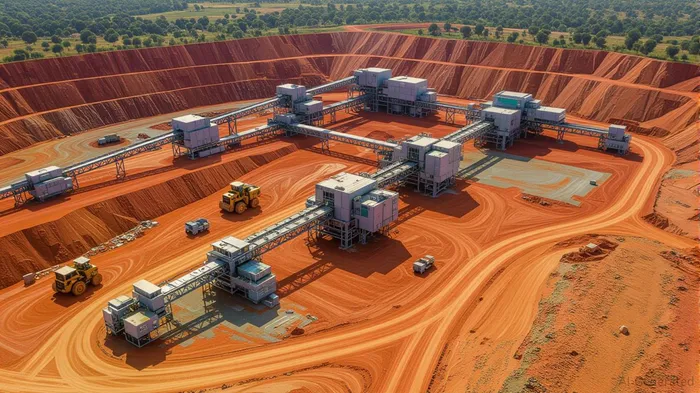
The Sentinel mine, FQM's flagship asset in Zambia, produced 230,792 tonnes of copper in 2024, an 8% increase over 2023, driven by higher grades and throughput. In 2025, FQM aims to further boost production by optimizing blast fragmentation, upgrading milling rates, and deploying innovative infrastructure like the Rail Running Conveyor (RRC)—a first-of-its-kind system reducing electricity and maintenance costs by 20%. This technology, capable of transporting 5,000 tonnes/hour over 3.5 km, underscores FQM's focus on efficiency.
Crucially, FQM's 15% stake in Prospect Resources—a partnership valued at A$15.2 million—has unlocked access to the nearby Mumbezhi Copper Project. Located just 25 km from Sentinel, Mumbezhi's maiden resource estimate of 514,600 tonnes of contained copper could extend Sentinel's mine life beyond its current 12-year projection. “This investment de-risks future ore supply and positions us to capitalize on Zambia's copper boom,” said Anthony Mukutuma, FQM's Country Director in Zambia.
Zambia: The Heart of Global Copper Supply
Zambia, Africa's second-largest copper producer, is at the center of a historic shift. The government's “3MT by 2031” goal—to triple annual production—aligns with FQM's strategy. The Sentinel and Kansanshi mines, which together produced 402,000 tonnes of copper in 2024, are critical to this ambition. FQM's partnership with Saudi Arabia's Manara Minerals (in talks to acquire a 15-20% stake in its Zambian assets) further bolsters its financial resilience, reducing reliance on volatile commodity markets.
Zambia's strategic advantage lies in its existing infrastructure—transport, water, and power networks—built over decades of mining. The Kansanshi S3 Expansion, set for completion in mid-2025, will add 25 million tonnes/year of processing capacity, extending the mine's life to 2046. This project, combined with Sentinel's upgrades, ensures FQM remains a low-cost producer, with AISC (All-In Sustaining Costs) projected at $3.05–3.35/lb copper in 2025, among the industry's most competitive.
Mitigating Risks: Regulatory Hurdles and Power Challenges
Despite its strengths, FQM faces risks. Zambia's ISPON regulatory framework imposes strict safety and environmental compliance, with penalties for non-compliance. In 2025, a temporary shutdown at the Kansanshi mine following a fatal accident highlighted these risks. Meanwhile, power shortages—due to droughts reducing hydropower output—have forced FQM to import costly diesel power, squeezing margins.
Geopolitically, Zambia's resource nationalism poses a threat. The government's push for greater local ownership could complicate FQM's plans. However, the company's collaboration with local partners like Prospect Resources and its $500 million prepayment deal with Jiangxi Copper (securing liquidity post-Cobre Panama's closure) demonstrate its commitment to navigating these risks.
Investment Implications: Long-Term Opportunity with Short-Term Caution
For investors, FQM offers a compelling play on copper's structural demand. With global copper consumption projected to double by 2050 due to EVs and renewables, Zambia's role as a low-cost supplier becomes increasingly vital. FQM's focus on technological innovation (e.g., the RRC system) and regional diversification (e.g., Saudi partnerships) further reduces exposure to single-project risks.
However, short-term volatility looms. Commodity price fluctuations and regulatory headwinds could pressure FQM's stock. As of July 2025, FQM's shares have underperformed the broader market, reflecting these uncertainties.
Final Analysis
FQM's Zambia strategy is a masterclass in leveraging African infrastructure and resource potential. By extending Sentinel's lifespan, diversifying partnerships, and adopting cutting-edge tech, the company is well-positioned to dominate copper supply in a green economy. Investors seeking exposure to the energy transition should consider FQM as a long-term holding—but remain mindful of near-term risks tied to regulatory scrutiny and power costs.
In the words of Tristan Pascall, FQM's CEO, who has prioritized balance sheet strength and strategic alliances: “Zambia is our core. Our focus on operational excellence and regional partnerships will ensure we thrive in a high-demand, high-risk landscape.” For now, the bet on Zambia remains a bet on copper's future—and FQM is leading the charge.

Stay ahead of the market.
Get curated U.S. market news, insights and key dates delivered to your inbox.


AInvest
PRO
AInvest
PRO



Comments
No comments yet