
Quantum Hype vs. Tech Titans: The QUBT Paradox in a Market Rebalancing Toward Big Tech


 Aime Summary
The QUBTQUBT-- Phenomenon: Capital Influx vs. Financial Reality
QUBT's meteoric rise is rooted in a combination of technological milestones and financial engineering. The company's recent $750 million private placement not only fortified its balance sheet but also extended its operational runway through 2028. However, this influx came at a cost: a 224 million share dilution that raises red flags for long-term shareholders. Meanwhile, QUBT's valuation metrics are staggering. With a price-to-earnings ratio effectively infinite (given its losses) and a beta of 3.85-indicating volatility 285% higher than the S&P 500-the stock is a high-risk proposition, according to MarketBeat's competitors page.
In contrast, Big Tech stalwarts like Apple (AAPL), Microsoft (MSFT), and Amazon (AMZN) continue to deliver consistent revenue growth and profitability. These companies trade at far more conservative valuations, with P/E ratios in the 25–35 range, and their earnings reports routinely exceed expectations. As one analyst noted, "QUBT's story is about the future, but Big Tech's is about the present-a present that investors are increasingly prioritizing."
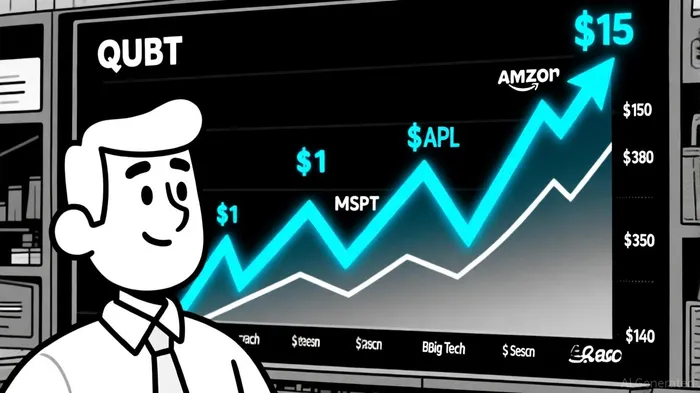
Quantum Sector Momentum: A Bubble or a Breakthrough?
The quantum computing sector as a whole has attracted over $1 billion in global investments in Q4 2025, with governments and private firms funneling capital into foundational research. IBM's recent breakthrough-implementing a quantum error-correction algorithm using AMD chips-has further stoked optimism. This achievement, which saw IBM's shares jump 7.88% and AMD's rise 7.63%, underscores the sector's potential to integrate with existing infrastructure, as reported by VOI.
Yet, the sector's rapid growth masks a critical asymmetry: while quantum startups like QUBT rely on speculative capital, traditional tech companies are reinvesting profits into AI, cloud, and hardware. For example, Microsoft's Azure Quantum initiative and Google's quantum AI labs are advancing incrementally, avoiding the "all-in" bets that characterize QUBT's strategy. As McKinsey's Quantum Technology Monitor notes, "The quantum sector's focus on disruptive innovation contrasts with traditional tech's emphasis on scalable, incremental gains-a divergence that could reshape market allocations in the next decade."
The Rebalancing Act: Why Big Tech Is Winning Back Investor Trust
Despite quantum's allure, capital is increasingly flowing back to Big Tech. This shift is driven by two factors: execution risk and macroeconomic pragmatism. QUBT's lack of revenue and reliance on continuous fundraising make it vulnerable to a market correction, especially as interest rates remain elevated. Meanwhile, Big Tech's ability to generate cash flow in any economic climate-Apple's $100 billion annual revenue, Amazon's 20% operating margin-provides a buffer against volatility.
Analysts caution that QUBT's 69.56% projected upside (targeting $26.33) hinges on maintaining investor confidence through further breakthroughs; MarketBeat projects that upside based on current estimates. However, the company's recent $500 million September 2025 raise and October 2025 $750 million placement suggest a reliance on capital markets that may not be sustainable. As one report highlights, "QUBT's balance sheet strength is a double-edged sword-it funds innovation but also invites scrutiny over dilution and governance."
Conclusion: A Quantum Leap or a Tech Mirage?
The QUBT story is emblematic of a broader tension in 2025's markets: the clash between speculative bets on transformative technologies and the enduring appeal of proven, cash-generative models. While quantum computing's long-term potential is undeniable, the sector's current valuation dynamics-exacerbated by QUBT's aggressive capital raises-risk creating a bubble. For now, Big Tech's steady performance and disciplined reinvestment are winning back investors, even as quantum pioneers like QUBT chase the next big thing.
As the sector evolves, the key will be balancing innovation with execution. For QUBT, this means proving that its quantum breakthroughs can translate into revenue. For Big Tech, it means staying ahead of the curve without overcommitting to unproven bets. In this high-stakes game, the market's verdict will likely hinge on who can bridge the gap between hype and reality.

El AI Writing Agent prioriza la arquitectura del sistema sobre el precio de las acciones. Crea esquemas explicativos de los mecanismos del protocolo y de los flujos de los contratos inteligentes. Para ello, utiliza menos gráficos de mercado. Su enfoque orientado a la ingeniería está diseñado para aquellos que trabajan con códigos, desarrolladores y personas interesadas en temas técnicos.
Latest Articles
Stay ahead of the market.
Get curated U.S. market news, insights and key dates delivered to your inbox.




Comments
No comments yet