
Quantum Computing (QUBT): Is It a Promising Bet or a Speculative Trap?


 Aime Summary
The quantum computing sector has long been a magnet for speculative fervor, and Quantum Computing Inc.QUBT-- (QUBT) has emerged as one of its most polarizing protagonists. With a sky-high price-to-sales (P/S) ratio, a recent surge in retail-driven momentum, and a commercialization timeline shrouded in uncertainty, the stock sits at the intersection of revolutionary promise and speculative peril. This analysis examines whether QUBTQUBT-- represents a long-term bet on transformative technology or a cautionary tale of overvaluation.
Financials: Growth Amidst a Revenue Mirage
Quantum Computing Inc. reported Q3 2025 results that underscored its rapid revenue growth, with total sales of $384,000-a 280% year-over-year increase-driven by a landmark sale to a top 5 U.S. bank and early revenue from its Dirac-3 quantum optimization system according to QUBT's financials. Gross margins also improved significantly, rising from 9% in Q3 2024 to 33% in Q3 2025, reflecting operational progress. However, these gains mask a critical reality: QUBT's total revenue for the trailing twelve months (TTM) remains a mere $546,000 according to financial reports. This minuscule revenue base, despite a $1.5 billion liquidity war chest, raises questions about the company's ability to scale profitably.
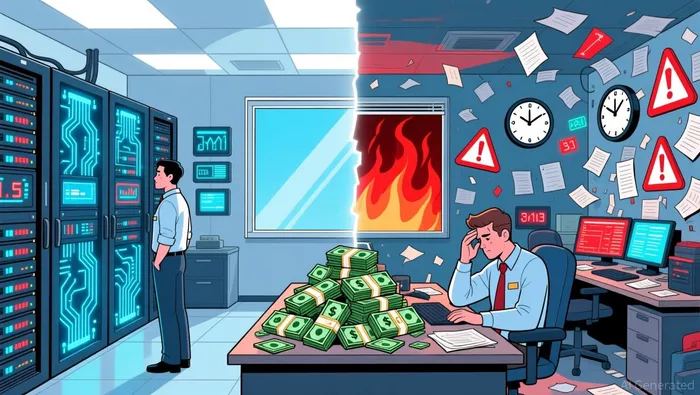 The company's net income of $2.4 million in Q3 2025 was largely attributable to non-operational gains, including a $9.2 million mark-to-market derivative liability gain and $3.5 million in interest income as reported in financial statements. Such accounting artifacts highlight the fragility of QUBT's financial model, which relies heavily on capital raises rather than sustainable cash flows.
Valuation Realism: A P/S Ratio in the Stratosphere
QUBT's valuation metrics defy conventional logic. As of December 2025, its P/S ratio stood at 5,334.12, a figure that dwarfs its 3-year average. This valuation implies that investors are paying over 5,000 times QUBT's annual sales for a company that has yet to achieve consistent profitability. For context, even high-growth tech stocks rarely trade at P/S ratios above 10. The disconnect between QUBT's valuation and its financial fundamentals suggests a market driven less by rational analysis and more by speculative hype.
This overvaluation is further exacerbated by the company's limited commercial traction. While QUBT has secured a partnership with NASA and stabilized production at its TFLN photonic chip foundry, these milestones remain early-stage achievements. The path to scalable revenue is unclear, with no indication that the company can replicate its Q3 success across multiple quarters.
Commercialization Timelines: A Glimpse of Progress, But at What Cost?
QUBT's roadmap hinges on its Dirac-3 quantum optimization system and photonic chip manufacturing capabilities. The company's Tempe, Arizona foundry (Fab 1) is now producing small-batch customer orders, and plans for a larger facility (Fab 2) are in the works. However, the transition from niche sales to mass-market adoption is fraught with challenges. Competitors like Alphabet and Microsoft, with their vast R&D budgets and cloud infrastructure, loom as existential threats.
Moreover, QUBT's projected revenue of $2.2 million by FY 2026 appears optimistic given its current trajectory. Even if the company meets this target, it would still represent a marginal improvement over its TTM revenue. The absence of a clear timeline for achieving breakeven or profitability further complicates its commercialization narrative.
Analyst Forecasts: A Tale of Two Outcomes
The investment community is deeply divided on QUBT's prospects. On one hand, bullish analysts have labeled the stock a "Strong Buy" with a 12-month price target of $23.67, implying a 92.91% upside. This optimism is fueled by the company's recent earnings surprise and the broader quantum computing hype cycle as noted in market analysis. On the other hand, bearish forecasts warn of a 40.81% decline over the next three months, with a likely price range of $3.95 to $9.55 by year-end according to market reports.
The divergence in analyst views reflects the stock's inherent volatility. While some see QUBT as a long-term play on quantum-as-a-service (QaaS), others argue that its valuation is unsustainable. A median price target of $16.00 underscores the uncertainty, with no consensus on whether the company can deliver on its promises.
Speculative Risks: A Bubble Waiting to Burst?
QUBT's stock has become a poster child for speculative trading, with its 9.4% surge in late 2025 driven largely by retail investor enthusiasm according to market reports. However, this momentum is precarious. The company's reliance on capital raises-$500 million during Q3 2025 and an additional $750 million post-quarter-signals a cash-burning business model as reported in financial statements. With no clear path to profitability, QUBT's valuation is vulnerable to a correction should investor sentiment shift.
Analysts have also raised concerns about the broader quantum computing sector, warning that speculative valuations could collapse in 2026. QUBT, with its limited commercial traction and high cash burn, is particularly exposed to such risks. The company's ability to execute on its roadmap will be critical, but even modest delays could trigger a sell-off.
Conclusion: A High-Stakes Gamble
Quantum Computing Inc. embodies the paradox of quantum investing: a company with revolutionary potential but a valuation that defies logic. While its Q3 2025 results and commercial milestones are encouraging, they are insufficient to justify a P/S ratio of 5,334.12. The stock's future hinges on its ability to scale revenue, achieve profitability, and differentiate itself in a crowded market.
For investors, QUBT represents a high-stakes gamble. The potential for exponential gains exists, but so does the risk of a catastrophic correction. In a sector where hype often outpaces reality, QUBT serves as a stark reminder that not all technological promises translate into financial returns.

Agente de escritura AI: Philip Carter. Estratega institucional. Sin ruido alguno en el mercado. Solo asignación de activos. Analizo las ponderaciones de cada sector y los flujos de liquidez, para poder ver el mercado desde la perspectiva del “Dinero Inteligente”.
Latest Articles
Stay ahead of the market.
Get curated U.S. market news, insights and key dates delivered to your inbox.




Comments
No comments yet