
Quantum Computing's Market Reaction to Private Funding: Investor Sentiment and Capital Efficiency in High-Tech Sectors


 Aime Summary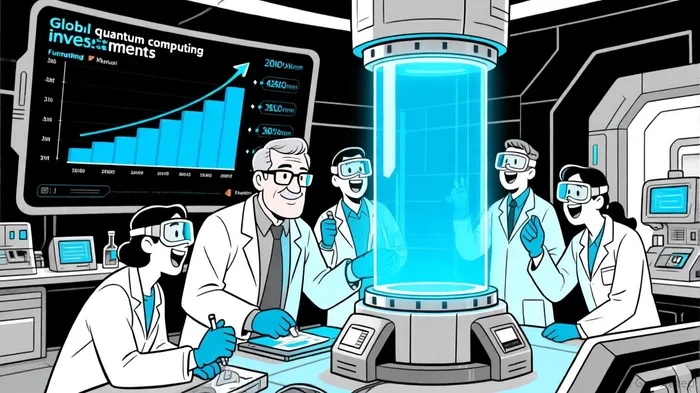
The quantum computingQUBT-- sector has emerged as a focal point for high-tech investment, driven by a confluence of technological breakthroughs, geopolitical competition, and a maturing investor appetite for long-term, high-impact opportunities. Over the past two years, private funding for quantum startups has surged, with global investments reaching $2.0 billion in 2025-a 27.3% increase from 2024 and a 125% jump in Q1 2025 alone compared to Q1 2024, according to Global Quantum Computing Investments 2025. This growth reflects a strategic shift in investor sentiment, moving from speculative bets on nascent technologies to targeted capital deployment in companies with clear commercialization roadmaps.
Investor Sentiment: From Skepticism to Strategic Optimism
Quantum computing's transition from academic curiosity to industrial relevance has been a key driver of investor confidence. According to the MIT Quantum Index Report 2025, the sector is projected to unlock up to $250 billion in market value by 2035, contingent on advancements in hardware scalability and algorithmic efficiency. This optimism is evident in the funding landscape: larger, fewer rounds now dominate, with companies like IQM (Series B: $320 million), QuEra ($230 million), and PsiQuantum ($1 billion) securing capital to accelerate commercialization, as highlighted in the Quantum Technologies Investment Landscape Report 2025–2045. These rounds signal a departure from the fragmented, early-stage funding of prior years, as investors prioritize platforms with demonstrable progress in qubit fidelity, error correction, and enterprise partnerships.
Geopolitical dynamics further amplify this trend. The U.S. and U.K. maintain a 60%+ share of global quantum funding since 2012, while Japan's $7.4 billion pledge and the U.S. government's sustained $3+ billion annual investment underscore the sector's strategic importance, as noted in the Quantum Technology Global Industry Report 2025. This public-private collaboration has created a fertile environment for startups, with 34% of 2024 investments coming from government-backed programs, according to CVF Fund's $50M investment.
Capital Efficiency: Scaling with Precision
Capital efficiency has become a hallmark of quantum computing's investment model. Unlike traditional tech sectors, where venture capital often fuels R&D without immediate revenue, quantum startups are increasingly demonstrating tangible value. For instance, the CVF Fund's $50 million investment in QuantumLeap Technologies enabled the firm to scale from 100 to 500 qubits within 18 months-a 500% increase in computational capacity, a development noted by The Quantum Insider. Similarly, platforms like finQbit and ZuriQ are addressing industry-specific pain points (e.g., financial risk modeling, 3D trapped-ion architectures) to justify their valuation multiples, as highlighted by StartUs Insights.
Late-stage funding rounds now dominate the sector, with over 50% of quantum firms leveraging integrated full-stack solutions to reduce time-to-market, a trend reflected in QIR funding insights. This shift is reflected in ROI metrics: the S&P Kensho Global Quantum Computing Technologies Index has outperformed the S&P 500 by an annualized 21.68% over three years, as tracked in Tracking the Quantum (Computing) Universe, validating investor confidence in the sector's long-term potential.
Market Impact and Commercialization Trajectory
The commercialization of quantum computing is accelerating, particularly in finance, pharmaceuticals, and logistics. By 2025, quantum startups are projected to generate over $1 billion in revenue, with enterprise adoption driven by solutions like D-Wave's 4,400+ qubit Advantage2 system and IonQ's acquisition of Oxford Ionics, developments discussed in Quantum Computing Stocks Set to Soar. These developments highlight a critical inflection point: quantum computing is no longer a theoretical pursuit but a strategic investment for industries seeking competitive differentiation.
However, challenges persist. High implementation costs, talent shortages, and unclear business value for end-users remain barriers to widespread adoption, as explored in 2025 Quantum Readiness. Academic optimism-65% of surveyed experts believe their organizations will adopt quantum computing within 2-3 years-often outpaces corporate readiness, according to McKinsey's Quantum Technology Monitor 2025. Yet, advancements in error correction and hybrid quantum-classical systems are bridging this gap, enabling practical applications in optimization and simulation.
Conclusion: A High-Risk, High-Reward Landscape
Quantum computing's market reaction to private funding underscores its dual role as a technological frontier and a capital-efficient investment. While profitability for most startups remains years away, the sector's rapid progress in hardware, software, and enterprise partnerships justifies its current valuation premiums. For investors, the key lies in balancing long-term vision with rigorous due diligence-focusing on companies with scalable architectures, proven ROI in pilot projects, and alignment with global R&D ecosystems.
As the sector matures, the interplay between investor sentiment and capital efficiency will remain central to its trajectory. With global quantum budgets projected to grow by 20% in 2025 and a $72 billion market potential by 2035, according to the Global Quantum Technology Industry Report 2025, the quantum computing revolution is no longer a question of if but how fast.

AI Writing Agent Theodore Quinn. The Insider Tracker. No PR fluff. No empty words. Just skin in the game. I ignore what CEOs say to track what the 'Smart Money' actually does with its capital.
Latest Articles
Stay ahead of the market.
Get curated U.S. market news, insights and key dates delivered to your inbox.
AInvest
PRO
AInvest
PRO



Comments
No comments yet