
Quantum Computing's Next Frontier: Evaluating D-Wave Quantum and NVIDIA's Strategic Play in 2025
 Aime Summary
The race to harness quantum computingQUBT-- is accelerating, with two distinct approaches emerging from D-Wave QuantumQBTS-- (NYSE: QBTS) and NVIDIANVDA-- (NASDAQ: NVDA). While both companies are shaping the future of quantumQMCO-- technology, their strategies, financials861076--, and long-term positioning diverge significantly. This analysis explores their 2025 trajectories, offering investors a framework to assess their relative strengths and risks in a rapidly evolving sector.
D-Wave Quantum: Pioneering Hardware Commercialization
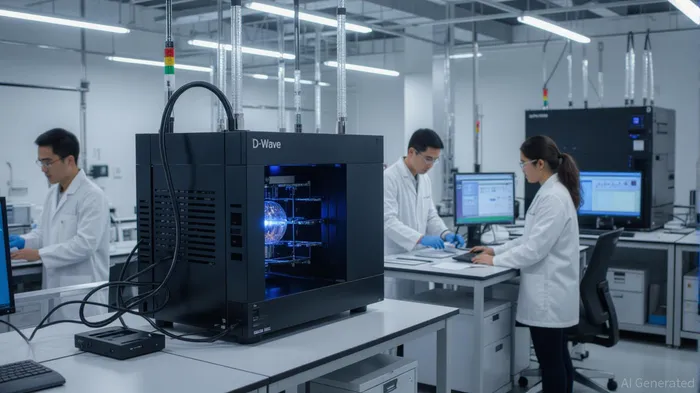
D-Wave has made headlines in 2025 by transitioning from quantum-as-a-service (QCaaS) to hardware sales, a shift that has unlocked higher-margin revenue. In Q1 2025, the company reported $15.0 million in revenue, a 509% year-over-year surge, driven by the sale of its Advantage™ system to a major research institution. This pivot to hardware underscores D-Wave's ambition to monetize physical quantum systems, a strategy that has boosted gross margins to 92.5% (GAAP) and 93.6% (non-GAAP), up from 67.3% and 76.6% in 2024.
Despite these gains, D-WaveQBTS-- remains unprofitable, reporting a $5.4 million net loss in Q1 2025. However, the reduction in losses—from $17.3 million in 2024—signals improved cost management. The company's liquidity is robust, with $304.3 million in cash as of Q1 2025, bolstered by a $146.2 million raise via its ATM program. This financial flexibility supports R&D and global expansion, including partnerships in the U.S. public sector and South Korea.
D-Wave's valuation is speculative, with a $5.3 billion market cap and a P/S ratio exceeding 600. This premium reflects investor optimism about its commercialization progress, but also raises questions about sustainability. Key catalysts include the integration of its Advantage2 system with Europe's first exascale supercomputer and a $40 million agreement with Canada's Digital Innovation Network.
NVIDIA: Enabling the Quantum Ecosystem
NVIDIA's approach to quantum computing is markedly different. Rather than developing quantum processing units (QPUs), the company is positioning itself as a bridge between classical and quantum computing through software and infrastructure. Its CUDA-Q platform—a quantum-focused extension of its CUDA software—aims to replicate the success of its AI ecosystem in the quantum domain.
In 2025, NVIDIA has also pursued strategic partnerships, including advanced talks to invest in PsiQuantum, a leading quantum startup. This move aligns with NVIDIA's broader vision of future-proofing its AI and data center dominance. The company's hybrid strategy—leveraging its expertise in silicon photonics, networking, and AI—positions it to benefit from quantum advancements without the high costs of direct QPU development.
NVIDIA's financials in 2025 are staggering. With a $4 trillion market cap, the company's data center revenue hit $39.1 billion in Q1 2025, up 73% year-over-year. Its forward P/E ratio of 40.1 is justified by 50%+ revenue growth projections and a $53.69 billion cash reserve. While quantum computing is not yet a material revenue driver, NVIDIA's investments in silicon photonics (e.g., Spectrum-X and Quantum-X switches) and its research centers in Boston and Japan signal a long-term play on quantum infrastructure.
Comparative Analysis: Valuation, Momentum, and Risk
Valuation Metrics
- D-Wave: A P/S ratio of 600+ is extreme, even for a high-growth tech stock. Its valuation is justified by revenue acceleration and strategic partnerships but lacks the diversified revenue base of NVIDIA.
- NVIDIA: A forward P/E of 40.1 is reasonable given its 50%+ growth and dominance in AI. Its quantum initiatives are a small but strategic component of its broader ecosystem.
Revenue Momentum
- D-Wave's 509% revenue growth is unparalleled, but its net losses and reliance on equity raises raise concerns about scalability.
- NVIDIA's $39.1 billion data center revenue in Q1 2025 reflects a more sustainable, diversified model. Its quantum bets are low-risk, high-reward.
Long-Term Positioning
- D-Wave is a pure-play quantum hardware provider, with all the risks and rewards of being first to market. Its partnerships with governments and research institutions could unlock recurring revenue.
- NVIDIA is a tech infrastructure play, betting on its ability to integrate quantum computing into existing workflows. Its hybrid approach reduces risk but may limit upside if quantum adoption lags.
Investment Implications
For investors with a high-risk appetite and a long-term horizon, D-Wave offers exposure to quantum computing's commercialization phase. Its 509% revenue growth and aggressive expansion justify the speculative valuation, but caution is warranted given its unprofitability and dependence on equity financing.
For those seeking a more balanced approach, NVIDIA's hybrid strategy provides a safer bet. Its quantum initiatives are a small part of a $4 trillion empire, but its CUDA-Q and silicon photonics investments position it to benefit from quantum computing's eventual mainstream adoption.
Key Takeaway: D-Wave is ideal for aggressive investors betting on quantum hardware's rapid commercialization, while NVIDIA offers a diversified, infrastructure-focused play on the quantum future. Both face uncertainty, but their strategies reflect different risk profiles.
In the quantum computing race, the winner may not be the one building the fastest QPU but the one best positioned to integrate quantum power into the existing tech stack. For now, D-Wave and NVIDIA are charting distinct paths—each with compelling opportunities for investors willing to navigate the sector's volatility."""

Delivering real-time insights and analysis on emerging financial trends and market movements.
Latest Articles
Stay ahead of the market.
Get curated U.S. market news, insights and key dates delivered to your inbox.




Comments
No comments yet