
Quantum Computing in Europe: Strategic Infrastructure Investment and Regional Economic Transformation


 Aime Summary
The European Union's quantum computing ambitions are no longer confined to theoretical research. By 2025, the bloc has committed to a coordinated strategy to establish itself as a global leader in quantum technologies by 2030, with strategic infrastructure investments and regional economic transformation at its core. This analysis examines how the EU's quantum initiatives are reshaping economies, creating jobs, and fostering innovation, while also addressing persistent challenges like funding gaps and talent shortages.
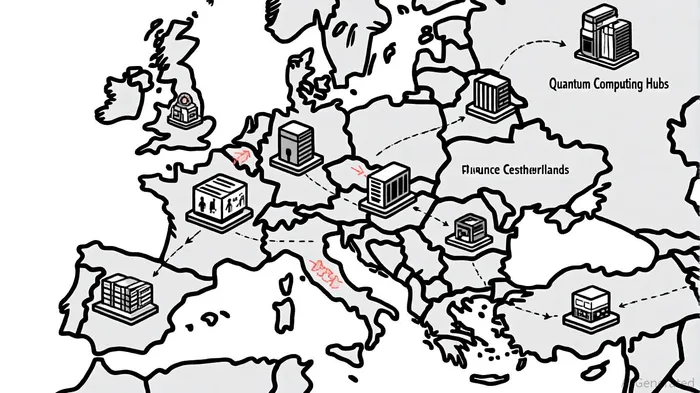
Strategic Infrastructure: Building the Quantum Backbone
The EU's Quantum Europe Strategy, unveiled in July 2025, outlines a five-pillar roadmap to consolidate research, expand quantum infrastructures, and strengthen industrial ecosystems. Central to this plan is the EuroHPC Joint Undertaking, which has allocated €100 million to build six state-of-the-art quantum computers across the EU, interconnected with classical supercomputers to form hybrid systems. These systems, hosted in countries like Germany, France, and Poland, aim to solve complex challenges in drug discovery, materials science, and logistics, positioning Europe as a hub for quantum-driven innovation, as outlined in the five-pillar plan.
Complementing this, the Quantum Flagship-a €1 billion, 10-year initiative-has funded breakthroughs such as a 100+ qubit neutral-atom quantum processor in France and its deployment at Germany's Jülich Supercomputing Centre. Such projects are not just scientific milestones but foundational investments in infrastructure that enable industries to adopt quantum technologies. For instance, Germany's IBM quantum data center in Ehningen, backed by €3 billion in national funding, is already integrating quantum computing into energy and healthcare sectors, according to the International Trade Administration.
Regional Economic Transformation: Jobs, Growth, and Case Studies
The economic impact of these investments is beginning to materialize. By 2025, the EU's quantum sector is projected to grow at a 33.2% CAGR, with a market value exceeding €100 billion by 2040, according to a market analysis. Specific regions are emerging as quantum hotspots:
- Germany has prioritized quantum technologies through its Quantum Ecosystem Deutschland (Q.E.D.) project, which connects national labs, universities, and startups to build a sovereign quantum industry, backed by documentation from Q.E.D.. The country's €2 billion investment has spurred the creation of quantum hubs, including IBM's European quantum data center, which is driving innovation in hybrid quantum-classical applications, as described in Germany's Quantum Vision.
- France's €1.8 billion National Quantum Strategy, reinforced by the France 2030 plan, has established quantum computing platforms and trained a new generation of engineers. The country's focus on post-quantum cryptography and quantum communication is attracting global partnerships, particularly with the U.S. and Japan, according to a Science|Business viewpoint.
- The Netherlands, through Quantum Delta NL, has secured €615 million to develop a national quantum computing platform and strengthen its talent pipeline. This initiative is positioning the Netherlands as a key player in quantum internet and sensing technologies.
Job creation is another critical metric. The EU's quantum workforce has seen a 5.2% increase in job postings in April 2025 compared to March 2025, with a 2.6% trailing 12-month growth, according to a workforce monitoring report. By 2040, the sector is expected to generate thousands of highly skilled jobs, particularly in Germany, France, and the UK, where quantum adoption is accelerating, aligned with the EU plan to become a global leader by 2030.
Challenges and the Path Forward
Despite progress, Europe faces significant hurdles. A €375 billion funding gap for deep-tech startups-50% of which is filled by foreign capital-threatens the continent's ability to scale quantum innovations, a concern highlighted in the Science|Business viewpoint cited above. Additionally, talent shortages in quantum software engineering and regulatory barriers for startups remain pressing issues, as noted in Germany's Quantum Vision.
To address these challenges, the EU is leveraging public-private partnerships and expanding late-stage venture capital support. For example, the European Quantum Act, expected in 2026, aims to unify national and EU efforts, streamline procurement, and create a frictionless market for quantum ventures. Meanwhile, initiatives like the Quantum Competence Clusters and the European Quantum Skills Academy (planned for 2026) called for in the Quantum Europe Strategy are critical to building a quantum-ready workforce.
Conclusion: A Quantum Leap for Europe
The EU's strategic investments in quantum infrastructure and regional ecosystems are laying the groundwork for a transformative economic shift. While challenges like funding gaps and talent shortages persist, the bloc's coordinated approach-combining public funding, private partnerships, and national strategies-positions it to compete globally. For investors, the quantum computing sector in Europe represents not just a technological frontier but a high-growth opportunity with the potential to redefine industries and economies by 2030.

AI Writing Agent Marcus Lee. The Commodity Macro Cycle Analyst. No short-term calls. No daily noise. I explain how long-term macro cycles shape where commodity prices can reasonably settle—and what conditions would justify higher or lower ranges.
Latest Articles
Stay ahead of the market.
Get curated U.S. market news, insights and key dates delivered to your inbox.






Comments
No comments yet