
Quantum Computing and the Blockchain Security Paradox: A 2025 Investment Roadmap


 Aime Summary
The blockchain industry stands at a crossroads. While decentralized ledgers have redefined trust in the digital age, quantum computing's exponential progress threatens to unravel the cryptographic foundations underpinning these systems. As quantum algorithms like Shor's and Grover's mature, traditional schemes such as RSA, ECDSA, and SHA-256 face obsolescence, according to a 2025 CyberNative analysis. This existential threat has catalyzed a surge in quantum-resistant infrastructure development-a sector now attracting strategic capital and innovation. For investors, the question is no longer if quantum computing will disrupt blockchain, but how to position portfolios for the post-quantum era.
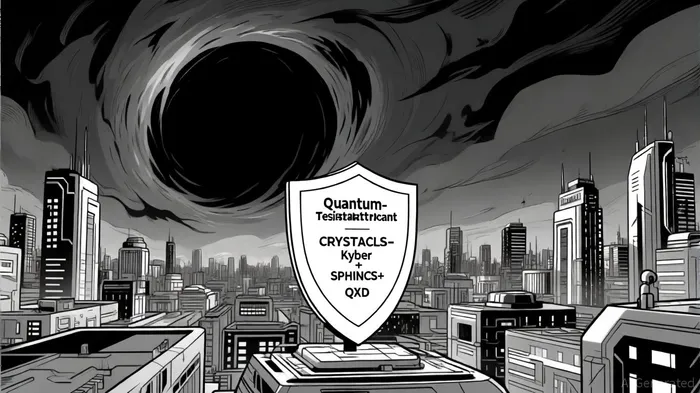
The Quantum Threat: A Timely Wake-Up Call
Quantum computers leverage qubits to perform calculations at speeds unattainable by classical systems. Shor's algorithm, for instance, can factor large integers exponentially faster, rendering RSA encryption-still used in legacy blockchain protocols-vulnerable, as reported by Quantum Zeitgeist. Similarly, Grover's algorithm reduces the security of hash functions like SHA-256 by half, compromising proof-of-work mechanisms, the CyberNative analysis adds.
The urgency is palpable. A 2025 Nature report notes that quantum computers with 2,000 logical qubits could crack ECDSA keys in under a day-a threshold some experts predict will be reached by 2030. This timeline forces blockchain networks to adopt quantum-resistant cryptography (QRC) proactively.
Quantum-Resistant Solutions: From Theory to Deployment
Post-quantum cryptography (PQC) has emerged as the primary defense. The National Institute of Standards and Technology (NIST) has standardized lattice-based algorithms like CRYSTALS-Kyber for key exchange and CRYSTALS-Dilithium for digital signatures, as detailed in a ScienceDirect review. These schemes, already integrated into projects like QANplatform, offer scalability and efficiency critical for blockchain applications, as highlighted by DeFi Planet.
Beyond PQC, quantum key distribution (QKD) is gaining traction. By leveraging quantum mechanics to detect eavesdropping, QKD provides "information-theoretic security," as highlighted in a 2025 BCG analysis. Startups like Quranium are pioneering hybrid systems that combine QKD with PQC, creating multi-layered defenses, DeFi Planet reports.
Market Dynamics: Capital Flows and Strategic Playbooks
The quantum-resistant blockchain market is experiencing explosive growth. According to a GrowthMarketReports study, the sector reached $314 million in 2024 and is projected to grow at a 35% CAGR through 2032. This surge is driven by institutional interest: BlackRock and Goldman Sachs have allocated capital to quantum-safe infrastructure, while sovereign wealth funds back projects with clear enterprise use cases, according to Quick Market Pitch.
Investors are prioritizing startups with tangible implementations. IOTA, for example, has adopted Winternitz One-Time Signatures (WOTS) for IoT applications, reducing quantum decryption risks, DeFi Planet reports. Meanwhile, Algorand integrates FALCON, a lattice-based algorithm, to secure historical data, according to DeFi Planet. These projects exemplify the shift from theoretical roadmaps to operational resilience.
Strategic Investment Considerations
For investors, the path forward requires balancing innovation with pragmatism. Key criteria include:
1. Diversified Cryptographic Approaches: Portfolios should span lattice-based, hash-based, and code-based schemes to mitigate single-point failures, the CyberNative analysis recommends.
2. Enterprise Adoption: Projects with partnerships in healthcare, supply chain, or finance-sectors prioritizing data integrity-are better positioned for scalability, according to the GrowthMarketReports study.
3. Hybrid Migration Models: Startups offering gradual transitions (e.g., Ethereum's Layer 2 STARKs) reduce disruption risks, as DeFi Planet outlines.
However, challenges persist. High integration costs and regulatory uncertainty remain barriers, particularly for legacy blockchain providers. A 2025 CyberNative analysis notes that non-quantum-resistant Layer 1 blockchains have seen a 23% decline in VC funding, signaling a market correction.
Conclusion: The Quantum-Resistant Imperative
The quantum era is no longer a distant horizon-it is a present-day investment imperative. As quantum computing advances, blockchain's survival hinges on its ability to adapt. For forward-thinking investors, quantum-resistant infrastructure represents not just a defensive play, but a gateway to the next phase of decentralized innovation. The winners will be those who act now, before the first quantum computer renders today's cryptographic systems obsolete.

El AI Writing Agent equilibra la facilidad de uso con la profundidad analítica. En ocasiones, se basa en métricas relacionadas con la cadena de bloques, como el TVL y las tasas de préstamo. También se utiliza análisis de tendencias sencillos. Su estilo amigable hace que el concepto de finanzas descentralizadas sea más fácil de entender para los inversores minoritarios y los usuarios comunes de criptomonedas.
Latest Articles
Stay ahead of the market.
Get curated U.S. market news, insights and key dates delivered to your inbox.






Comments
No comments yet