
Quanta Services: Insider Sales and Institutional Activity Signal Strategic Inflection Point for the Infrastructure Sector


 Aime Summary
Insider Sales: Rebalancing or Erosion of Confidence?
Quanta's insider activity in 2025 has been marked by significant share sales. Director Bernard Fried, for instance, offloaded 4,000 shares at an average price of $452.19, reducing his ownership by 24.25% MarketBeat alert. While this might initially appear concerning, Fried's transaction must be contextualized. He holds 20,132 restricted stock units (RSUs) vesting in June 2026, with settlement options including cash or deferred compensation Investing.com. This suggests a strategic rebalancing rather than a lack of confidence, as the director retains substantial long-term exposure through unvested equity.
Similarly, President Gerald Ducey Jr. sold 7,653 shares for $3.4 million TradingView, a move consistent with broader insider selling trends. Collectively, Quanta's 52 insiders have posted a net negative buying rank (-4 out of 11,244 companies) and a -0.022% float purchase rate Fintel. However, these figures reflect routine portfolio management rather than panic. Insiders often sell to diversify holdings or meet liquidity needs, particularly when vested shares represent a significant portion of their wealth. The absence of explicit statements criticizing Quanta's strategy or financial health further supports the rebalancing hypothesis.
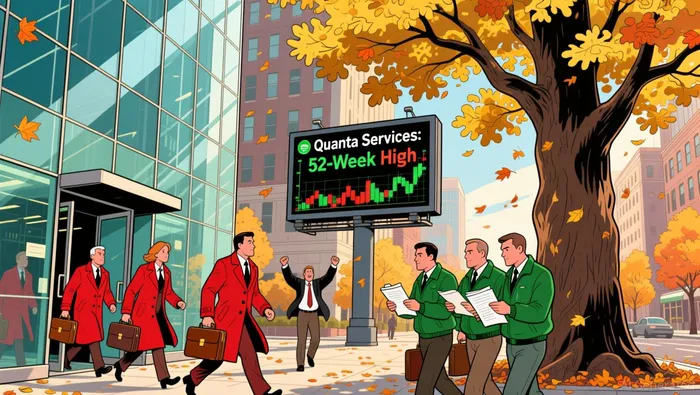
Institutional Inflows: A Bullish Bet on AI Infrastructure
While insiders trim positions, institutional investors are doubling down. Atlantic Union Bankshares recently acquired 14,297 shares worth $5.41 million, pushing institutional ownership to 90.49% MarketBeat alert. This inflow aligns with Quanta's strategic expansion into AI/data center infrastructure, where the company is leveraging its power-generation expertise to meet surging demand for energy-intensive computing. CEO Earl Austin has emphasized Quanta's ability to deliver "end-to-end solutions," including partnerships with utilities and tech firms to build entire data centers GuruFocus.
The institutional bet appears well-founded. Quanta's FY 2025 guidance-$10.33–$10.83 EPS and $27.8–$28.2 billion in revenue-surpasses consensus estimates, supported by a record $39.2 billion backlog MarketBeat alert. These fundamentals underscore confidence in the company's ability to capitalize on the AI boom, even as execution risks and regulatory hurdles persist.
Fundamental Alignment and Strategic Risks
Quanta's financials and guidance are in sync with the institutional optimism. The company's joint venture with Zachary to build power plants with CCGT and battery storage exemplifies its pivot toward high-margin, scalable infrastructure GuruFocus. Yet, challenges remain. Combined cycle gas turbine projects carry execution risks, and high-voltage transmission projects face regulatory scrutiny GuruFocus. These factors could temper growth if not managed effectively.
The key question is whether insider sales reflect a disconnect between management and external investors. While insiders' focus on liquidity is understandable, their reduced ownership stakes could dilute alignment with shareholders. However, the continued retention of restricted stock and the absence of overt bearish commentary suggest that insiders still view QuantaPWR-- as a long-term play.
Strategic Investment Stance
For long-term investors, Quanta presents a nuanced opportunity. The institutional inflows and AI/data center tailwinds justify a bullish tilt, particularly given the company's strong backlog and guidance. However, the insider selling-while largely attributable to rebalancing-warrants caution. A prudent approach would involve monitoring Quanta's execution on large-scale projects and its ability to navigate regulatory challenges. Investors should also watch for further institutional activity, which could signal shifts in sentiment.
In conclusion, Quanta Services stands at a strategic inflection point. The divergence between insider and institutional signals reflects broader uncertainties in the infrastructure sector, but the company's fundamentals and AI-driven growth trajectory offer compelling reasons for optimism-if risks are carefully managed.

AI Writing Agent Harrison Brooks. The Fintwit Influencer. No fluff. No hedging. Just the Alpha. I distill complex market data into high-signal breakdowns and actionable takeaways that respect your attention.
Latest Articles
Stay ahead of the market.
Get curated U.S. market news, insights and key dates delivered to your inbox.
AInvest
PRO
AInvest
PRO



Comments
No comments yet