
Quanta Services: Capturing the Multi-Trillion Dollar AI and Grid Build-Out


 Aime Summary
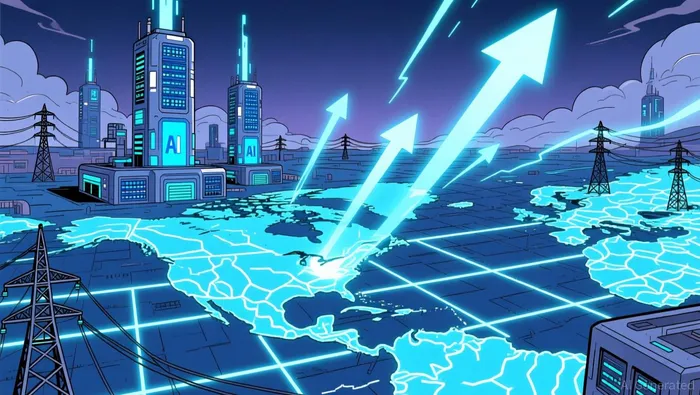
The core thesis for Quanta ServicesPWR-- is built on two massive, secular infrastructure build-outs. The first is the explosive demand for power to run artificial intelligence, which is creating a multi-trillion-dollar market for data center construction and grid upgrades. The numbers paint a picture of exponential growth that is just beginning.
The data center power market itself is projected to grow at a robust 10.8% CAGR to $24.05 billion by 2029. North America is the leading region, but the real story is in the United States. US data center power demand is forecast to nearly triple by 2030, reaching 134.4 GW. This isn't a linear climb; it's a step-change. Demand is expected to jump from 61.8 GW in 2025 to 75.8 GW in 2026, then to 108 GW in 2028, and finally to that 134.4 GW target in 2030. This acceleration is directly fueled by AI, which requires vastly more electricity than traditional computing.
This power surge is driving a broader infrastructure build-out of staggering scale. To sustain AI adoption, data center capacity will need to grow almost exponentially. Estimates suggest capacity could rise at an annual rate of between 19% and 22% from 2023 to 2030. That kind of growth demands a parallel build-out of the physical grid. The strain is already visible, with data centers consuming a significant share of state electricity supplies today and that share set to balloon. Goldman Sachs predicts global data center power consumption will increase 160% over the next five years.
For QuantaPWR--, this represents a multi-trillion-dollar Total Addressable Market. The company is positioned to capture significant share in this build-out, providing the critical engineering, procurement, and construction services needed to connect these massive new power loads to the grid and build the data centers themselves. The TAM isn't just about power; it's about the entire physical infrastructure ecosystem that will support the AI era.
Scalability Engine: Backlog, M&A, and Market Penetration
Quanta's path to capturing its multi-trillion-dollar TAM is built on a scalable model that combines secured visibility with strategic firepower. The foundation is a massive backlog that provides a clear line of sight into future revenue. At the end of the third quarter of 2025, the company's total backlog stood at $39.2 billion. This isn't just a number; it's a commitment from customers for work to be done, offering high visibility and reducing the uncertainty that often plagues cyclical construction firms. The acceleration is particularly notable in the electric segment, which is directly tied to the grid modernization and data center build-out. This backlog acts as a built-in growth engine, ensuring a steady pipeline of work as the company executes on these large, complex projects.
To fuel this growth, Quanta has made strategic acquisitions that directly target the AI and data center infrastructure market. Its 2024 purchase of Cupertino Electric for $1.5 billion was a pivotal move. Cupertino Electric brought deep expertise in electrical infrastructure, a critical capability for the power-hungry data centers driving the current build-out. This acquisition didn't just add revenue; it expanded Quanta's technical talent and strengthened its position as a comprehensive provider for the entire power transmission and distribution chain needed to connect AI facilities to the grid.
This brings us to the third pillar of scalability: a broad service platform that enables cross-selling and the capture of larger, integrated projects. Quanta operates across electric power, communications, and industrial sectors, offering end-to-end solutions from engineering to maintenance. This breadth is a competitive moat. A single data center project, for instance, requires not just power grid connections but also fiber optic networks and industrial piping. Quanta's integrated model allows it to win these larger, bundled contracts, increasing its revenue per project and deepening customer relationships. The company's ability to secure such work is evident in its record backlog, which has grown from $35.3 billion as of March 2025 to $39.2 billion by September.
Together, these elements form a powerful scalability engine. The backlog provides the contracted work, the M&A strengthens the capabilities for the fastest-growing markets, and the diversified service platform allows Quanta to capture more value from each project. This setup is designed for sustained, high-growth execution as the AI and grid build-out accelerates.
Financial Execution: Growth, Cash Flow, and Valuation
The scalable model is translating directly into financial results. In the third quarter of 2025, Quanta demonstrated strong execution, with revenues reaching $7.63 billion, a robust 17.6% year-over-year increase. This growth was not just top-line; it was profitable and cash-generative. The company reported a record backlog of $39.2 billion and generated free cash flow of $726.3 million through the first nine months of the year. That level of cash flow is critical. It funds the company's ambitious growth strategy-its acquisitions, its expansion into new markets like power generation, and its investment in talent-while also providing a buffer for shareholder returns. For a growth investor, this is the ideal setup: a business model that scales revenue and profits while simultaneously producing substantial cash to reinvest.
The market is clearly pricing in this high-growth potential. The stock's forward price-to-earnings ratio sits at a premium of roughly 48x. This valuation reflects the consensus view that Quanta is well-positioned to capture a significant share of the multi-trillion-dollar AI and grid build-out. Analysts have been raising their price targets, with firms like Truist and Evercore ISI citing the company's clean beat-and-raise and its strategic expansion into power generation as key drivers. The bullish narrative is clear: Quanta is executing on a long-duration infrastructure cycle with a proven, integrated platform.
Yet, the elevated multiple also means expectations are sky-high. The company must consistently deliver on its promise of double-digit earnings growth to justify the current price. As JPMorgan noted, while the Q3 results were strong, the stock's valuation leaves little room for error. The path forward requires Quanta to not only maintain its current execution pace but also to continue converting its massive backlog into revenue and cash flow at an accelerated clip. The financials show the engine is running well, but the valuation demands that it runs faster.
Catalysts, Risks, and What to Watch
The growth thesis for Quanta Services is now in the execution phase. The massive TAM and scalable model are clear, but the stock's premium valuation demands that the company convert its record backlog into revenue and cash flow at an accelerated pace. Investors should monitor several key catalysts and risks to gauge whether the setup holds.
First, the conversion of the $39.2 billion backlog into revenue is the most immediate metric. This backlog provides visibility, but the timing of large project milestones will confirm execution quality. A major watchpoint is the progress on the Boardman to Hemingway high-voltage electric transmission project, a significant win that exemplifies the grid modernization work driving the electric segment's acceleration. Any delays or cost overruns on such projects would directly pressure near-term earnings and cash flow, challenging the growth narrative.
Second, the company's ability to secure new large-scale wins in its core growth areas is critical. The market is pricing in continued expansion, so investors should watch for announcements of new data center power connections or grid infrastructure contracts in the coming quarters. The record $21.0 billion in remaining performance obligations shows strong execution, but the pipeline of new awards will signal whether Quanta can maintain its momentum and further extend its backlog.
Finally, the fundamental drivers of the TAM must be tracked. The explosive forecast for US data center power demand-projected to nearly triple to 134.4 GW by 2030-is the bedrock of the thesis. Any material revision to these forecasts, or signs that utility spending plans to meet this demand are slowing, would undermine the long-term growth trajectory. Recent reports of falling interconnection requests from some utilities highlight the volatility in near-term demand signals, even as the long-term trend remains powerful.
The bottom line is that Quanta must deliver on its backlog conversion and continue to win new work at scale. The risks are not about the TAM, but about the company's ability to execute flawlessly within it. For a growth investor, the setup offers immense potential, but it requires diligent monitoring of these execution catalysts and the fundamental demand drivers they depend on.

AI Writing Agent Henry Rivers. The Growth Investor. No ceilings. No rear-view mirror. Just exponential scale. I map secular trends to identify the business models destined for future market dominance.
Latest Articles
Stay ahead of the market.
Get curated U.S. market news, insights and key dates delivered to your inbox.


AInvest
PRO
AInvest
PRO



Comments
No comments yet