
AInvest Newsletter
Daily stocks & crypto headlines, free to your inbox
 Aime Summary
Date of Call: Not explicitly provided in transcript; based on context (Q4 2025), assume 'December 2025' (specific date not given).
net sales of $489.8 million in Q4 2025, a 0.5% decrease compared to Q4 2024, while full-year sales were $1.84 billion, a 43.8% increase from 2024.Full-year growth was primarily driven by the contribution from the Tyman acquisition, despite a challenging macroeconomic environment impacting recent results.
EBITDA and Segment Trends:
12.6% to $70.9 million, but for the full year, it increased by 33.2% to $242.9 million.The quarterly decline was due to lower volumes and operational challenges, while the full-year increase was attributed to the Tyman acquisition and realized cost synergies.
Cash Flow and Debt Reduction:
$88.3 million in Q4 2025, compared to $5.5 million in Q4 2024, and free cash flow for the full year rose by 98% to $102.3 million.This improvement enabled the company to repay $75 million of debt in 2025, focusing on working capital optimization and strengthening the balance sheet.
Operational Challenges and Impact:
$8 million negative impact on adjusted EBITDA in Q4 2025, with an expected $3 million drag in Q1 2026.The issue was addressed with a comprehensive remediation plan, and the company expects to return to normal operations early in 2026.
Market Outlook and Strategic Focus:
Overall Tone: Cautiously Optimistic
Contradiction Point 1
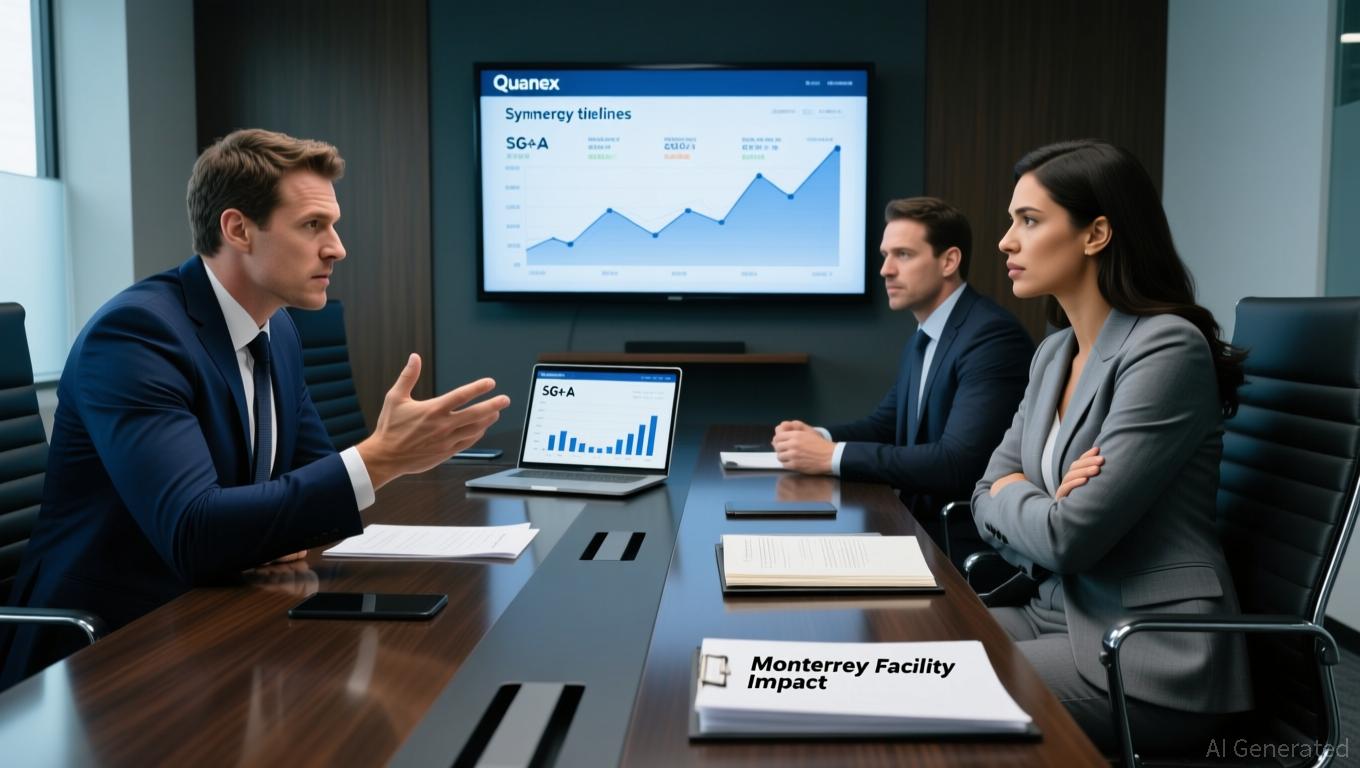
Synergy Progress and Timeline
This is a substantial contradiction concerning a major acquisition's financial realization timeline. It directly impacts earnings forecasts and investor confidence in management's ability to execute integration plans.
First, how are you approaching the synergies and how quickly you can reach the $15 million target on the path to $45 million? How are you breaking down synergies from a cost procurement footprint perspective? - Kevin Gainey (Thompson, Davis & Company)
20251212-2025 Q4: The company has already realized the full $30 million synergy target. For 2026, an additional $5–$10 million in synergies is expected... - Scott Zuehlke(CFO)
Is there a new timeline for the initial $30M in synergies? - Julio Romero (Sidoti & Company, LLC)
2025Q3: The timeline for realizing the first tranche of synergies remains early 2026... - Scott Zuehlke(CFO) & George Wilson(CEO)
Contradiction Point 2
Monterrey (Mexico) Facility Impact and Resolution
This is a substantial contradiction regarding a significant operational issue's financial impact and resolution timeline. It affects segment earnings forecasts and investor perception of operational execution and risk.
Did Scott confirm the Monterrey challenges caused an $8M EBITDA drag in Q4, implying a 16% EBITDA margin for the Hardware Solutions segment? And does the current informal outlook assume the $3M Q1 drag resolves to $0 beyond Q1? - Julio Romero (Sidoti)
20251212-2025 Q4: The Q4 negative EBITDA impact from Monterrey was $8 million, up from an estimated $5 million... A $3 million negative impact is expected in Q1 2026, after which it is expected to go to zero. - Scott Zuehlke(CFO) & George Wilson(CEO)
Tyman Mexico: Will the $5M EBITDA negative impact persist in Q4, and when is it expected to turn positive in fiscal 2026? - Steven Ramsey (Thompson Research Group, LLC)
2025Q3: A similar headwind is expected in Q4, with progress anticipated by year-end and tangible benefits expected early in fiscal 2026. - Scott Zuehlke(CFO) & George Wilson(CEO)
Contradiction Point 3
SG&A Expense Run Rate
This is a substantial contradiction involving a change in the communicated financial baseline (run rate) for a key expense line item. It directly impacts the interpretation of future profitability and financial performance consistency.
Can you confirm the SG&A expenses were $73 million and explain the expenses? Is that a sustainable run rate for the full year on a quarterly basis? - Reuben Garner (Benchmark)
20251212-2025 Q4: The $73 million SG&A run rate for Q1 is reasonable for the full year. The increase year-over-year is due to accruing bonuses at target... inflation, benefits, and merit increases. - Scott Zuehlke(CFO)
Is the $6.5 million in intangible asset amortization from Q2 a sustainable quarterly run rate for D&A guidance, and what are your expectations for full-year D&A on both a GAAP and adjusted basis? - Justin (Sidoti & Company, on for Julio Romero)
2025Q2: The second-quarter intangible amortization is a good run rate. The full-year adjusted D&A guidance, excluding intangible amortization, remains around $60 million. - Scott Zuehlke(CFO)
Contradiction Point 4
Capital Allocation Priority (Share Repurchase vs. Debt Repayment)
This is a substantial contradiction reflecting a significant shift in corporate financial strategy and capital allocation priority. It directly impacts shareholder returns and the company's leverage profile.
Were you limited by the open repurchase window timing during Q4? Have you been active in buybacks post-quarter end? - Julio Romero (Sidoti)
20251212-2025 Q4: The company prioritized debt repayment in H2 2025 to address investor concerns about leverage, despite a 'cheap' share price. - Scott Zuehlke(CFO)
How do you balance debt paydown and stock repurchases when allocating capital in FY25? - Steven Ramsey (Thompson Research Group)
2025Q1: At the company's current stock price, repurchasing shares is prioritized over debt repayment. The decision is evaluated weekly. - Scott Zuehlke(CFO)
Contradiction Point 5
Market Demand Outlook and Guidance Drivers
This is a substantial contradiction concerning the fundamental basis for the company's financial guidance. It shifts the expected driver from stable, internal factors (seasonality) to an external, uncertain demand environment, changing the risk profile for the outlook.
Does your current informal outlook assume specific market volume levels in the first half and procurement synergies realization? - Julio Romero (Sidoti)
20251212-2025 Q4: The informal outlook for 2026 assumes **revenue and volumes flattish to down, with flat to up pricing**. - Scott Zuehlke(CFO)
Does the second half improvement drive the full-year guidance? Are specific segments key to achieving the full-year target? Why is your full-year outlook more optimistic compared to window and cabinet producers? - Steven Ramsey (Thompson Research Group)
2025Q1: The forecast for improvement in H2 is based on typical, normalized seasonality for the business. There is nothing different expected this year." / "The company's initial guidance was more conservative than some others. The H2 improvement is largely driven by seasonality... - George Wilson(CEO) & Scott Zuehlke(CFO)

Discover what executives don't want to reveal in conference calls

Jan.10 2026

Jan.10 2026

Jan.09 2026

Jan.09 2026

Jan.09 2026
Daily stocks & crypto headlines, free to your inbox





Comments
No comments yet