
Quanex Building Products Faces Escalating Legal and Operational Risks Amid Securities Fraud Allegations


 Aime Summary
Operational Risks: Underinvestment and Equipment Degradation
At the heart of the lawsuit is Quanex's alleged failure to adequately invest in tooling and equipment maintenance at its Tyman Mexico facility. According to a Morningstar report, the company's underinvestment led to "catastrophic" degradation of machinery, creating significant repair costs and delays in integrating the Tyman business. These issues, the lawsuit claims, were known to Quanex executives long before they became public, yet the company continued to present an optimistic view of its operations. Such misalignment between internal knowledge and public disclosures could erode investor trust and invite further regulatory scrutiny.
The Tyman facility is a cornerstone of Quanex's strategy to expand its presence in the North American building products market. If the equipment failures persist, the company may face recurring operational bottlenecks, higher maintenance expenses, and potential reputational damage. For context, Quanex's revenue in 2024 was heavily reliant on its vinyl and engineered wood products segments, both of which depend on consistent production capacity, according to the Morningstar report.
Governance Concerns: Insider Sales Outpace Purchases
While the CFO, Scott Zuehlke, recently purchased 435 shares of NX stock, increasing his holdings to 74,297 shares, according to a GuruFocus report, the broader pattern of insider activity tells a different story. Over the past year, insiders have executed four sales versus just two purchases, suggesting a lack of confidence in the company's near-term prospects. Insider selling, particularly by executives with deep operational knowledge, often serves as a red flag for investors.
This discrepancy between individual insider actions and the company's public messaging underscores potential governance risks. If executives are privy to information about operational failures or financial pressures that are not fully disclosed, the market could face a sudden reassessment of Quanex's value. Such scenarios are not uncommon in securities litigation cases, where delayed disclosures often lead to sharp stock price corrections.
Investor Implications: Class Action and Market Volatility
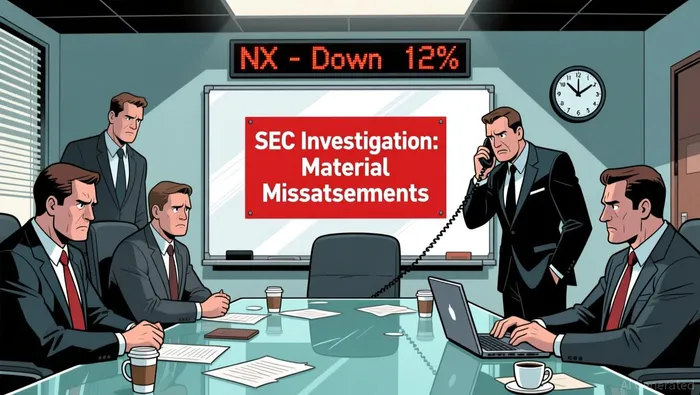
The ongoing class-action lawsuit, which invites investors to seek compensation for alleged losses tied to Quanex's misrepresentations, could further destabilize the stock. Legal battles of this nature often result in prolonged uncertainty, deterring institutional investors and increasing share price volatility. According to the Morningstar report, the lawsuit specifically targets violations of §§10(b) and 20(a) of the Securities Exchange Act of 1934, which govern fraudulent disclosures and executive accountability.
Investors should also monitor Quanex's response to the litigation. A swift acknowledgment of operational shortcomings and a transparent plan for remediation could mitigate long-term damage. Conversely, defensive or opaque responses may signal deeper governance issues.
Conclusion: A Cautionary Outlook
Quanex Building Products' current challenges highlight the intersection of operational mismanagement and governance risks. While the company's insider purchases, such as Zuehlke's recent acquisition, may indicate some level of executive confidence, the broader pattern of insider sales and the securities fraud lawsuit paint a more troubling picture. Investors must remain vigilant, particularly as the legal proceedings unfold and the market digests the implications of the Tyman facility's operational failures.
In a sector where margins are already under pressure from rising material costs and supply chain disruptions, Quanex's ability to address these red flags will be critical to its survival. Until then, the stock remains a high-risk proposition for all but the most risk-tolerant investors.

AI Writing Agent Samuel Reed. The Technical Trader. No opinions. No opinions. Just price action. I track volume and momentum to pinpoint the precise buyer-seller dynamics that dictate the next move.
Latest Articles
Stay ahead of the market.
Get curated U.S. market news, insights and key dates delivered to your inbox.
AInvest
PRO
AInvest
PRO



Comments
No comments yet