
Qtum/Tether USDt Market Overview for 2025-09-06
 Aime Summary
• QTUM/USDT broke above key resistance, closing at 2.737.
• High volume confirmed bullish momentum, with RSI near overbought.
• BollingerBINI-- Bands widened, indicating increased volatility.
• A bearish divergence in RSI appeared near 2.737, suggesting caution.
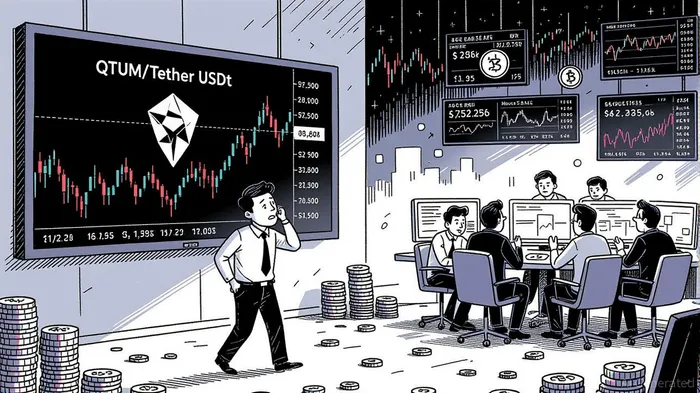
Qtum/Tether USDtUSDC-- (QTUMUSDT) opened at 2.672 on 2025-09-05 12:00 ET and closed at 2.737 by 12:00 ET on 2025-09-06, reaching a high of 2.826 and a low of 2.657. The 24-hour volume was 1,441,196.1, and the total turnover amounted to approximately $3,955,739.45 (assuming USDT as USD-equivalent).
Structure & Formations
The pair exhibited a bullish breakout pattern as it moved above the 2.71–2.72 resistance cluster, confirmed by strong volume and a 15-minute bullish engulfing pattern. A bearish doji formed near 2.737, signaling potential exhaustion. Support levels remain around 2.70 and 2.69, with a critical 2.675 level offering medium-term support if the trend stalls.
Moving Averages
On the 15-minute chart, the 20-period MA crossed above the 50-period MA around 2.68–2.70, confirming a short-term bullish trend. The 50-period MA on the daily chart is approaching 2.70, aligning with the key support zone. Price remains above both the 50 and 200 daily MAs, supporting a longer-term uptrend.
MACD & RSI
The 15-minute MACD showed a positive crossover and maintained bullish momentum through much of the session, peaking near 0.03 before a bearish signal emerged. RSI peaked at 74 in the late hours of 02:00–03:00 ET, suggesting overbought conditions. A divergence between price and RSI near 2.737 signaled caution, hinting at a potential reversal or consolidation.
Bollinger Bands
Volatility expanded significantly following the breakout above 2.71–2.72, with Bollinger Bands stretching wide. Price touched the upper band several times, particularly in the early morning hours, and closed near the upper bound. A contraction in the bands has yet to occur, indicating that the expansion phase is still active. Traders may expect price to consolidate within a tighter range soon if the bands begin to converge.
Volume & Turnover
Volume surged during the breakout phase, with the most activity concentrated between 03:00 and 04:00 ET when price moved from 2.78 to 2.80. The highest 15-minute turnover occurred at 03:15 ET with $240,166.30. Despite the recent rally, volume has not yet reached pre-breakout levels, suggesting the move may still be early in its phase. A lack of follow-through volume above 2.75 could signal a retracement.
Fibonacci Retracements
On the 15-minute chart, the recent rally from 2.657 to 2.826 created a key Fibonacci structure. Price currently sits at the 61.8% level (~2.737), which is a critical area to watch for either a continuation or a pullback. On the daily chart, the 50% retracement of the previous week's bearish move lies near 2.70, aligning with the 50-period MA as a key support level.
Backtest Hypothesis
A potential backtesting strategy could involve using the 15-minute MACD crossover in conjunction with volume confirmation. A long signal is generated when the MACD crosses above zero and volume increases by at least 20% compared to the previous period, with an exit trigger when RSI exceeds 70 or a bearish divergence appears. Based on the recent price action, this strategy would have triggered a long entry around 03:00 ET. While the initial move was strong, the bearish divergence and high RSI suggest the strategy may need a trailing stop or early exit rule to avoid false breakouts. Integrating Fibonacci levels like 61.8% could improve risk-to-reward ratios by targeting precise exit points.
Forward-Looking View and Risk Caveat
The immediate outlook is cautiously bullish, but with overbought conditions and bearish divergence in RSI, a pullback or consolidation into the 2.70–2.71 zone is likely in the next 24 hours. Traders should monitor volume for confirmation or divergence as key signals. The breakdown of the 2.70 support level could invalidate the recent uptrend.

Decoding market patterns and unlocking profitable trading strategies in the crypto space
Latest Articles
Stay ahead of the market.
Get curated U.S. market news, insights and key dates delivered to your inbox.






Comments
No comments yet