
The QQQ Double Top Warning: A Cautionary Tale for Growth Investors
 Aime Summary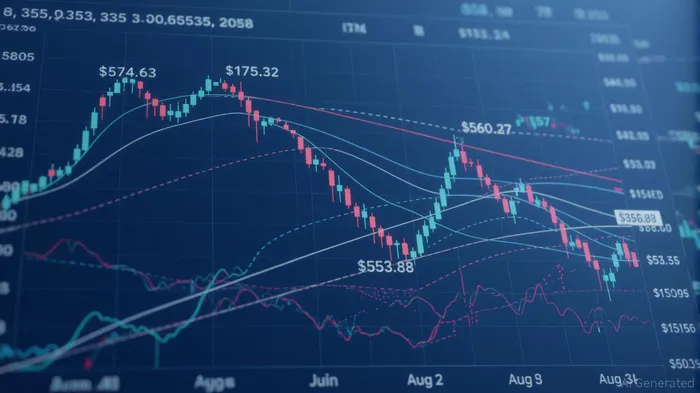
The Invesco QQQ Trust (QQQ), a benchmark for growth investors chasing the NASDAQ-100's tech-heavy exposure, has long been a magnet for euphoric sentiment. Yet, as the ETF's price action in late 2025 suggests, the line between optimism and complacency is perilously thin. A potential double top pattern, coupled with behavioral biases amplifying market noise, signals a high-risk phase for investors.
The Technical Case for Caution
QQQ's recent price trajectory has drawn attention to a classic bearish reversal pattern: the double top. The ETF reached a high of $574.63 on July 31, 2025, followed by a pullback to $560.27, and then a retest of the prior high with a close at $567.10 on August 7. While the second peak fell short of the first, the formation of a descending channel—bounded by resistance at $564–$567 and support at $553–$554—adds credibility to the pattern. A breakdown below the neckline at $553.88 would validate the double top, projecting a target of $533.87 (the 0.236 Fibonacci retracement level).
Volume analysis further underscores the pattern's validity. The first peak on July 31 saw 64.6 million shares traded, while the second peak on August 6 recorded 29.3 million shares—a decline in volume that often signals weakening bullish conviction. Meanwhile, the 100-day average true range (ATR) of 8.54 (or 1.51% of price) highlights QQQ's volatility, amplifying the risk of a sharp correction.
Behavioral Biases and the Illusion of Control
Technical indicators alone cannot explain QQQ's current dynamics. Behavioral finance offers critical insights. The ETF's 31.00% annualized return over 12 months and its 17.50% gain in three months have fostered a sense of invincibility among investors. This euphoria is compounded by confirmation bias, where traders selectively interpret data (e.g., a bullish RSI surge to 67.9) while ignoring conflicting signals (e.g., a bearish MACD crossover).
Moreover, the herd mentality is in play. QQQ's $358.14 billion in assets under management (AUM) means even minor price swings attract massive inflows or outflows. When the ETF's price nears psychological levels like $550 or $570, retail and institutional investors often act in unison, exacerbating volatility. This collective behavior can distort technical patterns, making reversals both more likely and more abrupt.
The High-Risk Phase: What Investors Should Fear
The convergence of technical and behavioral factors creates a volatile cocktail. QQQ's 76.9 RSI reading—a clear overbought condition—is often dismissed by bullish investors as a “buy-the-dip” opportunity. Yet, the ADX's decline from 24.89 to 8.48 over 50 days suggests weakening directional momentum, hinting at a potential trend reversal.
A breakdown below $553.88 would not only confirm the double top but also trigger a cascade of stop-loss orders and algorithmic selling. Historical volatility of 29.60% implies that a 10% correction is within the realm of possibility, erasing months of gains in weeks.
Strategic Recommendations for Growth Investors
- Hedge Exposure with Options: Investors holding QQQ can use put options or inverse ETFs to protect against a breakdown. A put with a strike price at $550 would cap downside risk while allowing participation in a potential rebound.
- Monitor Key Levels: Closely watch the $553.88 neckline and the 0.236 Fibonacci level at $533.87. A sustained close below $553.88 would justify reducing long positions.
- Rebalance Portfolios: Given QQQ's concentration in tech, diversify into sectors like utilities or consumer staples to mitigate sector-specific risks.
- Embrace Contrarian Discipline: Avoid chasing momentum. Instead, consider entering long positions only after a confirmed rebound from the $533.87 level, ensuring technical validation.
Conclusion
The QQQ double top warning is not merely a technical exercise—it's a reminder of the fragile psychology driving markets. While the ETF's growth trajectory remains intact, the interplay of overbought conditions, behavioral biases, and structural volatility demands caution. For growth investors, the key is to balance conviction with prudence, using technical tools to navigate the storm rather than ignore it. In the words of Warren Buffett, “Be fearful when others are greedy.” QQQ's current price action offers a compelling case to heed that wisdom.

Delivering real-time insights and analysis on emerging financial trends and market movements.
Latest Articles
Stay ahead of the market.
Get curated U.S. market news, insights and key dates delivered to your inbox.




Comments
No comments yet