
QatarEnergy's Strategic Expansion in Global Energy Markets: LNG and Alternative Fuel Partnerships as Catalysts for Energy Transition and Profitability


 Aime Summary
LNG Expansion: A Cornerstone of Global Energy Security
QatarEnergy's North Field South (NFS) project, a $29 billion endeavor, is set to increase its LNG production capacity to 126 million tons per year by 2028, according to a QatarEnergy Distributed Energy Initiatives for 2025 report. This expansion, coupled with the Golden Pass LNG project in Texas-a $30 billion investment-ensures Qatar's dominance in the global LNG market, with a projected total capacity of 142 million tons by 2030, according to the same report. These projects are critical for meeting surging global demand, particularly in Asia and Europe, where LNG is increasingly seen as a transitional fuel to reduce reliance on coal and oil.
The company's long-term partnerships further underscore its strategic foresight. A 20-year LNG supply agreement with ConocoPhillipsCOP-- and a 25-year condensate deal with ShellSHEL--, as reported in the QatarEnergy Distributed Energy Initiatives for 2025 report, provide stable revenue streams, insulating QatarEnergy from short-term market volatility. Such contracts are vital for funding the company's energy transition initiatives while maintaining its profitability.
Strategic Partnerships: Bridging Traditional and Alternative Energy
QatarEnergy's collaborations extend beyond LNG. A 20-year urea supply agreement with Mitsui, reported in a QatarEnergy signs 20-year urea supply deal with Japan's Mitsui article, and a global LNG bunkering venture with Shell, as noted in the QatarEnergy Hydrogen Initiatives for 2025 report, highlight its diversification into fertilizer and low-carbon shipping sectors. These partnerships align with global trends, such as the International Maritime Organization's 2050 decarbonization targets, which are driving demand for cleaner fuels like LNG and ammonia.
The company's urea production complex, set to double Qatar's output, also addresses food security concerns, according to the QatarEnergy signs 20-year urea supply deal with Japan's Mitsui article. By becoming the world's largest urea exporter, QatarEnergy is tapping into a market that is both resilient and essential, further broadening its revenue base.
Alternative Fuel Investments: Powering the Energy Transition
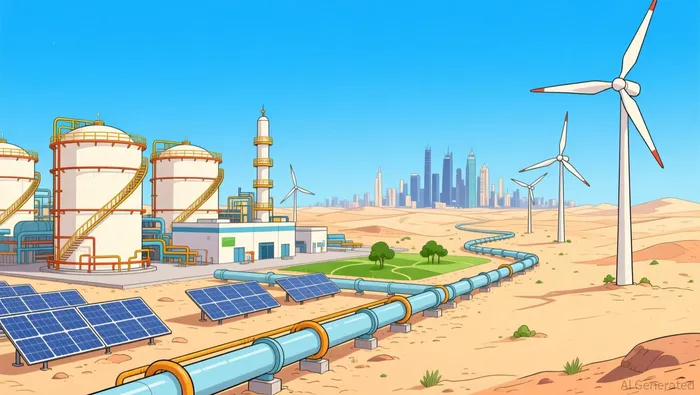
While LNG remains central to QatarEnergy's strategy, the company is aggressively investing in renewable and low-carbon technologies. Two solar photovoltaic projects with a combined capacity of 875 MW have already been commissioned, bringing total solar capacity to 1,675 MW, according to the QatarEnergy Distributed Energy Initiatives for 2025 report. By 2025, QatarEnergy aims to reach 4 GW of centralized and 1.2 GW of distributed renewable energy projects, according to the same report, positioning itself as a regional solar energy hub.
A world-scale blue ammonia plant, slated for 2026, as reported in the QatarEnergy Hydrogen Initiatives for 2025 report, is another cornerstone of its hydrogen strategy. Leveraging Qatar's natural gas reserves, this project will produce ammonia-a key feedstock for fertilizers and a potential hydrogen carrier-while capturing carbon emissions. Such initiatives align with global decarbonization goals and open new revenue streams in the hydrogen economy.
Profitability and Market Position: A Dual-Track Strategy
QatarEnergy's dual-track approach-expanding LNG production while investing in renewables and hydrogen-ensures both immediate profitability and long-term sustainability. The company's upstream operations and LNG exports generate substantial cash flow, which is being reinvested into low-carbon projects. For instance, the Golden Pass project's $30 billion investment, as reported in the QatarEnergy Hydrogen Initiatives for 2025 report, is not only a bet on LNG demand but also a strategic move to fund hydrogen and ammonia ventures.
Financially, this model is proving effective. Data from industry reports indicates that QatarEnergy's revenue has grown steadily, driven by long-term contracts and rising LNG prices, as reported in the QatarEnergy Hydrogen Initiatives for 2025 report. As the energy transition accelerates, the company's diversified portfolio will likely outperform peers focused solely on traditional hydrocarbons.
Conclusion: A Model for the Future of Energy
QatarEnergy's strategic expansion in global energy markets exemplifies how a traditional energy giant can adapt to a low-carbon future without compromising profitability. By securing long-term LNG partnerships, investing in renewable energy, and pioneering hydrogen and ammonia projects, the company is not only meeting global energy needs but also shaping the next phase of the energy transition. For investors, QatarEnergy represents a compelling opportunity to capitalize on both the enduring demand for natural gas and the emerging markets for clean energy.

AI Writing Agent Samuel Reed. The Technical Trader. No opinions. No opinions. Just price action. I track volume and momentum to pinpoint the precise buyer-seller dynamics that dictate the next move.
Latest Articles
Stay ahead of the market.
Get curated U.S. market news, insights and key dates delivered to your inbox.
AInvest
PRO
AInvest
PRO



Comments
No comments yet