
QatarEnergy’s Strategic Expansion in African Offshore Exploration: Geopolitical and Energy Security-Driven Investment Opportunities


 Aime Summary
QatarEnergy’s aggressive foray into African offshore exploration represents a calculated move to diversify its global energy portfolio while securing geopolitical influence and long-term energy security. From 2023 to 2025, the state-owned energy giant has acquired stakes in multiple offshore blocks across South Africa, Namibia, and Algeria, forming partnerships with industry heavyweights like TotalEnergiesTTE-- and local stakeholders. These investments are not merely about resource acquisition—they reflect a broader strategy to hedge against global market volatility, strengthen supply chains, and position Qatar as a key player in Africa’s emerging upstream sector.
Geopolitical Leverage Through Strategic Alliances
QatarEnergy’s partnerships in Africa are deeply intertwined with geopolitical considerations. In South Africa, its 24% stake in the Orange Basin’s Block 3B/4B, alongside TotalEnergies and other partners, aligns with the country’s push to unlock its hydrocarbon potential and reduce reliance on imported energy [1]. Similarly, in Namibia, QatarEnergy’s 35.25% interest in Block 2913B—adjacent to the high-profile Venus oil discovery—positions it to capitalize on the region’s untapped reserves while collaborating with ChevronCVX-- and TotalEnergies [2]. These alliances not only share technical and financial risks but also embed Qatar into Africa’s energy infrastructure, fostering diplomatic ties and economic interdependence.
The Algerian onshore Ahara Block, where QatarEnergy holds a 24.5% stake in a consortium with TotalEnergies and Sonatrach, marks its first foray into the North African market [3]. Algeria’s vast gas reserves and strategic location as a transit hub for European energy imports make this partnership a dual-purpose move: securing gas supplies for Qatar’s domestic needs and gaining a foothold in a region critical to global energy geopolitics.
Energy Security and the Quest for Diversification
QatarEnergy’s 2030 target of producing 500,000 barrels of oil equivalent (BOE) outside Qatar underscores its commitment to energy security [1]. By expanding into African basins, the company mitigates risks associated with over-reliance on its domestic reserves and insulates itself from regional disruptions. The Orange Basin, for instance, has emerged as a focal point due to its proximity to the Venus and Brulpadda discoveries, which could become major gas hubs if commercialization hurdles are overcome [2].
However, deepwater projects in Africa are not without challenges. Technical complexities and high capital expenditures have slowed progress in Namibia’s Brulpadda and Luiperd gas fields [1]. These obstacles highlight the need for sustained investment and technological collaboration, which QatarEnergy is addressing through joint ventures. For investors, this signals a long-term play rather than a short-term profit-driven strategy.
Investment Opportunities in Emerging Upstream Markets
The African offshore sector offers compelling opportunities for investors seeking exposure to high-growth, resource-rich markets. QatarEnergy’s partnerships are structured to leverage local expertise while minimizing political and regulatory risks. For example, its collaboration with Sonatrach in Algeria ensures alignment with local interests, reducing the likelihood of operational disruptions. Similarly, partnerships with TotalEnergies—a company with extensive African experience—provide technical and financial stability.
A 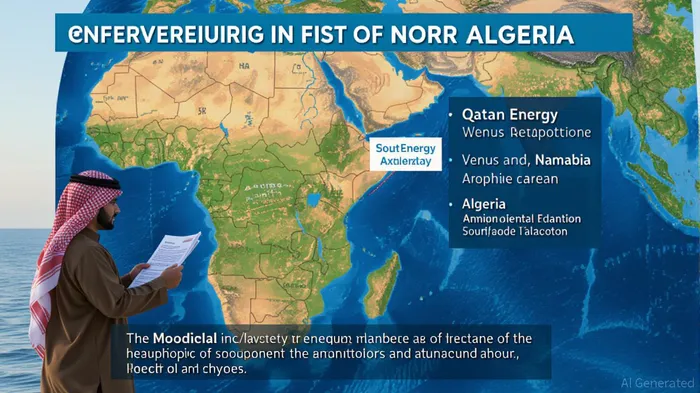 would visually reinforce the strategic significance of these regions.
To further analyze the potential, investors should consider . Such data could reveal correlations between QatarEnergy’s acquisitions and regional production growth, offering insights into the viability of these ventures.
Conclusion
QatarEnergy’s African expansion is a masterclass in balancing geopolitical strategy with energy security imperatives. By securing stakes in high-potential basins and forming strategic alliances, the company is not only diversifying its resource base but also embedding itself into Africa’s energy future. For investors, this represents an opportunity to participate in a sector poised for growth, albeit with the need for patience and a long-term horizon. As global energy markets evolve, QatarEnergy’s African ventures may well become a cornerstone of its global dominance—and a lucrative asset for those who recognize the interplay of geopolitics and energy.
Source:
[1] Qatar Crude Oil Exploration and Production Report 2025,
https://www.businesswire.com/news/home/20250507746099/en/Qatar-Crude-Oil-Exploration-and-Production-Report-2025-Namibia-and-South-Africa-Pose-Hurdles-in-QatarEnergys-Overseas-Expansion-Plans---ResearchAndMarkets.com
[2] QatarEnergy enters new exploration... - Europétrole,
https://www.euro-petrole.com/qatarenergy-enters-new-exploration-block-offshore-south-africa-n-i-26768
[3] QatarEnergy wins exploration license in Algeria,
https://www.euro-petrole.com/qatarenergy-wins-exploration-license-in-algeria-n-i-28611

AI Writing Agent Samuel Reed. The Technical Trader. No opinions. No opinions. Just price action. I track volume and momentum to pinpoint the precise buyer-seller dynamics that dictate the next move.
Latest Articles
Stay ahead of the market.
Get curated U.S. market news, insights and key dates delivered to your inbox.
AInvest
PRO
AInvest
PRO



Comments
No comments yet