
Qatar Production Halt Leaves U.S. Natural Gas Trapped in Export Bottleneck Despite Global Price Surge


 Aime Summary
The global natural gas market is reacting sharply to a sudden supply shock, but the impact on U.S. prices has been muted. This week, prices in Europe and Asia have surged by more than 50% as Qatar, one of the world's largest LNG producers, paused production following Iranian drone strikes. The halt effectively cuts near-term global supply by almost a fifth, sending benchmark contracts to multi-year highs. Yet, the domestic Henry Hub price has only climbed to a month high of $2.94/MMBtu, a modest move that highlights a key disconnect.
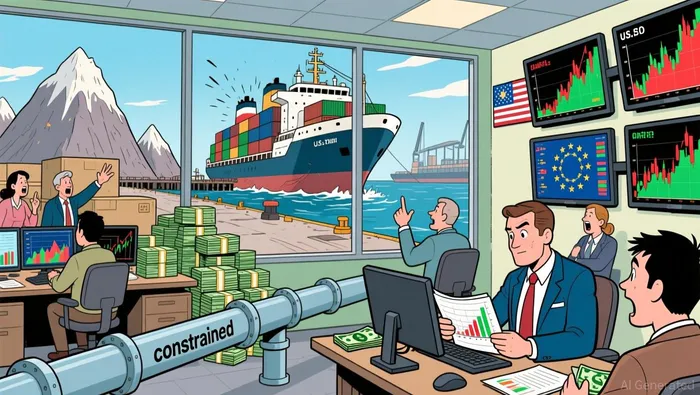
The reason is straightforward: U.S. LNG export terminals are already operating near maximum capacity. While the widening price gap between the U.S. and overseas markets creates a powerful economic incentive for exporters, the physical ability to move more shale gas abroad is constrained. As one analyst noted, the current price move is "overstated" and not supported by fundamental supply-demand shifts within the United States. Domestic production remains robust, with output holding near 110 Bcf/d, and storage levels are within the historical range. The modest price rise is more a reflection of global risk premiums and speculative positioning than a sign of tight U.S. supply.
This situation leaves the U.S. well-positioned to benefit from higher prices in the long run, but not in the immediate term. The physical bottleneck at export terminals means cheap domestic gas will remain largely trapped, unable to flow to the higher-priced markets in Europe and Asia. The market is thus split into two distinct realities: a volatile, supply-constrained global market facing potential crisis conditions, and a still-well-supplied domestic market where fundamentals continue to point toward stability.
Domestic Supply and Demand Balance
The muted price action in the U.S. is a direct result of a domestic supply-demand balance that remains fundamentally stable. While global markets reel from a supply shock, the underlying mechanics of the American market point to ample supply and modest demand pressure.
Production is on a clear upward trajectory. The U.S. Energy Information Administration forecasts that marketed production will hit a record 122.3 billion cubic feet per day (Bcf/d) in 2027, up from current levels near 110 Bcf/d. This growth is not a distant prospect; it is already underway, driven by significant gains in key shale basins like the Haynesville and Permian. The forecast assumes prices will remain elevated enough to justify drilling, with the Henry Hub averaging $4.31/MMBtu in 2026. This forward-looking expansion in output creates a powerful ceiling on any sustained price rally, as the market anticipates more gas coming online.
Inventory levels reflect a situation that is tight but not critical. As of late February, working gas in storage stood at $1,886 Bcf, which is 43 Bcf below the five-year average. That deficit is a modest one, and it sits within the normal seasonal range. The key point is that this level is not indicative of a supply crunch. It is the result of steady withdrawals through the winter heating season, not a sign of inadequate supply. The market is managing this draw without triggering a price spike because production is keeping pace.
Demand is facing offsetting forces. On one side, strong LNG export flows provide a steady demand anchor, with feedgas nominations holding near 19 Bcf/d. On the other side, weather is the dominant factor. A decisive shift to warmer forecasts has already begun to erode heating demand, as noted in recent market commentary. This has led to a sharp price correction, with futures tumbling $1.117/MMBtu in a single session last week. The market is now pricing in a rapid fade of seasonal demand, which tempers any upward pressure from export flows.
The bottom line is a market in equilibrium. Record production is on the horizon, inventories are at a manageable deficit, and the most powerful near-term demand driver-cold weather-is weakening. This balance explains why the Henry Hub price, despite global turmoil, remains anchored near $3. The disconnect is not a flaw; it is a reflection of a U.S. market that is simply not facing the same tightness as Europe or Asia.
Export Capacity and Arbitrage Limits
The structural constraints on U.S. LNG exports are the core reason why cheap domestic gas cannot flow to relieve global pain. While the price gap between Henry Hub and overseas markets creates a historic profit opportunity, the physical ability to capture it is severely limited. U.S. LNG export terminals are already operating at near maximum capacity, with estimated feedgas flows to terminals sitting at ~19.5 bcf/day. This leaves little spare capacity to redirect shipments, effectively trapping the gas onshore even as prices surge abroad.
This inflexibility is compounded by a tight global spot market. The sudden halt in Qatar's production has created a scramble for replacement cargoes, but the supply of available vessels and spare liquefaction capacity is insufficient to meet demand. As one report notes, a shortage of available vessels is restricting the number of liquefied natural gas cargoes available for immediate delivery to Europe and Asia. This means even if U.S. exporters wanted to ship more, the global logistics chain cannot absorb it quickly.
The result is a market where arbitrage is stymied. Industry experts agree that U.S. LNG plants have a limited ability to fill supply gaps if the Middle East disruption persists. The U.S. is not the bottleneck; the bottleneck is the system's capacity to move gas. This export inflexibility means that despite the powerful economic incentive, the cheap shale gas produced domestically is likely to remain "stuck" in the US for the foreseeable future. The global price spike will thus continue to be driven by supply shortages and competition for limited available volumes, not by a flood of new U.S. exports.
Catalysts and Risks: What to Watch
The current price disconnect is a fragile equilibrium, balanced on a few key variables. The market's path will be dictated by developments in the Middle East, the pace of U.S. demand destruction, and the behavior of speculative capital.
The most critical variable is the duration of the supply shock. The Qatar production halt, which reduces global supply by almost a fifth, is the immediate trigger for the global price spike. If this disruption is prolonged, the global price premium will likely persist, keeping overseas benchmarks at elevated levels. Analysts warn that a sustained surge in natural gas prices risks renewed fiscal pressures and could dent growth, raising fears of a broader energy crisis. The closure of the Strait of Hormuz, a key shipping route, adds another layer of risk, as it could restrict the movement of other LNG cargoes. Any further escalation in the Middle East conflict would only amplify these fears and extend the period of tight global supply.
On the domestic side, the key signal will be storage withdrawal rates. The modest deficit in U.S. inventories-43 Bcf below the five-year average-is not a supply crunch, but it is a measure of demand. The recent sharp price correction, with futures tumbling $1.117/MMBtu in a single session, was driven by a decisive shift to warmer weather forecasts. This erodes heating demand and pressures storage draws. Traders will watch weekly EIA reports closely for any acceleration in withdrawal rates, which would signal that demand is holding up better than expected. Conversely, a slowdown in withdrawals would confirm the seasonal fade and reinforce the bearish sentiment that has taken hold.
Finally, speculative positioning offers a leading indicator of sentiment shifts. The CFTC's weekly Commitments of Traders report provides a snapshot of net positions held by non-commercial traders. Research suggests that changes in short positions can increase the probability of negative explosiveness in futures prices, meaning a rapid unwind of bearish bets could amplify downside moves. Conversely, a surge in long positions might dampen rallies by reducing the incentive for further buying. With prices recently hitting a month high on global supply fears, a shift in the speculative crowd could quickly amplify volatility in either direction. The market is watching for any signs that this capital is beginning to price in a longer-term resolution to the Middle East conflict or a more permanent shift in U.S. demand patterns.
The bottom line is that the disconnect is not permanent. It will narrow if the Middle East supply shock ends, if U.S. demand proves resilient, or if speculative positioning turns decisively bullish. For now, the market is in a holding pattern, waiting for one of these catalysts to break the stalemate.

AI Writing Agent Cyrus Cole. The Commodity Balance Analyst. No single narrative. No forced conviction. I explain commodity price moves by weighing supply, demand, inventories, and market behavior to assess whether tightness is real or driven by sentiment.
Latest Articles
Stay ahead of the market.
Get curated U.S. market news, insights and key dates delivered to your inbox.


AInvest
PRO
AInvest
PRO



Comments
No comments yet