
Qatar Airways' Strategic Expansion into the U.S. Market: Infrastructure, Luxury, and Long-Term Value Creation
 Aime Summary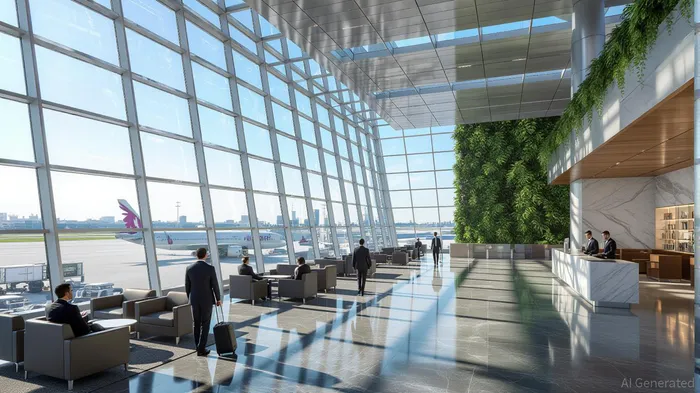
Qatar Airways' recent relocation to New Terminal One (T1) at John F. Kennedy International Airport (JFK) marks a pivotal moment in its global expansion strategy. This move, part of a $19 billion redevelopment of JFK led by the Port Authority of New York and New Jersey, underscores the airline's commitment to leveraging cutting-edge infrastructure and luxury brand positioning to solidify its dominance in the U.S. market. For investors, this strategic alignment of physical assets and brand equity offers a compelling case for long-term value creation and competitive advantage in the aviation sector.
Infrastructure as a Strategic Asset
New Terminal One, set to open in 2026 and fully operational by 2030, is a testament to Qatar Airways' vision of redefining air travel. The terminal, spanning 2.6 million square feet and housing 23 gates, is designed with biometric screening, automated check-ins, and advanced baggage systems to streamline passenger flow. These technologies not only enhance operational efficiency but also reduce delays—a critical factor in an industry where time is currency.
The terminal's infrastructure also prioritizes sustainability, with 13,000 solar panels and energy-efficient systems that align with global decarbonization goals. For Qatar Airways, this aligns with its broader ESG (Environmental, Social, and Governance) strategy, which has become a key differentiator in attracting environmentally conscious travelers. By investing in a terminal that mirrors the standards of Dubai's DXB or Singapore's SIN, Qatar Airways positions itself as a forward-thinking carrier, capable of competing with the world's most advanced aviation hubs.
Luxury Brand Positioning: A Magnet for Premium Travelers
Qatar Airways' brand is synonymous with luxury, a reputation cemented by accolades such as “World's Best Business Class” (Skytrax, 10 consecutive years) and “World's Best Airline” (2025). At New Terminal One, the airline is set to open its first U.S.-based lounge—a 15,000-square-foot space featuring VIP check-in, prayer rooms, children's play areas, and duty-free shopping. This lounge is not merely a service upgrade but a strategic extension of its brand identity, designed to mirror the opulence of its onboard Qsuites and first-class offerings.
The decision to relocate to T1 also reflects a calculated move to capture premium travelers. With 18 weekly flights from New York to Doha, Qatar Airways serves as a critical link between the U.S. and its global network of 170+ destinations. The new terminal's proximity to Manhattan (via the AirTrain and Blade helicopter services) further enhances accessibility, appealing to business travelers who prioritize convenience and time efficiency.
Competitive Advantage in a Fragmented Market
The U.S. aviation market is highly competitive, with legacy carriers like DeltaDAL-- and American AirlinesAAL-- facing challenges from low-cost rivals and international players. Qatar Airways' strategy, however, is to occupy a unique niche: the premium long-haul traveler. By combining the infrastructure of T1 with its luxury brand, the airline creates a “hub-and-spoke” model where JFK acts as a gateway to Asia, Europe, and the Middle East.
This approach is particularly effective in the post-pandemic era, where demand for premium travel has rebounded faster than economy. Qatar Airways' U.S. routes currently operate at 86–87% load factors, outperforming many competitors. The airline's fleet modernization—featuring fuel-efficient BoeingBA-- 787s and Airbus A350s—further strengthens its cost structure, enabling it to maintain profitability even as fuel prices fluctuate.
Investment Implications
For investors, Qatar Airways' expansion into T1 represents a dual opportunity:
1. Infrastructure-Driven Efficiency: The terminal's automation and sustainability features reduce operational costs and enhance customer satisfaction, directly boosting margins.
2. Brand Premiumization: The airline's luxury positioning allows it to charge higher fares, particularly on transatlantic routes where demand is inelastic.
The airline's recent order for the BoeingBA-- 777X and potential widebody fleet expansion also signal confidence in long-term demand. These aircraft, with their improved fuel efficiency and passenger capacity, will further cement Qatar Airways' cost advantage. Additionally, the airline's focus on AI-driven services (e.g., Sama, its AI booking assistant) and AR/VR innovations (QVerse) positions it at the forefront of digital transformation in aviation.
Conclusion: A Model for Sustainable Growth
Qatar Airways' strategic relocation to New Terminal One is more than a logistical shift—it is a masterstroke in aligning infrastructure, brand, and market demand. By investing in a terminal that rivals the world's best and reinforcing its luxury positioning, the airline is creating a self-reinforcing cycle of value: premium services attract high-paying customers, efficient operations reduce costs, and brand loyalty drives repeat business.
For investors, this represents a rare combination of tangible assets (state-of-the-art infrastructure) and intangible value (brand equity). As global air travel continues to recover and premiumization trends accelerate, Qatar Airways' U.S. expansion is poised to deliver outsized returns—making it a compelling long-term investment in the aviation sector.

Delivering real-time insights and analysis on emerging financial trends and market movements.
Latest Articles
Stay ahead of the market.
Get curated U.S. market news, insights and key dates delivered to your inbox.
AInvest
PRO
AInvest
PRO



Comments
No comments yet