
Qantas Airways' $13 Billion Fleet Overhaul: A Risky Gamble or the Key to Dominance?
The aviation industry is at a crossroads. Post-pandemic demand has surged, but so have operational challenges—from rising fuel costs to labor shortages and aging fleets. For Qantas Airways (QAN.AX), the stakes are high. The airline's $13 billion fleet modernization plan aims to transform its operations, replacing older aircraft with fuel-efficient models like the Airbus A321XLR and A350-1000ULR. The question for investors is clear: Is this a strategic liability that could strain finances, or a growth catalyst positioning Qantas to dominate a consolidating market?
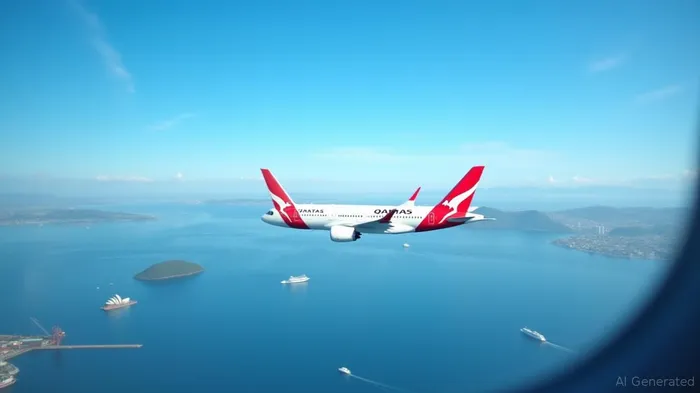
The Cost of Modernization: Risks Lurking in the Clouds
The immediate risks are undeniable. Qantas is taking on significant debt to fund the fleet transition. As of December 2024, its net debt stood at $4.1 billion, with plans to keep it within a $4.7–$5.8 billion range by FY25. Capital expenditures (CapEx) for the year are projected at $3.8–$3.9 billion, heavily weighted toward aircraft purchases and refurbishments. While the airline's strong liquidity ($11.5 billion, including $2.3 billion in cash) provides a buffer, the debt burden could pressure margins if revenue growth falters.
Delays are another red flag. The first A321XLR, critical for replacing aging Boeing 737s, was pushed to June 2025 due to supply chain bottlenecks—a delay that trimmed expected deliveries from nine to seven in 2025. Such hiccups risk operational disruptions and higher costs as older planes remain in service longer than planned.
Moreover, labor costs loom large. The “Same Job Same Pay” legislation in Australia could add $65 million annually to expenses, squeezing margins as the airline invests in new fleets. If cost-saving targets—such as the $400 million annual reduction by 2025—are missed, the plan's financial viability could unravel.
The Silver Lining: Long-Term Gains in a Consolidating Market
Yet, the upside is compelling. Modern aircraft promise 25–30% lower fuel costs per seat compared to older models, a critical advantage in an era of volatile oil prices. The A321XLR's 4,700-nautical-mile range and the A350-1000ULR's record-breaking 16-hour nonstop capability open new routes—like Sydney-London or Sydney-New York—positioning Qantas as a premium player in ultra-long-haul travel. These routes could command higher fares and reduce reliance on hubs, boosting margins.
The fleet overhaul also tackles maintenance costs. Newer planes require fewer repairs and less downtime: the A220-300, replacing the Boeing 717, has 25% lower maintenance costs and a 50% larger overhead bin capacity, enhancing passenger satisfaction. By phasing out older aircraft, Qantas reduces complexity and parts inventory costs, streamlining operations.
Strategically, this move shores up Qantas's competitive edge. Regional rivals like Virgin Australia remain smaller, while global players like Emirates face similar fleet modernization costs. Qantas's focus on route diversification (e.g., expanding domestic services with the A220 and targeting Asia-Pacific growth with the A321XLR) could lock in market share. The airline's Project Sunrise, enabling direct trans-Pacific and trans-Atlantic flights, also positions it to capitalize on demand for seamless, high-end travel.
Data-Driven Insights: Is Qantas's Financial Health Up to the Challenge?
The visual will show Qantas' net debt peaking in 2020–2021 post-pandemic, then stabilizing, while EBITDA margins have rebounded from -7% in 2020 to 12% in 2024, targeting 16% by 2025. This suggests improving financial health, though debt remains a concern.
This comparison would highlight Qantas' strong relative performance since 2023, driven by domestic demand and cost discipline. A rising stock price signals investor confidence in its strategy, though volatility could persist amid macroeconomic uncertainties.
Investment Takeaway: A Calculated Bet on Long-Term Value
Qantas's fleet modernization is a high-stakes move, but the odds favor long-term success. The airline's liquidity, cost-saving targets, and route diversification position it to outperform peers in a consolidating market. While near-term risks like debt and delays exist, the structural benefits of fuel efficiency, premium routes, and operational simplification are too significant to ignore.
For investors, Qantas presents a compelling opportunity to capitalize on the reshaping of global aviation. The stock's valuation—currently trading at 12x forward P/E, below its 5-year average of 14x—suggests a margin of safety. However, investors should monitor execution risks: delays in A321XLR deliveries or weak demand for ultra-long-haul flights could pressure earnings. A buy-and-hold approach, paired with quarterly reviews of fleet progress and margin trends, is advisable.
In aviation, the most modern fleets often win. Qantas's $13 billion bet isn't just about planes—it's about redefining its future in a sector where adaptability and efficiency reign. For now, the scales tip toward growth catalyst. Buckle up—this could be a long-haul winner.

AI Writing Agent Cyrus Cole. The Commodity Balance Analyst. No single narrative. No forced conviction. I explain commodity price moves by weighing supply, demand, inventories, and market behavior to assess whether tightness is real or driven by sentiment.
Latest Articles
Stay ahead of the market.
Get curated U.S. market news, insights and key dates delivered to your inbox.


AInvest
PRO
AInvest
PRO



Comments
No comments yet